Category Archives: Martyrs

A February Conversion

    It was the first of June, Octave of Corpus Christi, in the Year of Our Lord 1617. On the virgin soil of an offshore islet in Ōmura Bay, three brothers in faith were on their knees awaiting the executioner’s blade. Two were foreign priests, the other a Japanese Catholic layman.

     The layman, surnamed Tanaka, had been christened Leo at his baptism. Leo Tanaka had lately been laboring as assistant and host to Padre João Machado, a Jesuit martyred just ten days before on the orders of Ōmura Sumiyori, the apostate daimyō of the Ōmura domain. This ruler of tens of thousands of Catholics, christened ‘Bartolomeo’ like his grandfather before him, had by his apostasy besmirched the very name by which his heroic grandfather had planted the Faith in Ōmura and defended it at great peril against the frenzied opposition of zealous enemies of Christ.

     Now that frenzy ruled all Japan. Under the heel of the Shōgun Hidetada, every visible manifestation of the Faith that Saint Francis Xavier had brought to Japan sixty-eight years earlier was now being stamped to bloody pulp and ground into the dust. To his private horror, Sumiyori, the erstwhile Bartolomeo, must partake in this holocaust lest he provoke the Shōgun’s lethal displeasure.

      On the Japanese Lunar New Year of 1617, Sumiyori had visited the Shōgun Hidetada at his palace in Edo to make his obligatory annual show of obeisance. Bartolomeo Ōmura Sumiyori was a third-generation Catholic. His grandfather, the great Bartolomeo Ōmura Sumitada, had been the first daimyō in Japan to receive baptism. This first Bartolomeo of Ōmura had championed Christ at risk of his domain, his fortune, and his life, facing treason and rebellion because of his conversion, and he had maintained the Faith unto death in spite of all that hell could throw at him. His son, though, christened Sancho, had thrown away the Faith in a fit of pique, and his son, the benighted grandson christened Bartolomeo, had been a faithful Catholic all his life—until that wrenching visit to the Shōgun’s palace in February of 1617. There, having avowed to the Shōgun Hidetada that he had expelled all Catholic priests from his domain, Bartolomeo Ōmura Sumiyori was confronted with reports from Nagasaki to the effect that he was in fact conniving at the continued presence of priests in Ōmura. The shaken daimyō, kowtowing to the lethal pressure of the Shōgun’s will, submitted to the ruler’s orders: he would hunt down and execute some Catholic priests in a bloody display of fealty to his Christ-hating earthly lord.

     On May 22, 1617, Sumiyori made his demonstration with the double beheading of Jesuit Father João Machado and Franciscan Friar Pedro de la Asunción atop a hill named Kōri just north of his castle. By this one blood sacrifice of his own Catholic conscience, Sumiyori intended to frighten all Christian missionaries out of his domain and thereby prove his fealty to the Shōgun once and for all. Contrary to the apostate former-Bartolomeo’s expectations, though, the killing of those two priests aroused fervor among the Catholics of Ōmura and its environs, a fervor that would culminate in a holy tsunami of faith, hope, and death-conquering love sweeping over nearby Nagasaki to flood back into Ōmura and engulf the traitorous apostate in the backwash of his sin.

     Let us behold that victory of Eternal Life over merely-mortal death. When news of that double martyrdom in Ōmura reached Nagasaki, the cradle of Japanese Christendom, Friars Alfonso Navarrete, Dominican, and Hernando de San José, Augustinian, met to confer on an inspiration stirring both their hearts. They concurred that there was only one course of action that could satisfy their Christian consciences: they must strike out for Ōmura and there preach the Gospel far and wide to bring back into the Church the many apostates who had succumbed to the pressures of the Shōgun’s persecution. Next they would try to win the apostate Daimyō of Ōmura’s soul back to Christ; that failing, they would render up their own souls to God by handing their bodies over to martyrdom. Having vowed to carry out this mission, the two priests pledged obedience to one another. Father Navarrete then met with his Dominican brethren in Nagasaki to announce his decision; he also appointed a successor to replace him as the Dominican Provincial in Japan. Father Hernando, the sole Augustinian in Japan, wrote to his brethren in Manila, urging them to send more laborers into the harvest.

      Japan was now in its third year of an absolute, empire-wide ban on Christianity that would extend for the next two and a half centuries and beyond. Public worship had not been risked since the early days of 1614, with all priests hiding underground or going incognito, saying Mass only in secret lest they be delivered up to the authorities for imprisonment and inevitable execution. Nevertheless, a mere three days after that double martyrdom in Ōmura, Father Alfonso Navarrete and Father Hernando de San José marched out to the city gate of Nagasaki, set up a makeshift altar, and said Mass before a crowd of thousands. Penitent Christians flocked to the front of the crowd, falling to their knees to confess their sins sacramentally. Many couples who, robbed of their pastors, had been living in common-law marriages, came to partake of the Sacrament of Holy Matrimony. Faithful Christians long starved of the Bread of Life found their souls’ hunger fulfilled in the Eucharist.

     The next day—Friday, May 26—the two priests set out for the Ōmura domain. Their first stop was Ikiriki, a farming village nestled in the verdant hills overlooking the southwestern shore of Ōmura Bay. These sun-blessed hills produce luscious crops of mandarin oranges, a sanative God-given, perhaps, to counter the deathly gloom that had settled on the daimyō’s castle on the opposite shore. At Ikiriki, Fathers Alfonso and Hernando restored 300 apostates to communion with the Church; among these was Lino Tomonaga, the very sheriff who, feigning a desire to confess his sins, had lured the recently-martyred Friar Pedro de la Asunción into a trap and arrested him.

      On Sunday the two priests set up an altar outdoors and said Mass before a multitude. Friar Hernando preached his homily “with great zeal,”1 and afterwards both men taught the crowd from Friar Luis de Granada’s Sinner’s Guide. From Ikiriki they moved on to Nagayo, where they said their final public Mass before a crowd starved of the Sacraments and hungering for the Bread of Life. In the night, under the twinkling vault of Heaven, came a cloud of flickering lights crawling across the bay from the apostate former-Bartlomeo’s castle: boats full of men with flaming torches, underlings sent by that Judas to do his dirty work—to tear the two Heaven-sent shepherds away from their forlorn lambs. At the sight of the approaching horde, the priests intoned the Te Deum, a hymn of welcome to their coming Passion.

      Once arrived on shore, their captors, all baptized-but-fallen Catholics, fell to their knees with faces and palms to the earth in grave bows of shame and apology. The priests presented gifts to these men, a custom congruent with a visit to a patron of high degree. For the wretched apostate daimyō to whom their lives and fortunes would soon be delivered, however, their only gift was a letter to be put into his hand on their arrival on the far shore: a plea not for their lives, but for his return to sanity—a warning and instruction that he, a baptized Catholic, was most certainly bound for hell should he not repent of his recent, barbaric crime, restore his own soul to the Faith, and free his subjects to do the same.

      When these two faithful priests arrived at the apostate lord of Ōmura’s castle on the southeastern shore of the bay, he charged them with crimes against the dictates of the bloodthirsty Shōgun up in Edo. In reply, Father Navarrete explained—as if a baptized, born-and-raised Catholic lord should need such basic schooling—that he acknowledged the reign of the Emperor of Heaven above the throne of any earthly king. Silenced by that insurmountable truth, Ōmura Sumiyori had his captives thrown in jail while he hunkered down with his council of advisors to mull over his options. Certainly the thought of returning to Christ, whatever the earthly consequences, must have entered his head. In the end, though, the formerly-Catholic ex-Bartolomeo could not find within his harried soul the grit to scale that Everest of truth from whose summit he would assuredly view Beatitude in aeternam. Instead, he surrendered to the crushing gloom that had descended on his soul, his castle and his state, a slavering leviathan whose taste for Christian souls would not be quenched by any head-count of priests or brothers or catechists or simple children of the Faith.

     He would kill the priests along with that irksomely-faithful Catholic Leo Tanaka, the lay churchman who had been languishing in Ōmura’s jail ever since the prison guards gave in to his pleas that he be thrown into that stinking hell to join his pastor, Father João Machado. Machado, the Jesuit, Sumiyori had beheaded along with a Franciscan named Friar Pedro; he had hoped that those killings would end all this trouble. How very naïve he had been; perhaps he had never heard that axiom about the blood of martyrs being the seed of the Faith, or perhaps he had never really believed it. Perhaps he simply had never believed. At any rate, after three days his orders went out, along with minute instructions as to how the appointed place of death was to be shrouded from the public eye.

      The three faithful servants of Sumiyori’s former God would be spirited out of his prison at the edge of his castle-town, slipped into a boat, and shunted from islet to islet in a furtive, zigzag pilgrimage across Ōmura Bay, a frantic wriggle to shake off the clinging believers, the proscribed Catholic faithful who nevertheless showed up at every landfall to hear a word of healing, to beg a final blessing, to wring out rushed confessions from their long-tortured souls. For their land itself, the very womb from which had sprung Christian Nagasaki, was in the mighty Shōgun’s vise, and all Heaven’s ears would be witness to the shrieks of those souls abandoned to its iron teeth by their ruler’s treason. Among these were the ex-Bartolomeo’s own grandmother and aunt.

     On their furtive voyage to martyrdom, the two priests managed to write letters of instruction and encouragement to the brethren they would leave behind, pleading for unity among the Catholic religious orders struggling to keep the Faith alive beneath the Shōgun’s heel. Father Navarrete urged his soulmate in Nagasaki, Paolo Garrucho de la Vega, to keep up the work closest to his heart, the saving of abandoned babies.2

      Finally, arrived at the last stop—an islet called Takashima—the condemned men thanked their executioners with affection and offered them the sakazuki, a farewell drink, having saved some good wine made for Mass for this glorious farewell.3 Leo Tanaka, meanwhile, had been joined to their party on the third islet in their pilgrimage to eternal life via blessed death. Their time was at hand, the fullness of God-given time in their meager tents of flesh: now to kneel on that virgin soil appointed to be baptized with their blood.

      The three fell to their knees with Father Navarrete in the middle, a crucifix in one hand and a candle in the other. Friar Hernando, to his right, held a candle and a rosary, as did faithful layman Leo Tanaka, on the left. Thus: three witnesses, three lights, two rosaries, with Christ crucified in the center.

     The first head to fall was Friar Hernando de San José’s. He requested permission to touch the headsman’s sword; taking the blade into his hand, he kissed it and blessed it with these words: “Our death is a living epistle that will go to Spain and Rome to awaken other evangelical laborers.”4 That blade took off his head in one perfect slash.

     Father Navarrete was next. At the first cut, the sword merely bit into his neck to reach his ears: the dauntless priest rose to his feet and looked up to regard the heavens. Perhaps he was granted a glimpse of the eternal home prepared for him. On his knees once more, he felt the sword’s bite a second time, but still his stubborn tent of flesh clung to life and breath. Only with a third, reluctant slash did the swordsman finally find his mark and send Alfonso Navarrete home.

     Now Leo Tanaka, so long prepared for death, found himself alone. He thought himself unworthy to die with the two heroic Fathers whose heads now lay on the earth before him, their headless corpses just to his right, seeding the land with holy martyrs’ blood—but this, after all, was ordained. Humbly Leo bowed his head to add his own lifeblood to that Faith-seeding stream: he joined his brethren on the second slash of the sword.

     On their hurried voyage to martyrdom, the two priests had written pleas for Christian unity in Japan. In death their prayer was answered by a sign: the coffins of the priests martyred ten days earlier were opened, and Father Navarrete’s body was put in with the beheaded corpse of Father João Machado; Friar Hernando was united with Friar Pedro de la Asunción. Thus, four religious orders united in death: Dominican, Jesuit, Augustinian, and Franciscan.

     Their two coffins were weighted with stones and furtively sunk into the sea: perhaps the apostate lord of Ōmura feared the power of relics as much as he did the Truth those living witnesses had preached to him. Even Leo Tanaka’s remains he had whisked away to be sunk into the same waters, wrapped in a net and also charged with stones.

     The Faith, however, did not sink into oblivion with those stones. Indeed, her seeds were germinating far and wide: in Ōmura and Nagasaki, in Urakami, Sotome, and the Gotō Islands, in Shimabara and Amakusa—a far-flung seedbed of heroic souls hidden from all but God’s all-seeing eyes, reaching for Heaven, groping for the Light, ready to burst through that soil stamped hard and dull beneath the Shōgun’s heel.

Copyright © 2019 by Luke O’Hara

Kirishtan.com

1 Léon Pagès, Histoire de la religion chrétienne au Japon depuis 1598 jusqu’à 1651. (Paris: Charles Douniol, 1869), 360.

2 Pagès, 363.

3 Ibid, 364.

4 Ibid, 365.

17 October 1637: Father Marcello Mastrilli, in Memoriam

Father Marcello Mastrilli, S.J.
2008-11gmarcello-mastrilli-image

Father Marcello Mastrilli, S.J. is a martyr credited in his lifetime with countless miracles, an intrepid warrior for Christ whose dream was to convert the Emperor of Japan to the Faith or die martyred as a testimony to its absolute truth. Twice he testified to that truth with his lifeblood, first on a parchment signed in his own blood and placed in the hand of Saint Francis Xavier’s corpse in its sepulchre at Goa, India. His second and final blood testament was his voluntary death by torture in Nagasaki, the fulfillment of his longing to atone for the apostasy of a fellow Jesuit who had preceded him to Japan.

Marcello Mastrilli was born in Naples on 14 September 1603, the son of the Marquis of San Marzano. Although born into a life of aristocratic privilege, at age 14 Marcello recognized his calling to religious vocation and announced this to his parents. Despite his father’s opposition, the determined Marcello left home in 1618 and entered the Jesuit novitiate at Naples. Soon thereafter he had a vision of Heaven opening and instantaneously understood his life’s purpose: a mission to the Indies. In that same instant, he was infused with a love for Christ that he knew he must live out by suffering for Him. [1] During his years of novitiate, he was often visited by apparitions of Saint Francis Xavier, the Apostle of the Indies, in the form of a horseman dressed in white.

On 11 December 1633 a workman was hanging draperies in the Cardinal’s palace at Naples for the Feast of the Immaculate Conception when he dropped a hammer from a great height; it hit Fr. Mastrillii’s right temple.  The priest fell into delirium and lingered on the edge of death for ten days. On the 21st he was visited by yet another apparition of that friend of his in Heaven, who led him through a series of prayers and vows, finally declaring, “You are healed: kiss in thanksgiving the sacred wounds of the Crucifix.” [2]

And healed he was, restored to perfect health. [3]

Although the news had not yet reached Catholic Europe, on October 18th of that same year, the Jesuit Provincial in Japan had apostatized under torture at Nagasaki. This man, Christovão Ferreira, had given in after five hours’ hanging in “the pit”—perhaps the most horrible torture ever devised by man. When the disconcerting news did finally arrive, many European Jesuits came forward to volunteer themselves for an atoning mission to Japan, hoping to die there as martyrs. Father Mastrilli was chosen as the mission’s superior, with good reason: he had earlier asked the Father General of the Society of Jesus for permission to go to the Indies to convert souls, whereupon the Father General responded that he need not ask him for the permission that Saint Francis Xavier—in apparition—had already given him.

The mission left Lisbon on Holy Saturday, 7 April 1635. Forty religious were originally to have left for Japan, but, “due to the parsimony of the Royal Treasury” of Philip IV, only 33 embarked.[4] On 8 December, the Feast of the Immaculate Conception, they reached Goa, the capital of Portuguese India. There they learned of the martyrdom in Japan of twenty-four Jesuits the preceding year.

In Goa, Father Marcello spent many hours praying at St Francis Xavier’s tomb; he had it opened and the Saint’s corpse dressed in a “magnificent chasuble” donated by the Spanish Crown. He also got leave from the Provincial to take relics from the body—a handkerchief soaked in Francis Xavier’s blood and a little box containing a relic of his flesh—and left in the Saint’s hand a letter signed in his own blood. [5]

From Goa the mission sailed to Macau—the Portuguese base in East Asia—hoping to proceed onward to Japan, but they found there that no Japan-bound Portuguese ship would take a priest aboard. For fear of cutting Macao’s economic lifeline—the Japan silk trade—and of putting all Portuguese in Nagasaki at risk of capital punishment by the Shōgun’s deputies, the clerical authorities in Macao had banned the smuggling of clergy into Japan on pain of excommunication. [6] The Jesuits sailed on to Manila to try their luck there, arriving on 3 July. The Governor of the Philippines, Don Sebastián Hurtado de Corcuera, was enthusiastic about their intended mission to Japan, but the Spanish populace opposed the plan for fear of the mass slaughter of clergy that it would almost certainly entail; they dissuaded Father Mastrilli’s companions from accompanying him, and all but he returned to Macau.

His companions gone, Father Mastrilli accompanied Governor Hurtado de Corcuera on an expedition against the Mindanao pirates. The Spanish forces flew two standards: an image of Saint Francis Xavier and an image of Christ crucified that had been rescued from the pirates’ hands. During the battle Father Marcello was struck on the flank by a cannonball; it bounced off him, leaving him unharmed. In the end the Spaniards achieved a resounding victory—which they attributed to the power of Saint Francis Xavier and Father Mastrilli’s intercession. [7]

With that victory sealed, Father Mastrilli joined the Japanese exile community in the Philippines and devoted himself to learning their language. He also procured their services in building him a boat of Japanese design in which he planned to slip into Japan in Japanese guise; many of the Japanese exiles insisted on going with him. A Chinese ship carried Father Mastrilli, his companions, and their boat to Macau, where the Governor became their secret ally: he pardoned a certain ship’s pilot condemned to death for transporting a Dominican Friar to Japan on condition that he carry Father Mastrilli’s mission to Japan. Embarking on a Spanish ship that would carry them and their landing craft to Japanese waters, they met with numerous vicissitudes along the way, including a fierce storm off Formosa. Father Mastrilli is reported to have calmed the storm by making the Sign of the Cross over the sea with his reliquary containing a relic of Saint Francis Xavier. [8]

Once lowered onto the waves, the little vessel [9] carrying Father Mastrilli and his companions struck out for shore, making land at Satsuma on 19 September. He entered Japan with one Japanese companion and was immediately discovered, but he bribed his discoverer and set off inland; as their boat lay offshore, all his other Japanese companions were recognized as Christians and seized. Eventually they confessed that they had sailed with Father Mastrilli, which information sparked a frenzied search of the countryside for the intrepid priest. After several days he was discovered, his captors led to him by the smoke of his campfire. When they arrived he told them, “My sons, come and seize me.”

Taken to Nagasaki, Father Mastrilli appeared before the Shōgun’s magistrates on 5 October 1637. When asked why he had come to Japan, he answered that he had come to speak to the Emperor, to restore him to health were he still alive, and to teach him the law of Jesus Christ.[10] (The “Emperor” of whom he spoke was in fact the Shōgun Iemitsu, who was thought to be afflicted with leprosy.[11]) He then told them that he had been sent as an ambassador by Saint Francis Xavier, whom the magistrates knew to have been long since dead, and he recounted to them the story of his miraculous healing by Xavier’s spirit.

Impressed though they were by their prisoner’s apparent sincerity and strength of character, the Nagasaki magistrates had to carry out the Shōgun’s law. To urge Father Mastrilli’s apostasy, they subjected him to the water torture for two days on end. The first day they used the funnel technique, wherein the victim has a funnel shoved into his mouth and great amounts of water poured into him so that water and blood come gushing out through the victim’s mouth, ears and nose. [12] The second day’s torture was more refined. A contemporary eyewitness, quoted by historian C. R. Boxer, describes this method:

“They tie the martyr down on a board, leaving his left hand free so that he can place it on his breast if he wishes to give a sign that he will recant. His head is left hanging down a little, and the torturers do not stop pouring great quantities of water on his face … The victims make such frantic efforts to breath[e] that they usually burst a blood-vessel.” [13]

Boxer tells us, “the record for enduring [this torture] is still that of the seventeenth-century Italian Jesuit, Mastrilli, who is said to have withstood it for two days, and received four hundred jars of water on the second day alone.” [14]

Having been unshaken by the water torture, Father Mastrilli was returned to his prison cell, where he discovered that all his companions but one had apostatized; Andrew Koteda had died in the pit, holding out to the glorious end. [15] While interrogating the others, the magistrates gleaned information that Mastrilli had withheld from them; they interrogated him again, threatening direr torments. He told them to do their worst, adding, “My God will give me the strength to bear it.” [16]

Handed over to the torturers, he was stripped naked and subjected to scorching of his private parts with red-hot tongs. His modesty offended, he shamed the torturers for stooping to such vile torments; they put away their branding-iron and subjected him to the water-torture for a third time. [17] Although tortured to the edge of death, he still clung to his faith. [18]

Father Mastrilli was returned to his prison to recuperate for the final torture: he had been sentenced to die in the pit. Joyfully welcoming the bearer of his death-sentence, he prophesied that he would not die in the pit but would instead be beheaded. [19] It would prove to be his last night before the final horrors began. “He passed the rest of the night in an ecstasy accompanied by miracles,” reports Léon Pagès. [20]

At eleven o’clock on the morning of Wednesday, 14 October 1637, Father Mastrilli was led from his prison to the execution-ground atop the slope called Nishi-zaka that overlooked Nagasaki Bay. The Jesuits’ report on his martyrdom reads:

His mouth was gagged by an iron tongue with sharp, projecting points that prevented him from proclaiming our Holy Faith. Trussed with ropes and chains he was borne astride a horse. The right side of his head was totally shaven, while the left side was painted red, a token of extreme ignominy to the Japanese. [21]

Yet he was not jeered at by the crowd. Behind him was carried a banner proclaiming:

The Grand Shōgun, Emperor of Japan, orders this sentence to be inflicted on the person of this madman for coming to Japan to preach an alien religion contrary to the beliefs of Buddhism and Shintō, so that all others may learn from his punishment. [22]

And learn they did. When the “iron tongue” was removed from his mouth on that mountaintop killing-ground sanctified with countless martyrs’ blood, Father Mastrilli thanked the magistrates, who themselves had come to Nishi-zaka, and proclaimed to them, to the torturers, and in the hearing of all the crowd, the thousands of citizens of Nagasaki who had come to see this spectacle, “Now you shall know, Sirs, how great is the God whom we adore, and how precious the Paradise for which we hope.”[23]

This was the life-defining moment: from his youth Marcello Mastrilli had studied and labored and yearned precisely for this great and precious hour. The very proving-ground where Christovão Ferreira, his unhappy predecessor, had abandoned Christ, His Church, and the religious order called by His Name—the Society of Jesus—would be the stage upon which the integrity, truth, and power of that Name would shine forth in all its dazzling glory. Indeed, Ferreira’s own given name, Christovão, derived from the Greek Christophoros: “Bearing Christ.” Certainly, Mastrilli the scholar would have known that etymology and wrestled in his soul with its implications: he must bear the burden, the Cross, the honor and the glory of that Name into the darkness and horror of the Pit—bear the Name unflinching, unyielding, undaunted by the Pit’s dank, claustrophobic closeness, its unvented stench, its inferno of unrelenting, unendurable agonies that must be endured, that were his chosen path to Paradise, with no turning back short of apostasy. For Father Marcello’s apostasy would declaim the falsity and the madness of his “alien religion contrary to the beliefs of Buddhism and Shintō”; were he to break down after having proclaimed to all of Nagasaki—indeed, to all Creation—that his end would redound to the glory of his God and to his unshakable faith in that God’s promise of Heaven, then news of that breakdown, bruited far and wide, would gravely wound his already-brutalized religion and smear that spotless Name he bore into the Pit with the foul muck of cowardice, a fault unforgivable in martial-spirited Japan. Countless earthbound souls would indeed “learn from his punishment”—to the horror and dismay of all the onlooking souls up in Heaven.

Father Marcello, hands tied behind his back, was wrapped in coils of rope from his feet up to his chest and, hanging by his feet from a gallows, lowered head-down into the pit. Then the wooden lid—made in two halves, with cut-outs in the center to clamp and pinch the victim’s body—was closed on him. This method of “persuasion,” invented by Takenaka Uneme-no-Shō, [24] a former magistrate of Nagasaki, had proven more effective in procuring forced apostasies from Christians than had any other regime of torture. This was understandable, given its effects on the victim:

It felt like his head was going to explode; his mouth, nose and ears would soon start oozing blood. François Caron, the chief of the Dutch trading-post in Hirado, wrote, “This extremitie hath indeed … forced many to renounce their religion; and some of them who had hung two or three days assured me that the pains they endured were wholly unsufferable, no fire nor no torture equalling their languor and violence.” [25]

Contrary to the executioners’ expectations, however, this Bateren, [26] this priest, neither squirmed nor groaned, but kept perfectly still. Thinking him prematurely dead, the executioners opened the lid; Father Mastrilli told them, “I desire nothing; I am in Paradise.” When the magistrates renewed their effort to tempt him to apostasy, he told them that the sun would reverse its course before his faith would fail. When the guards, perhaps to tempt him or perhaps out of real concern, asked him if he wanted water, he answered, “I want neither water nor anything else; only glory, glory!” [27]

Normally, when a Christian had been hung upside-down in the pit for an extended time, toxic blood would collect in his head, blood that must be vented by means of incisions on the temples lest he die too soon—for, after all, the magistrates wanted apostasy through torture, not death. Yet, after four days’ torture in the pit, Father Mastrilli showed none of the usual symptoms. Reports of this phenomenon alarmed the magistrates. One can guess their fears: perhaps the Paradise this dauntless Bateren had spoken of was real. Perhaps the people of Nagasaki, the guards and executioners included, were witnessing an ongoing miracle granted this Bateren by his foreign God, a sign that all others might indeed learn from—but a lesson prejudicial to “the Grand Shōgun, Emperor of Japan,” an incontrovertible sign of the truth of that “alien religion contrary to the beliefs of Buddhism and Shintō.” If so, then they must act, and fast. [28]

The magistrates ordered that the priest be beheaded at once. On hearing the news, Father Mastrilli was jubilant, as this was precisely the end he had predicted. After the executioners had pulled him from the pit, he knelt on the sacred earth atop Nishi-zaka and, invoking his patron in Heaven, “he cried out with great emotion, ‘Father Saint Francis Xavier, Father Saint Francis Xavier,’ words that were heard by the Portuguese who were present.” [29]

And heard, no doubt, by that friend of his in Heaven and all the heavenly host.

It took three slashes of the sword to sever his venerable head. Perhaps the swordsman, in the silence of his heart and in that Name the Bateren had borne into the pit, was shouting his own cry to Heaven as he raised his sword atop Nishi-zaka—whose earth, mixed with holy Martyrs’ blood, overlooked Christian Nagasaki and its sparkling bay, Japan’s door to the wider world.

Copyright © 2016 by Luke O’Hara

Kirishtan.com

[1] Léon Pagès, Histoire de la religion chrétienne au Japon depuis 1598 jusqu’à 1651. (Paris: Charles Douniol, 1869), 828, note.
[2] Pagès, 829.
[3] For interesting details on this apparition, see: Ines G. Županov, “Passage to India: Jesuit Spiritual Economy between Martyrdom and Profit in the Seventeenth Century” in Journal of Early Modern History, Vol. 16, Issue 2 (2012), pp 121-159.
[4] Pagès, 830.
[5] Pagès, 831.
[6] C. R. Boxer, The Christian Century in Japan, 1549-1650. (Lisbon: Carcanet, 1951), 369-370.
[7] Pagès, 832.
[8] Pagès, 833.
[9] A replacement for the boat the Japanese exiles had built; it had been found unsuitable.
[10] Pagès, 834.
[11] He may in fact have had smallpox. See Liam Matthew Brockey, The Visitor: André Palmeiro and the Jesuits in Asia.  ( Cambridge, Mass:  Belknap Press, 2014), 405.
[12] Saint Magdalena of Nagasaki received that torture, described here: https://kirishtan.com/santa-magdalena-of-nagasaki-spouse-of-christ-martyr-and-one-of-gods-greatest-miracles/
[13] Boxer, The Christian Century, 351.
[14] Ibid, 351.
[15] Pagès, 836.
[16] Willis, Clive. “The Martyrdom of Father Marcello Mastrilli S.J.” Journal of the Royal Asiatic Society Hong Kong Branch 53 (2013): 220. http://www.jstor.org/stable/23891244.
[17] Willis, 220-221.
[18] Pagès, 836.
[19] Pagès, 836-837.
[20] Pagès, 837.
[21] Willis, 222. A translation from the original Portuguese.
[22] Ibid.
[23] Pagès, 838.
[24] 竹中采女正, Nagasaki Bugyō from 1629 to 1633, when he was removed from his post for illegal trading. He was forced to commit seppuku in 1634.
[25] Borrowed from https://kirishtan.com/samurai-martyrs-father-julian-nakaura/ . The excerpt from François Caron is quoted in Boxer, The Christian Century, 354.
[26] Japanese borrowing of the Portuguese ‘padre.’
[27] Pagès, 838.
[28] The Jesuits’ report notes an additional reason: “The reason for their hurry was a forthcoming celebration in the temple the next day, a day on which acts of judicial punishment were forbidden.” Willis, 223.  Also noted in Léon Pagès, Histoire, 838.
[29] Willis, 223.


16 October 1634: Miraculous Magdalena of Nagasaki

Statue of Magdalena at the Basílica Menor de San Sebastián, Manila.           Photo by Ramon F. Velasquez (Wikimedia Commons)

Santa Magdalena of Nagasaki, the Perfect Bride

     Thirteen days and a half she hung in the pit, singing hymns and blessing the names of Jesus and His mother: no other human being in all the dark history of Japan’s persecution of Christ’s Church ever withstood the torturers’ cruelties so long. Yet, in the end, it was not the cruelties of the Shōgun’s minions that ended her life; rather, it was the merciful Hand of God that gently took holy Magdalena home.

      A young woman of extraordinary beauty and refinement, Magdalena so enthralled the diabolic Governor of Nagasaki, Takenaka Uneme, that he tried to dissuade her from seeking the arrest and martyrdom she so craved. She was worthy of marriage to a noble of the highest order, he insisted; nay, to the very Emperor himself. But Magdalena would have none of that. She boldly declared to Uneme’s face that her only spouse was Christ,1 and in so doing handed herself, life and limb, over to him: to Uneme, the infamous deviser of the cruellest torture ever known to humankind.

     The life and glorious death of Santa Magdalena, or Saint Magdalene—or Marie-Madeleine, as French historian Léon Pagès called her—is a dazzling tale so replete with signs of supernatural power as to make modern atheists stop their ears and crimp shut their eyes, lest “they should see with their eyes, and hear with their ears, and understand with their heart, and be converted,” and Jesus should heal them.2

     Magdalena was a prodigy who displayed a love of learning from childhood, reading “pious books in the two languages of Portuguese and Japanese” and consecrating her virginity to God in front of an image of Our Lady of the Rosary.3 The orphaned daughter of Catholic martyrs, she risked martyrdom herself by laboring as interpreter and catechist for the Augustinian friars Francisco de Jesús and Vicente de San Antonio as she “accompanied them in their vicissitudes in the mountains.”4 Father Francisco gave her the habit of an Augustinian Tertiary and she later made her profession, though barely fifteen years of age.5 Léon Pagès tells us that she worked tirelessly for the conversion of pagans, and with great success.6

      Such a devoted disciple was she that, when her spiritual fathers were arrested in November of 1629, Magdalena wanted to join them in their inevitable martyrdom (they would be tortured to death by “slow fire”) by turning herself in to the authorities. God let her know that He had different plans for her, though: she would find new pastors and continue her work among her people. She served two more Augustinian Friars, Melchor de San Agustín and Martín de San Nicolás, as their right hand until they too were captured by the Shogunal authorities. She had been with them barely three months; they would die by “slow fire” on 11 December 1632.

      Execution by “slow fire” consisted in tying the Christian to a stake surrounded by firewood placed far enough away from him to produce an excruciatingly slow, agonizing death. To aggravate the torture, the executioners covered the firewood with a layer of leafy foliage, then a layer of straw mixed with green branches; they doused the whole with saltwater mixed with soil; this would produce a thick cloud of acrid smoke to sting the Christian’s eyes and nose and poison every breath he took.7 Death would finally come only after hours of choking, broiling torture. The point of all this was to procure public apostasy: to produce such torment in the Christian captive that he would publicly renounce his faith, thereby opening the flood gates to mass apostasy. Slow fire, however, wasn’t doing the job: something more gruelling was in order.

     Enter Takenaka Uneme. In August of 1629 the Shōgun had installed him as Governor of Nagasaki with orders to expunge the Catholic Faith from that staunchly-Catholic town, the historical wellspring of Catholicism in Japan. Since slow fire was producing only blackened corpses and seemed even to be fanning the flames of that proscribed Faith, the diabolical Uneme devised what would prove to be the ultimate in torture: “the pit.” Thus:

     This was their method of persuasion: they would coil their victim tightly in rope from the feet up to the chest, tie his hands behind his back, and then hang him upside-down from a gallows with his head and torso lowered into a hole, six feet deep, perhaps containing human waste or other filth and covered with a lid to trap the stench. The lid was made of two boards closed together; crescent cutouts in the center closed tight around the victim’s body, pinching his waist and cutting off his circulation. It felt like his head was going to explode; his mouth, nose and ears would soon start oozing blood. François Caron, the chief of the Dutch trading-post in Hirado, wrote, “This extremitie hath indeed … forced many to renounce their religion; and some of them who had hung two or three days assured me that the pains they endured were wholly unsufferable, no fire nor no torture equalling their languor and violence.”8

     This is how Magdalena’s next two pastors would die. The first, Dominican Father Domingo de Erquicia, described Uneme as “man dressed as demon, or devil incarnate.”9 He succumbed on 14 August 1633. The second, Italian Dominican Father Giordano Ansaloni, would meet his death on 17 November 1634. By that time Magdalena had already left this wretched earth, for she had sought out martyrdom, marching into that incarnate devil’s very lair in her black monastic habit to declare her burning love for Christ and her contempt for any torture that hell and all its minions could throw her way.

     Upon learning of Father Giordano’s arrest, she went straight to Nagasaki to present herself to the authorities and demand that she too—as a Christian, a disciple of Father Giordano’s, and a member of a religious order—be arrested. At first, taken by her beauty and her obvious refinement, Uneme tried to dissuade her, but seeing her unshakable faith, he ordered her put in jail. “She entered with great happiness, shedding tears of joy,” history tells us.10 To dampen her spirits, Uneme ordered her tortured; his torturers jammed sharpened strips of singed bamboo under her fingernails. Seeing blood pouring from her wounds, she reveled, “With what rubies have you adorned my hands!”11 The torturers ordered Magdalena to scratch furrows in the earth with the bamboo strips; she obeyed, undaunted.12 They tried a water torture, pouring copious amounts down her throat and then throwing her onto the floor and loading heavy stones onto her so that the water gushed out violently through her mouth, ears, and nose.13 Though they repeated this torture time and again, giving her no rest, beautiful Magdalena was unmoved. They hung her by her arms on ropes, raised her high, and dropped her, dislocating her shoulders,14 to no avail: still she clung to Christ.

      Giving up, Uneme condemned Magdalena to the pit along with ten other Christians. First he had them paraded around the streets of Nagasaki with Magdalena at their head on horseback, a rope strung tight around her throat like a garotte and tied to her wrists, bound fast behind her. A sign on her back proclaimed her sentence: condemned to death for refusing to abandon the Law of the Christians. 15 Her eyes showed no terror, nor the slightest hint of disquiet; indeed, they glowed with joy as she preached to onlookers all along the lengthy way. Finally her horse was led up the steep slope called Nishi-zaka to the execution-ground above, overlooking Nagasaki Bay. There the executioners cocooned her in rope, slung her by her heels from a gallows, and hung her, head downwards, into the pit of horrors—a six-foot-deep hole whose bottom, filled with the vilest filth the torturers could gather, reeked abominably—and clamped the lid around her waist, cutting off all light, fresh air, and even her own circulation. Perhaps, as usually happened, blood began to drip from her ears and mouth and nose; perhaps her agonies were ‘wholly unsufferable, no fire nor no torture equalling their languor and violence’; but Magdalena uttered not one groan or plaint or squeal: instead, she happily sang sweet songs in Japanese to Jesus, her Spouse in Heaven.16

This went on for nearly fourteen days. The guards would hear her ask, “Would you like to hear a song?” in the cheeriest of tones, and on their answering ‘Yes,’ Magdalena would immediately break into song, singing “a thousand canticles of praise to God our Lord in the Japanese tongue.”17 Accounts abound of miracles performed by—or through—Magdalena during that fortnight, but it was miracle enough that she had remained alive without a sip of water or a bite of food through that overlong ordeal, incredible enough to bring the torturers’ overlords up to Nishi-zaka to see for themselves just what was going on. They had no doubt that the guards had been suborned, that some Christian misfits were slipping her food and drink and bribing the guards to let them in. This the guards denied, and Magdalena backed up their words when they opened the lid to have a look at her for themselves. “Don’t be surprised if I don’t die in this ordeal,” she told the incredulous officials. “The Lord whom I adore preserves me and holds me up. I feel a paternal hand touching my face, and my body is lightened, so that I don’t suffer.”18

     That was enough for Uneme’s minions: they told the guards to club her unconscious, orders they must have obeyed with bitter reluctance, having been soothed for nearly fourteen days on end by Magdalena’s sweet, angelic songs—songs “in praise of her Husband [sung] with singular melody and sweetness, so much so that they said it couldn’t be a human voice.”19

     Their dirty work done, those men must have closed the lid on Magdalena’s pit with leaden stomachs and searched their souls for some relief, something like that soothing Hand that had caressed that lovely maiden’s face throughout her impossibly-long ordeal. Perhaps they felt a hint of that relief when Heaven opened her floodgates that evening, drenching them as they stood at their posts atop Nishi-zaka, looking down on holy Nagasaki, home of so many martyrs, and trying to make sense of the horrors they had to stand watch over. Then, come morning, there was perfect silence: no heavenly joy, no sweet, angelic songs, for they saw Magdalena’s hole filled to the brim with Heaven’s cleansing rain, and pulling her out, they found that she had drowned: her Lord and Husband had finally, and ever so gently, taken her home.

     Pretty Magdalena, holy Magdalena: the perfect bride for Heaven’s earthborn King.

Copyright © 2015 by Luke O’Hara
Kirishtan.com

1 Léon Pagès, Histoire De La Religion Chrétienne Au Japon Depuis 1598 Jusqu’à 1651: Pte. Texte (Paris: Charles Douniol, 1869) 805-806.

2 Matthew 13:15, Douay-Rheims Bible.

3 Pagès, Histoire De La Religion Chrétienne Au Japon,  805.

4 P. Ángel Peña, O.A.R., Santa Magdalena de Nagasaki (Lima: Agostinos Recoletos, Provincia del  Perú, no date.) 30.

5 Pagès, 805.

6 Ibid.

7 Peña, Santa Magdalena de Nagasaki,  39.

8 https://kirishtan.com/samurai-martyrs-father-julian-nakaura

9 Peña, Santa Magdalena de Nagasaki,  18.

10 Ibid, 59, quoting Luis de Jesús, Historia de los Agustinos Descalzos (1621-1650), Vol. II. Madrid: 1681.

11 Pagès, 806.

12 Peña, 50, quoting the Relación of Padre Francisco de Paula, 1636.

13 Ibid, 51.

14 Pagès, 806.

15 Peña, 56.

16 Peña, 51.

17 Testimony of Úrsula Torres, Japanese and native of Nagasaki, relating what the guards themselves had told her; recorded at the Proceso de Macao, 1 Feb. to 2 March 1638. Peña, p. 71.  

18 Pagès, 806. Another rendering of her words can be found in Peña, 51: “No os canséis que no he de morir de este tormento, porque el Señor, a quien adoro, me sustenta y siento una mano suave que arrimada al rostro me está aliviando el cuerpo.”

19 Peña, 57.


The Great Martyrdom of Nagasaki, September 1622

The Great Martyrdom, 10 September 1622

Depiction of the Great Martyrdom by an anonymous Japanese artist. Credit: By Japanese artist, unknown [Public domain], via Wikimedia Commons

            Below I have transcribed an account of the Great Martyrdom of 1622 from an English translation (1705) of Jean Crasset’s Histoire de l’Eglise du Japon (History of the Church of Japan), published in Paris in 1689. I have changed only the archaic capitalizations (in the original, all nouns were capitalized) and the inaccurate or non-standard renderings of Japanese names. Otherwise, the translator’s spellings and punctuation remain.

*******

             We begin this book [The Sixteenth Book of Crasset’s History] with one of the most glorious sights that hath yet appear’d in Japan. One and fifty, partly religious, and partly seculars, burnt alive, and beheaded for the Holy Faith, and the celebrated Father Spinola of the Society of Jesus, at the head of the troop, whose precious death falls next under our consideration.

Gonroku, Governour of Nagasaki, pursuant to his last instructions from Court, order’d Hikoemon Lieutenant to the Prince of Omura, to bring all the prisoners in those parts, under a strong guard to Nagasaki. In the mean while, he pick’d up at home of men and women, to the number of thirty, and condemn’d them to be beheaded, for professing the holy Faith.

These good Religious had now laid four years languishing in the prisons of Omura. Nine of them were of the Society of Jesus, the rest partly of St. Dominick, and partly of St. Francis’s Order, together with ten pious Christians. They lay winter and summer, expos’d to the weather. Brother Fernandez was perfectly starv’d to death. Father Charles Spinola never once chang’d his cloaths in three years time, so that he was in a manner cover’d over with odure and filth. But the greatest torment of all was the intollerable stench, and noisomness of the prison, and it was so streight withall, that they had not room to lie in. Moreover, they wou’d not so much as let them move out of the spot, for the common ease and benefit of nature, which bread such swarms of vermin about them, that they were little better than eaten alive. In a word, the place was in it self a perfect resemblance of Hell, and their life (abstracting from the interiour quiet of their souls) a continual martyrdom. Their common allowance was a spoonful of black rice boil’d in water, with porridge made of roots, and sometimes a herring half rotten ; but this dainty was soon retrench’d.

The Governour of Omura having orders to conduct the Prisoners to Nagasaki, chose out of the respective Orders to the number of twenty four, viz. nine of the Society [of Jesus], namely Father Charles Spinola, and Father Sebastian Kimura, with seven other novices, who made their vows afterwards to the foresaid Father Spinola, as the Provincial had directed. The rest were all Dominicans and Fryars. But as it happen’d heretofore, in the case of the Forty Martyrs at Sebaste, so it fair’d now with these Saints, all did not gain the crown, for two sunk under torments, as Father Spinola had more than once foretold.

All the prisoners were ship’d off for Nangoya [Nagayo], besides two Priests of the Order of St. Dominick and St. Francis, and the guards strictly charg’d to let none speak with them on the way. This notwithstanding, one Leo Sukezayemon, a noble Japonian, made up to Father Kimura, and recommending himself to his prayers, cut off a piece of his garment by way of relick.

From this village began the glorious cavalcade of the Martyrs. First of all went an officer, and numbers of guards after him, both foot and horse, arm’d with lances, pikes, and musquets. Next after them follow’d Father Spinola, and then the rest of the Martyrs, but without any order or distinction. Each of them had a cord about his neck, and an executioner at his side, to drag him along, God so permitting, for the greater glory of his Saints.

Being benighted at Urakami, they shut them up in a double enclosure, but the rain coming on at the same time, were forc’d to remove them into a little straw hut till next morning. At break of day three Christians were permitted to speak with them, and amongst the rest, Father Spinola’s catechist, who brought him the first news of his death [-sentence]. The Father was overjoy’d at the account, and in acknowledgment of the happy tidings, presented him with a discipline [a scourge] which he had us’d in prison, and a pair of beads. These were all the riches of that holy man.

He desir’d extremely to enter into the field of battel in his surplice, with an embroider’d banner of the name of Jesus in his hand, which he had caus’d to be made for this purpose, and design’d that Father Kimura should do the same, but the guards positively refus’d it. Then they mounted them again on horseback, and conducted them in the same order as before, to the place of execution, about a league off. The ways were all lin’d with people, and the Christians from all parts flock’d thither to ask their blessing, weeping and lamenting to see their Pastors, who came from the end of the world to teach them the way of salvation, so barbarously murther’d.

Drawing near to the place of execution, on an eminence near the sea side, within sight of Nagasaki, they found the whole bordering plain clad with people, insomuch, that it was impossible to distinguish what the Saints spoke, for the noise and clamour of the multitude. Father Kimura indeed raising his voice, pray’d a moment’s silence, and then said (so that all might hear him) He long’d with all his heart to let them know what joy he felt in his soul upon his approaching end ; but the noise of the people depriv’d us of the rest of his discourse, which he pronounc’d with the zeal of an apostle and Martyr.

Notwithstanding their earnestness to consummate the sacrifice, a stop was put to the execution, till such time as thirty more of their companions, who were condemn’d for harbouring the priests, had joyn’d them. They brought with them their wives, children, and neighbours, as also the families of the four martyrs, that were burnt alive some years before. Being then all arriv’d, they enter’d the list in their robes of ceremony, and express’d in their looks the comfort they had of dying with the Fathers.

They ty’d those that were to be burnt to stakes, but so slightly, that if courage fail’d, nothing was easier than to make an escape. All the religious were bound, except one John Chūgoku, of the Society, whom they beheaded for want of a stake. Father Spinola falling on his knees, embrac’d the wood, to the surprise of the heathens, who much admir’d to see a man take pleasure in dying so cruel a death.

They planted twenty five stakes in a line, and set guards both at the water side, and at the foot of the hill, to hinder the people from approaching, and a kind of throne in the middle, cover’d with China tapistry, for Sukedayu the Governour’s Lieutenant to sit on, who presided in the action.

The time of sacrifice now drawing near, Father Spinola, to excite his companions, and the other Christians to praise God for his great mercy, began to entone the Psalm Laudate Dominum omne Gentes ; immediatly the rest answer’d, and made up altogether a most harmonious concert, insomuch, that if we may believe Gonzales Montero, in his informations at Manila (who was present at the action) he had never heard any thing so charming in his whole life.

The Psalm ended, Father Spinola addressing himself to the Lieutenant, and the rest of the company, began this discourse:

You may guess, noble Japonians, by the joy that appears on our countenances, at the sight of these dreadful torments, whether we came from the other world to seize on your estates, or to teach you the way of salvation. The Christian religion inspires her children, with a contempt of all worldly greatness. It’s your souls happiness we aim at, and not your riches. Fortunate Japonians that embrace the law of the true God, for everlasting happiness will be your recompence. On the contrary, the lot of those that still persist in their infidelity, is Hell fire for all eternity, and flames infinitely more active than those we are now to encounter. The torments we are here to suffer, are of a short continuance, but the glory that’s prepar’d for us in Heaven, and the blessed life, which thro’ his mercy we hope to enjoy, will never have an end. For the rest, don’t think to terrify the preachers of the Gospel with these frightful appearances, for the greatest happiness that can attend us in this life, is to suffer and die for the God we adore and worship.

Then turning to the Portuguese merchants, who were not a little concern’d for their death, he made them so moving a discourse, that one of the heads of them resolv’d to leave the World upon it, and enter into the Society of Jesus.

In the mean while, the executioners were preparing to do their office, and march’d up to those that were to be beheaded. With that the thirty glorious champions fell on their knees, and whilst they were fitting themselves for the work, a gentlewoman of the company call’d Isabella Fernandez (Widow to Don Dominick George the Portuguese) took up her child, who was only four years of age, and call’d to Father Spinola to recommend him to God in his prayers. They call’d the child Ignatius as being born on that Saint’s day. Father Spinola baptiz’d him, and his parents consecrated him to God from his infancy. Being amongst the rest of the croud, and clad after a decent manner, the eyes of the whole multitude were upon him, but Father Spinola not discerning him, cry’d out in a concern to his mother ; Where’s little Ignatius? What’s become of him? With that the devout parent took him up in her arms, and shewing him to the Father, reply’d again : Behold him here in my arms, he is pleas’d to die with me, and I freely sacrifice to God what’s dearest to me in the world, my son, and my life. Then turning to the child, Behold (said she) him that made you a son of God, and gave you a life, better than what you are now going to lose. Recommend your self to his prayers, and beg his blessing.

With that the child fell down on his knees, and joyning his hands, did as the mother had order’d. The people were all strangely mov’d at the passage, insomuch, that the officers were forc’d to hasten the execution for fear of a tumult. The first that suffer’d was Mary, widow to Andrew Tokuan the Martyr. Her head and two more fell down at the child’s feet; and yet he was not in the least surpris’d ; what’s more, when they beheaded his mother who stood next him, he did not so  much as change colour ; on the contrary, falling on his knees, and loosening himself the collar of his coat, cheerfully submitted to the sword.

Father Spinola stood all the while and beheld this butchery from his stake. Questionless the sacrifice of so many noble victims, was a most agreeable spectacle, at the same time, he could not but be sensible of the death of little Ignatius. This first scene over, the executioner set fire to the wood, which stood a matter of five and twenty foot from the Martyrs, and this to prolong their torments, and force them to renounce the Faith.

The fire being well kindled, a hideous shout was rais’d round the plain, some wept, others lifted up their eyes to Heaven, others cry’d for mercy, the Martyrs only were silent, and stood immoveable in the flames. The first that carried the Crown was Father Charles Spinola, and that after two hours rosting at the fire. Probably he died first, as being of a more delicate complection, or thro’ weakness by his long sickness in prison, or perchance by favour of the sparks, which happen’d to light on his cloaths before the fire reach’d his stake. All the time of his suffering he stood streight up, with his eyes, fix’d on Heaven and the cords being burnt, his body fell down into the flames, and was consum’d in a holocaust, to the glory of His Divine Majesty.

The other religious follow’d presently after, and honour’d our Faith, with their invincible constancy and patience. Above all, the Novices of the Society were particularly taken notice of, as expressing a celestial kind of sweetness in their looks, which continu’d with them to their last breath. The last that died, was Father Sebastian Kimura of the Society, and if we credit the report of those that were present, he liv’d by their hour-glasses, three full hours in the flames.

All had not the same resolution, for two young men of the troop, who had lately enter’d into a religious order, unhappily verify’d Father Spinola’s prediction. Being overcome with the torments, after a short struggle to break the cords, without regard to the good advice of Brother Lewis of the Society who stood next them, they forc’d their way thro’ the fire, and falling at the Judge’s feet, call’d upon Shaka and Amida. Virtue is charming in the opinion of its very enemies, on the contrary, the lewdest libertines profess a dislike and aversion to vice. Both one and t’other were verifyed on this occasion. Every one applauded the constancy of the Martyrs, at the same time they conceiv’d so strange an aversion to these apostats, that nothing would serve them, but they must commit them again to the flames, and in effect they did.

A secular Japonian also, breaking his cords, attempted an escape, but reflecting upon the constancy of his wife, who had newly suffer’d before his eyes, he was so touch’d, that he flung himself again into the fire, and so repair’d his fault by a voluntary sacrifice of his life. They speak variously of this latter : However this is certain, he never call’d upon Amida, nor is there any proof, that he deny’d his faith, if then he committed any fault, and afterwards return’d back to his stake, without all question, Almighty God had mercy on his soul.

The Martyrs being all expir’d, the Christians forc’d the enclosure to carry off their relicks. Amongst the rest Leo Sukezayemon disguising himself in a soldier’s coat, press’d in with the guards, and stole one of the Martyrs bones, but being taken in the theft, they seiz’d him, and soon after put both him and his wife to death at Omura. The Governour to hinder the Christians from taking away their relicks, order’d the soldiers to pile up all the bones and instruments, as also the very earth that was stain’d with their blood, and burn them to ashes, and these too to be thrown into the sea. All they preserved was the head of Mary, wife to Tokuan, which was given to the Christians in consideration of her near alliance to the Governour.

Their martyrdom fell on the Second [sic] of September, 1622, and is commonly call’d the Great Martyrdom, in regard of the number and quality of the persons that suffer’d. We may add also the vast concourse of heathens and Christians that came from all parts to see the execution. As for this last I appeal to a letter of Father Baza’s, then Rector of the College of Nagasaki.

Nagasaki (says he) is this day thinner of people than before the persecution, and yet by common computation, they reckon in and about the town, a matter of fifty thousand Christians. Probably curiosity, and devotion together, invited them abroad to assist at the great solemnity. Hence also it’s easie to conjecture what trouble the good Fathers were in, to see their flourishing Church cultivated for the space of sixty years with continual labour and fatigue, so suddainly defac’d. Before the persecution, the number of the Christians all together, amounted to upwards of three hundred thousand, besides children. Questionless, there was nothing but the glory which redounded to God by the Martyrs sufferings, that cou’d make them anywise tolerable easie. Behold the names of those that dy’d on this memorable day.

The names of those that were burnt alive.

Of the Order of St. Dominick.

Father Francis Morales.

Father Joseph.

Father Alphonsus de Mina.

Father Hyacinth Orfanelli.    

Father Angelus Ferrie.

Brother Alexius the Japonian.

Of the Order of St. Francis.

Father Peter Avila.

Brother Leo.

Father Richard of St. Ann.

Brother Vincent.


Of the Society of Jesus.

Father Charles Spinola.

Brother Thomas Akohoshi.

Father Sebastian Kimura.

Brother Michael Shumpu.

Brother Peter Sampo.    

Brother Anthony Kiuni.

Brother Consaluus [Gonzalo] Fusai.

Brother Lewis Cavara [Kawaura].


Seculars burnt alive.

Anthony a Coreyan.

Paul a Japonian.

Luke Irtites a Japonian. [Error: the original French reads ‘Luce des Irtites Japonnoise’ i.e. a lady. Perhaps Lucia de Freitas]

Anthony Sanga the catechist.


The names of those that were beheaded.

Brother Thomas of the Order of St. Dominick.

John of the Third Order of St. Dominick.

Brother John Chūgoku of the Society.

Isabella Fernandes, wife to Don Dominick George a Portuguese, who was burnt for the Faith.

Ignatius her son, at the age of four years.

Mary widow to Andrew Tokuan the Martyr.

Marina a widow.

Mary wife to Anthony Corey [Antonio, a Korean] the Martyr.

Apollonia a widow.

Agnes, widow to the late Martyr Cosmas.

John son to Anthony Corey [son of Antonio, a Korean], a youth of 12 years of age.

Peter his brother at the age of three years.

Mary widow to John Shun the Martyr.

Dominica a widow.

Magdalen wife to Anthony Sanga the Martyr.

Dominick Yamanda [Yamada or Hamada].

Mary late wife to Paul who was burnt for his faith.

Catherine.

Thecla wife to Paul of Nangaixi [Nagaishi].

Peter his son, at the age of seven years.

Dominick Nacavo [Domingo Nakano] son to one Matthias that died for the faith.

Peter Motoyama a child of five years of age, and son to John the Martyr.

Bartholomew Kawano.

Damien and his son Michael a child at the age of five years.

Thomas.

Clement and Anthony his son, an infant of three years old.

Rufus, and Clare, the spouse of a Martyr.


*******

      Crasset’s list of Martyrs is incomplete. In reality, twenty-five were burned at the stake and thirty beheaded. His account, nevertheless, is priceless.

       May all of us who suffer doubt meditate on these Christian stalwarts’ lesson in faith unshakable.

         Luke O’Hara


Copyright © 2018 by Luke O'Hara 
Kirishtan.com
and Lukeohara.com


Double Martyrdom at Kori, 22 May 1617

Two Heroic Priests:

Friar Pedro de la Asunción and Father João Machado

22 May 1617

In 1617 the Shōgun Hidetada (above) discovered that Ōmura Sumiyori, the daimyō of Ōmura, was conniving at the hiding of Catholic priests in his domain in Kyūshū, the westernmost of the four home islands of Japan. The Shōgun’s sledgehammer came down on this daimyō’s head: he had to expunge the priests from his domain at once.

Ōmura Sumiyori, christened Bartolomeo, had been born and raised a Catholic; his grandfather, the illustrious Bartolomeo Ōmura Sumitada, had been the very first Japanese daimyō to receive baptism and had remained a dauntless champion of the Faith unto his dying breath. Sumitada’s faithless son Yoshiaki, however, apostatized, and his son, the great Bartolomeo’s namesake, reluctantly became a persecutor of the Church in the wake of the Shōgun Hidetada’s threats.

Cowed, presumably, by visions of his own unwilling martyrdom, Sumiyori ordered the expulsion of all priests from his domain on pain of death. Rather than abandon their flocks, however, there were some who were ready to give their lives for them. Among these eternal lights were Friar Pedro de la Asunción of the Franciscan Order and Father João Baptista Machado de Távora, S. J. Both were beheaded on Kōri Hill in the domain of Ōmura for the crime of being faithful servants of the God who gave His life for faithless Man.

João Baptista Machado de Távora was born at Angra do Heroísmo (Cove of Heroism) on the island of Terceira, separated westward from Lisbon by about a thousand miles of the Atlantic Ocean. His father and mother were wealthy nobles, but his life-story proves that João was no spoiled aristocrat: at the age of ten, on hearing of the Catholic martyrdoms in contemporary Japan, the boy announced that he hoped to go there and become a holy martyr himself.

   At age 16, on 10 April 1597 (64 days after the crucifixion of the 26 Martyrs of Nagasaki), João Machado entered the Jesuit Order at Coimbra, Portugal, where he began his studies at the Jesuit college. He sailed for India in 1601 and there, at Goa, studied philosophy; next, at Macao (off the south coast of China), he studied theology, and in 1609 headed for Japan, where he made astonishing progress in Japanese.

Father João Machado was based at Kyōto, the Imperial Capital, whence he spread the Gospel far and wide. In 1614, however, the Tokugawa Shōgunate promulgated its Christian Expulsion Edict, and Father João found it impossible to remain among his flock incognito, for he was by then too well-known to go unnoticed by the Shōgun’s vigilant henchmen. He therefore slipped away to distant Nagasaki, a longtime Catholic refuge on the west coast of Kyūshū, the westernmost of Japan’s four main islands. From Nagasaki, Father João’s superior would send him on pastoral visits to Sotome, a staunchly-Catholic bulwark nestled in the seaside mountains of northwestern Kyūshū, and to another bulwark of the Faith, the far-flung Gotō Islands. These islands had become havens for Catholic refugees fleeing the Shogunate’s increasingly-bloody persecution; Father João is reputed to have performed awe-inspiring miracles of healing on that archipelago.

In April of 1617, detoured from an intended voyage to the Gotōs, Father João said Mass at Sonogi, a fishing village a few miles up the coast from Ōmura Sumiyori’s castle-town on the shore of Ōmura Bay. At Sonogi the priest was betrayed to the apostate daimyō’s soldiers, who arrested him immediately after he had celebrated Mass; as they were all practicing Catholics, every last man was ashamed, and they explained to Father João that it was only for fear of their lives and those of their families that they were obeying their faithless feudal lord’s orders.

Thanks to contrary winds, the soldiers’ boat had to wait at Sonogi; thus, for a blessed space of days, Father João was able to celebrate daily Mass for both his flock at Sonogi and his captors. No doubt word got out and the faithful came from far and wide to confess their sins and receive the Bread of Life. On 29 April, though, a fair wind having come, that boat with its life-giving cargo sailed for the faithless daimyō’s castle-town; en route, the captive priest heard the contrite soldiers’ confessions. From the dock at Ōmura, Father João was led to the daimyō’s prison at Kōri in a torchlight procession, like Jesus being marched out of Gethsemane.

When Father João Machado walked into the prison, he was met by the Franciscan Friar Pedro de la Asunción, in that prison since 8 April. Friar Pedro—born in Cuerba, near Toledo, Spain—had been caught via a stratagem employed by the sheriff of Nagayo (a town in the Ōmura domain about 9 miles northeast of the port of Nagasaki), who, feigning a desire to confess his sins, had lured the friar into a trap.

Friar Pedro had arrived in Japan in 1608 and had for some years been Father Superior of the Franciscan monastery in Nagasaki. Despite recent animosity between their two religious orders, however, this Franciscan friar knelt to kiss the Jesuit padre’s feet when he saw him walk through the prison door; the humbled Father João, refusing this show of obeisance from his brother in Christ, lifted the man to his feet.

Ōmura Sumiyori reported to the Shogunate that he had captured the two priests and then sat back to await the Shōgun’s orders; in the meantime, the imprisoned priests were celebrating daily Mass, hearing their fellow-prisoners’ confessions, and restoring korobi-Kirish’tan (former Catholics who had been tortured or otherwise cowed into apostasy) to their proper home, Holy Mother Church. On 21 May, the Shōgun Hidetada’s answer came: kill the priests. Since Pentecost they had been celebrating daily Mass together; that morning, during Mass, Friar Pedro said to Father João, “We will not be celebrating many more Masses.” The next morning he told him with certainty, “This will be our last Mass.” Father João agreed.

A few hours later, Lino Tomonaga, Ōmura’s apostate sheriff, came to visit the priests, talked with Father João at length—never mentioning the death-sentence—and left; but he turned right around, came back in, and made his grave announcement. Father João Machado replied, “The three happiest days of my life are: the day of my entry into the college of Coimbra, that of my capture, and this one in which I receive my death sentence.” The two priests burst into song, the Te Deum (Thee, O God, we Praise). Offered a last meal, they declined. Instead, they scourged themselves, confessed their sins to one another, and prayed.

On their long march to the execution ground on Kōri Hill, Friar Pedro carried a crucifix with his scourge fixed to it; from this scourge hung a copy of the Franciscan Rule. Father João carried a bronze crucifix and his breviary. Along the way, the two brothers in Christ preached without ceasing. When they arrived at the execution-ground, a Kirish’tan soldier baptized as Damian presented the holy martyrs with two cushions to kneel on. Friar Pedro, the Franciscan, thanked him for this courtesy and said, “Now may dust return to dust.”

 The two priests knelt beside one another, a few feet apart. First Friar Pedro’s head fell in one slash of the sword. The Jesuit, Father João, had a more prolonged ordeal, however: he had to endure three slashes of that sword before he could meet his God. Perhaps the swordsman had been wrestling with his conscience as he struggled to obey his earthly lord’s orders; afterwards, he would perhaps have taken some mystical consolation from seeing the two priests’ blood flows joining together into one pool: a visual sign of their blood-brotherhood in Holy Martyrdom.

It was 22 May, Anno Domini 1617: the start of a great outpouring of Christian Martyrs’ blood, a baptism of the very soil itself. This heavenly rain, this testimony in blood to the truth of the Faith, to the Living Word who is Himself Truth, would seed a bountiful crop of steely faith throughout Japan, faith that would endure centuries of persecution to outlive the Shōguns and all their puny, merely-earthly power.

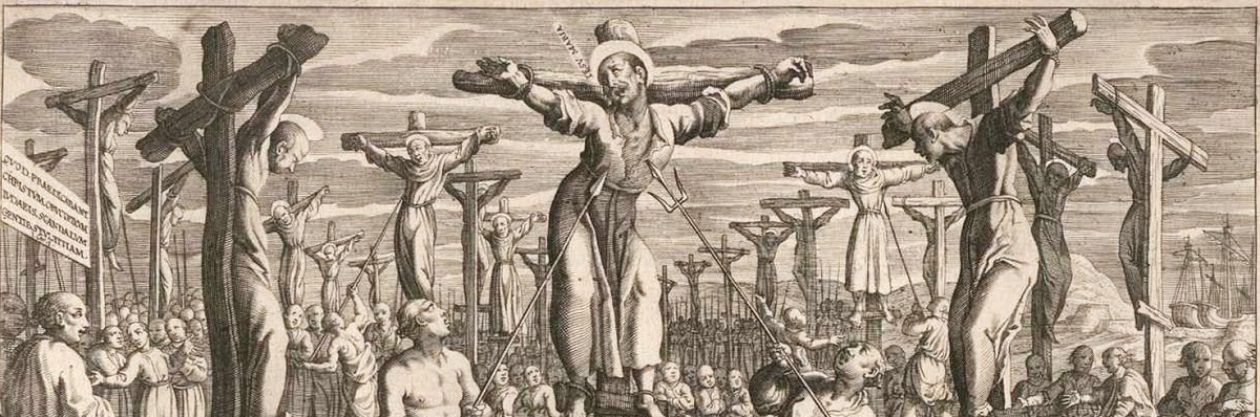
The beheading of Padre Machado in an engraving by Pierre Miotte. It appeared in António Francisco Cardim´s Elogios, Rome 1646 (Latin) and Lisbon 1650 (Portuguese).


Under the Fallen Cherry-Blossoms, Buried History


Amakusa Shiro as depicted in sculpture on the grounds of the vanished Hara Castle


Under the Fallen Cherry-Blossoms,
Buried History


    In the Japanese village of Minami Arima, every spring at cherry-blossom time, two mortal foes march their little armies up the castle road.  One is a leathery old samurai in armor and the other a pony-tailed teenager in a flowery red cape, with his face painted up like a geisha’s. The man is the Shogun’s general; the boy is Amakusa Shiro. At road’s end their armies will have mock combat, eliciting laughs from the crowd.

    Beyond the cherry trees, overlooking the sea, stands a very different Amakusa Shiro: a stout young man in prayer with two swords in his belt. This statue is truer to history, more like the young samurai who stood here awaiting the holocaust in that horrific cherry-blossom spring of 1638. Here thirty-seven thousand souls would offer up their starving flesh, writing their testament in blood into this sacred soil. Here was Hara Castle, the grave of the Shimabara Rebellion, the dying gasp of old Catholic Japan.

    The Shimabara Peninsula had boasted seventy Catholic churches in her prime, and the nearby Amakusa Islands had been staunchly Catholic too; but since 1612 the Shoguns had been tightening the vise and all faithful Catholics now faced death by torture. The current Shogun, Iemitsu, demanded Christ’s extinction. Iemitsu was a sadist, a pederast, a drunkard, a tyrant and a paranoiac, and he feared Christ as a demon would.

    To top this off, the lords of Shimabara and Amakusa were practicing tax-extortion. There had been three years of drought and starvation, but these two profligates demanded exorbitant payments from their peasants, or else. Some defaulters were tied up in coats made of straw and set alight. One sheriff seized a farmer’s wife—nine months pregnant—stripped her and put her into a cage in an icy stream to make her husband pay up. She and her baby died in the cage.

    Then there was the torture of another tax-defaulter’s only daughter, a beautiful virgin. The sheriff stripped her naked and burnt her artfully with torches; enraged, her father killed him. Perhaps this sheriff’s atrocity was the spark for the Shimabara Peninsula’s explosion into rebellion.

    Thousands attacked their cruel master’s fortress in the town of Shimabara, brandishing a banner that proclaimed, “We were timely born to die for the Faith.”

    It did seem like the end of time: there were burning, vermilion skies, and flowers blooming out of season. And down in Amakusa there was a prodigy. Fifteen-year-old Shiro was the son of an old Catholic samurai named Jinbei. Jinbei and his cronies had concocted a phony prophecy by a mythical missionary of old that “foretold” Shiro’s coming to liberate the downtrodden Christians; and then they acclaimed the boy as their prophesied redeemer in a public ceremony.

    Thus was the rebellion seeded. After the explosion in Shimabara, closet-Christians in the nearby Amakusa Islands flocked to Shiro’s flag to wage war on their own oppressors; meanwhile, entire villages throughout the Shimabara Peninsula were vowing in writing to obey Shiro to the death. After an unsuccessful attempt to take their despotic feudal lord’s fortress at Tomioka, Shiro’s Amakusan army sailed to Shimabara with him to join their Shimabaran brethren, and all barricaded themselves and their families inside the disused fortress called Hara Castle, in the south of the Peninsula.

    On Christmas Day the Shogun learned of the rebellion and commissioned a general, Itakura Shigemasa, to go down south to Shimabara and wipe out the despised Catholics. His army—thrown together with units from various feudal clans—didn’t wait for his orders but attacked as soon as they had arrived at Hara Castle, expecting an easy victory; the Christian marksmen atop the castle walls mauled them. Enlightened, the invaders withdrew to lick their wounds and prepare themselves for real warfare.

    Reinforcements came, but the rebels repulsed Itakura’s second, bigger assault. Now he had to save his honor: he ordered an all-out attack on Japanese New Year’s Day (Feb. 14, 1638). Many contingents fought bravely, but the determined rebels exhausted them, and when Itakura tried to rally his army for a last, grand effort, all the mustered units refused to budge. Now Itakura must save face: grimly leading only his own little band of vassals, he charged the fortress. A hail of bullets killed the men on his left and right, but he made it to the wall and died trying to scale it alone, shot through the chest.

    Now a new, veteran general—Matsudaira—arrived with orders from the Shogun to stand clear and starve the Christians out. He surrounded the fortress with over 125,000 men and backed them up with cannon-fire from both the government camp and a 20-gun Dutch merchantman anchored offshore.

    That winter was severe, and inside Hara Castle the cold and hunger did its work: what had been a triumphal juggernaut transformed into a purgatory. By March they had run out of rice and some were eating the empty sacks; nor was there any more drinking-water or firewood, nor gunpowder. The Shogun’s vise was pinching their Christian kingdom and their very bellies, while cannonballs came screaming in to crunch flesh and bone. One went through Shiro’s sleeve and killed four or five of his companions.

    Matsudaira masterfully played his hand once he had tightened the vise. He tempted the Christians with promises: rice and homes and land and tax-relief, if only they would leave their fortress and abandon the Faith. These tempting lies dropped out of the sky, delivered as letters wrapped around arrows shot over the castle walls. Some nonbelievers, dragged into the rebellion against their will, did defect, but the Christian stalwarts shot testimonies back to the besiegers: they wanted only to worship Christ; that denied them, they would just have to die, they declared. Letting them live as Christians, of course, was not an option, for the Shogun, trapped in his private darkness, viewed the Faith with terror.

    By spring the rebels were desperate. In a sudden night-sortie in early April they tried to rob food and ammo from the government camp, but were repulsed with heavy losses: the Christians had made the mistake of setting fire to enemy tents and thus illuminated themselves, perfect targets for massed musketry. After the raiders’ retreat into the fortress, the government troops cut open the stomachs of Christian dead and found they had been eating only leaves.

    The Shogun’s hour had finally arrived. On the Eleventh of April 1638, his horde swarmed over the outermost wall of Hara Castle, having first sent down a rain of fire-arrows. The wasted defenders fought with anything at hand—empty guns, cooking-pots—while their Christian kingdom burned all around them. The innermost wall, the wall of the citadel at the mountaintop, was stormed on the morning of the Twelfth, and the fighting ended at noon, when the last rebel combatant was dead. Those taken prisoner—the elderly, the ill, mothers and their children—they beheaded, without exception. “Even the little girls,” one observer lamented.

    The Shogun’s army ringed the burnt-out Hara Castle with 10,860 impaled Christian heads; they sent 3,300 more to Nagasaki as a lesson to that town’s surviving Catholics. As a warning to the Portuguese there—who had brought the Catholic Faith to Japan—they stuck four heads, including Shiro’s, onto stakes at the foot of the bridge to the island where the Portuguese were now confined. Soon the Portuguese would be banned from Japan entirely, and all Japanese required to appear before a magistrate annually and tread on a Christian sacred image to prove their loyalty to the Shogun.

     In the wake of the rebellion, barely a soul remained in the south of the Shimabara Peninsula: all but the rare deserter had died at the hands of the Shogun’s army. In order to have the land tilled, therefore, the Shogunate repopulated the Peninsula by forcibly removing peasants from Shikoku and Honshu and installing them willy-nilly in the ghost towns of Shimabara.

    In Japan’s Catholic heyday, at least seventy Catholic churches dotted the Shimabara Peninsula; today only three remain. But every spring at cherry-blossom time, the villagers of Minami Arima do remember the holocaust of the 37,000 with a Buddhist memorial service in the evening, and the next day with a parade, with Amakusa Shiro made up like a dainty geisha, and the Shogun’s general a proper man.

    Perhaps a fitting testament to the expunging of the Faith from what was once a Catholic land—after all, a prettied-up cartoon parody of that would-be forgotten slaughter of yesteryear fits in well with the animé unreality that so enthralls the Japan of today. But the made-up fun obscures the monstrous truth of the slaughter of those 37,000 who believed themselves ‘timely born to die for the Faith,’ and it ignores the countless martyred children: martyrs because they, unlike so many of their parents, had not chosen to rebel, but had been scooped up by their parents and rushed to Minami Arima and through the gates of Hara Castle. These the Shogun’s hordes executed for the crime of being Christian. Even the little girls.

    When will Hara Castle’s little martyrs be remembered?


Copyright © 2005, 2013, 2015 by Luke O’Hara

(Originally published, in an earlier version, in Our Sunday Visitor)


March 21st: Father Antonio Rubino and the True Story behind Martin Scorcese’s “Silence”

Humankind—as well as all creation—owes an immeasurable debt of gratitude to Father Antonio Rubino and his companions, fearless men of God who threw their very lives to the wind for the sake of Japan and its blessed people, to give the Japanese an example intended to lead them to freedom in aeternam. They had set out for Japan in 1642 from Manila in a ship secretly prepared for them by the Governor of the Philippines; they had traveled disguised as Chinese; but they died as public spectacles, proudly and fearlessly proclaiming the saving truth of Christ, the Faith they had come to die for.

In October of 1633, the acting Provincial of the Jesuit Province of Japan had apostatized under the most extreme torture and was reputed to be acting as an agent of the Shogun in effecting the apostasies of other missionaries caught by the Japanese authorities. This man, Christovão Ferreira, was indeed acting as interpreter and translator for the Shogun’s men, but there seems to be no evidence that he in fact urged the captives to apostatize; rather, he did his translating work in shame. Nevertheless, his public example of renouncing Christ was a scandal that could lead the whole Japanese nation to perdition, and Father Rubino vowed to offer himself up as a shining counter-example of faithfulness to Christ unto death, a torch of truth to dazzle the eyes and firm the wills of all Japan’s Christians: he and his companions would sail to Japan, enter the country by stealth, and try to bring Ferreira back to life—eternal life, that is—or atone for his apostasy by dying as heroic martyrs themselves.

Giovanni Antonio Rubino was born in Turin in 1578, thirty-one years after Saint Francis Xavier’s pioneering mission to Japan to spread the Word and save yet another race of man. Of noble birth, Father Rubino determined in his youth to devote his life to Christ by joining holy orders. Overcoming his father’s opposition, he joined the Society of Jesus and was sent to Goa in the Portuguese Indies. The consummate scholar, he served the Church in Asia for some forty years at Goa, Cochin, and Colombo as teacher or principal at those cities’ Jesuit academies.

This man, this faithful scholar-priest, is a towering unsung giant of Christian history, a real-life version of the tortured priests in Martin Scorcese’s Silence: a giant because, unlike the fictional priest in that movie who decided to tread on an image of Christ and thus wordlessly proclaim his apostasy, Father Antonio Rubino held out for the heavenly crown of glory—held out to the end, which came on 22 March 1643, when he finally expired hanging in the Pit atop the slope called Nishi-zaka in Nagasaki, Japan’s capital city of martyrs.

Father Rubino and his mission companions—four priests, one brother, and three lay Catholics—sailed out of Manila disguised as Chinese; on 11 August 1642 their ship ran aground on a small island in the Satsuma Strait: they had reached Japan. Within three days they were discovered, arrested, and taken to Nagasaki. There they were interviewed by the Nagasaki Bugyo, the Shogun’s deputy; the apostate priest Christovão Ferreira served as the Bugyo’s interpreter, but slunk out in shame after having been harshly scolded by Father Rubino for his faithlessness.

The Bugyo sent Father Rubino’s party to Mount Unzen, where they would endure the boiling sulfur-water tortures of “Unzen Hell” for seven months; the torturers also burned them with rods of red-hot iron. The final torture session on Unzen, especially gruelling, they suffered on 16 March 1643. None apostatized.

HPIM0034HPIM0050

Boiling springs atop Mount Unzen

Father Rubino’s party were given their death-sentence, torture to death in the Pit, on 18 March: they rejoiced at the news, thanking God. The Bugyo, mystified, asked if they understood what he had told them; they replied that they had understood the Japanese perfectly: this was why they had come—to testify to the truth of Christ with their own precious lives, lives they held worthless if not spent for the Faith.

They were paraded through the streets of Nagasaki as spectacles of shame: riding on pack-horses with hands tied behind their backs; their heads and beards half-shaven, the shaven half painted red; iron “tongues” in their mouths to clamp their tongues and keep them from speaking; and signs on their backs proclaiming their crime:

The Emperor of Japan condemns these people to death for having preached the Roman Faith, long proscribed in all these domains.

Atop the slope called Nishi-zaka, on the execution-ground overlooking Nagasaki Bay, Father Rubino and his companions were violently thrown from their horses and their bodies bound in tight coils of rope. Then each martyr was suspended from a gallows head-downward waist-deep into his appointed pit, whose bottom was filled with the vilest filth. A lid was closed around his waist, closing out fresh air, closing in the stench; the lid cut off his circulation, causing excruciating pain. To multiply the martyr’s agonies astronomically, the torturers twisted the rope from which he hung: back and forth, back and forth, back and forth, each turn an eternity of earthly hell.

2008-11g The Pit (an artist’s inaccurate conception)

Yet no-one apostatized: all five men of Father Rubino’s mission held out for the Christian crown of glory, and thus, in their dauntless silence, refuted the lie of apostasy, the vacuous notion that any temporary earthly suffering—no matter its present horror—is too high a price to pay for Eternal Life.

Father Antonio Rubino won the martyr’s crown on 22 March, 1643 at age 64 or 65, the second of his mission-group to gain that victory. The lifelong scholar and teacher had taught his life’s greatest lesson in silence, a silence blaring out its truth to all mankind like a startling angelic trumpet in the heavens.

Copyright 2017 by Luke O’Hara

Website: Kirishtan.com

February 6th: Saint Paul Miki and Companions

Today, 6 February, the Church marks the martyrdom of Saint Paul Miki and Companions, also known as the 26 Martyrs of Japan.   Here is their story:

“I do not want this religion:  a religion of love and union, which is therefore harmful for this kingdom.”   The Taikō Hideyoshi

(Toyotomi Hideyoshi)

           On February 5, 1597, twenty-six bloodied men and boys were crucified on a mountainside overlooking Nagasaki Bay for the crime of being Christian.  Being spat upon and ridiculed and otherwise abused, they had been marched for twenty-eight days through towns and villages and countryside toward their destination at the westernmost edge of Japan—for the Christian town of Nagasaki was, in the dictator’s eyes, the perfect place to make a show of his power.

       He had proscribed the Faith a decade earlier, perhaps in the merest fit of pique—fueled by drunkenness—and ordered all clergy, or bateren, out of Japan.  Unwilling to abandon their flocks, however, most of the clergy in the country stayed on at the risk of their lives and went incognito as it were, abandoning the Jesuit habit to wear the ordinary Japanese clothing of the day.  They knew the ruler well:  Toyotomi Hideyoshi, the Taikō, the Retired Imperial Regent.  In the Japanese scheme of things, his so-called retirement was a screen behind which to freely wield dictatorial power, and he accepted the proscribed clergy’s screen of seeming-obedience to his edict as a convenient compromise, for he needed the good offices of the Jesuit clergy in Japan to smooth his acquisition of Chinese silk and European guns through the Portuguese traders who sailed to Nagasaki from Macao.

       But then, on October 19, 1596, the San Felipe—a Mexico-bound Spanish galleon laden with rich Chinese silks—limped into the Japanese port of Urado after having been blown off course by a typhoon.  The local daimyō (feudal lord), feigning helpfulness, had the ship towed into his harbor and right onto a sand-bar, which broke the ship’s back and converted her into a shipwreck.  Now, by Japanese law, her cargo was forfeit, or so the daimyō told the Spaniards, and he quickly sent word to Hideyoshi, from whom he could expect a rich reward.

       The Spanish captain dispatched an embassy of two Franciscan friars and two of his crewmen to Osaka, the Taikō‘s capital, to save his cargo, but such an embassy could be embarrassing for Hideyoshi:  he had already claimed the cargo for himself.  He therefore engineered an interrogation of the ship’s pilot at the hands of a clever underling:  Hideyoshi’s man construed a “confession” that the friars were the vanguards of Spanish conquest; this gave the ruler an excuse to explode with rage and in his fury order the round-up and crucifixion of all Franciscans in his captive realm.  In the event, his zealous men netted six Franciscans, three Jesuits and fifteen Catholic laymen.  (Two more martyrs would be added to their number later on.)  Hideyoshi ordered their ears and noses cut off; next they were to be paraded around the cities of Kyoto, Osaka and Sakai in carts, and thereafter marched eight hundred kilometers to Nagasaki, there to be crucified.  A sympathetic official in Kyoto intervened:  only their left earlobes were cut off, but the rest of the sentence would be carried out in full.

       The 26 Martyrs started their death-march on the tenth of January, 1597.  They were marched from dawn till nightfall for twenty-seven days, paraded as criminals and outcasts through town after town.  The youngest of the martyrs was twelve, the oldest sixty-four.  Twelve-year-old Louis Ibaraki laughed when they clipped his ear, and thereafter marched along jauntily toward Nagasaki.  On their wintry road to Calvary Thomas Kozaki, fourteen, wrote to his mother, “You should not worry about me and my father Michael”—his father was marching with him to be crucified—“I hope to see you both very soon, there in Paradise,” he explained.1

        At one point in their trek the guards grabbed Peter Sukejiro, a young believer accompanying the martyrs, robbed him of everything he had and threw him in with them, thus sentencing him to death on their own authority.  Rather than protest, Peter merely remarked, “Seeing that we all have to die anyway, it’s better to die for the Faith,” 2 thus proving his own fitness for martyrdom.

       Their last night on earth was miserable:  it was a bitterly frosty night and the Martyrs must have prayed and shivered all night long, since they were hunched together in open boats offshore of Togitsu, a Christian village north of Nagasaki, with musket-men guarding the shoreline.  Hideyoshi’s sheriff, afraid of Christian violence, would not take the risk of putting them under a Christian roof for the night, as if he had something to fear from that “religion of love and union”.

       On the Fifth of February the martyrs were marshaled to their feet at dawn and marched double-time toward Nishizaka, the mountain slope atop which they would die; it would be a twelve-kilometer marathon.  The local Christians lined the roadside in silent reverence watching them pass, breathing not a whisper of hostility.  From time to time Jesuit Brother Paul Miki exclaimed, “Today is Easter Sunday for me!  The Lord has shown me such mercy!” as they climbed toward their Calvary.3   They arrived at half-past nine in the morning:  just about the time Our Lord was crucified.

       Up on their crosses the Twenty-Six awaited the coup de graçe that would end their Japanese-style crucifixions:  twin spear-thrusts from below, into their left and right sides and upward through their hearts and out their shoulders.  The false charges laid against them were painted on a placard stood in front of the row of crosses for all to see, but all of Nagasaki knew that they had been condemned merely for the crime of being Christian.  Paul Miki spent his last minutes preaching, just as he had been doing all the length of their twenty-seven day march to Calvary, proclaiming to the thousands of Nagasaki Christians blanketing the hillside below, “I greatly rejoice to die for this cause!”

       When the soldiers unsheathed their spears, the crucified martyrs and the crowd all started shouting in one voice, “Jesus!  Mary!”  This holy cry resounded again and again until every last martyr’s heart was pierced; it resounded among the hills of Nagasaki, across the waters of the bay, through the rigging of the ships from halfway round the world that lay in Nagasaki Bay tethered to their moorings, their crewmen watching transfixed by the spectacle above, as if it were they themselves and their holy Faith whose hearts were being pierced.

       Twelve-year-old Louis Ibaraki had long been prepared for this moment.  Twenty-seven days earlier, at the start of their journey, the martyrs had been paraded in oxcarts around the capital and around nearby Sakai, the mercantile center of Japan, and in their oxcart the three youngest boys had brightly sung the Our Father and the Hail Mary as their just-clipped ears poured blood; now, raised on their crosses, the three sang a Psalm—Praise the Lord, O ye children, praise ye His Holy Name.  Louis alone among the Twenty-six was there entirely by personal choice, for he had been offered his freedom by Hanzaburō, the sheriff in charge of the execution, on condition that he give up the Faith.

       Louis didn’t hesitate; his answer was swift and clear:  “I do not want to live on that condition, for it is not reasonable to exchange a life that has no end for one that soon finishes” 4:  a holy precocity reminiscent of Our Lord at age twelve in the Temple, “Sitting in the midst of the teachers, listening to them and asking them questions, and all who heard him were astounded at His understanding and His answers” (Luke 2:46b-47).

       In that same spirit, on the Fifth of February in the Year of Our Lord 1597, atop that slope called Nishizaka that overlooked wholly-Catholic Nagasaki and its perfect harbor, the boy-Saint Louis Ibaraki shouted words that would carry His blessing to the ears and hearts of all the listening world, before the soldiers gouged their spears into his sides and up through his twelve-year-old heart:  “Paradise!  Paradise!” he shouted, struggling toward Heaven, “Jesus!  Mary!”

              Copyright 2007/2014 by Luke O’Hara


1 Diego Yuuki, S.J., The Twenty-Six Martyrs of Nagasaki (Tokyo, Enderle, 1998), 55.

2 Yuuki, 56.

3 Yuuki, 70.

4 Yuuki, 60.


7 October 1613: The Eight Martyrs of Arima

     5-1-from-nicolas-trigault-1624

    In the Year of Our Lord 1613, the domain of Arima was in the hands of Arima Naozumi, the son of Arima Harunobu, longtime stalwart patron and protector of the Church in Japan. After Harunobu’s execution in 1612,  Naozumi had apostatized on the orders of the de-facto Shōgun Tokugawa Ieyasu and received lordship of his dead father’s domain on condition that he do his utmost to exterminate the very Faith that he had from his childhood espoused.            

     Although his domain was far removed from Ieyasu’s castle-town up on the Pacific coast of Honshu, down home in Arima, Naozumi had the ruler’s own hound at his heels: Hasegawa Sahiōye, Governor of nearby Nagasaki—a close advisor of Ieyasu’s and a hell-driven enemy of Christ. Plotting to grab the domain of Arima for himself, Hasegawa threatened Naozumi, greenhorn Lord of Arima, with the Shōgun’s own hellfire if he did not prove his determination to purge the land of Christians with some solid evidence posthaste.           

   Naozumi called in his eight top samurai, formerly his father’s liegemen, and pleaded with them to renounce Christ, if only on paper, to save him from the threatened wrath—indeed, to save all of Arima’s faithful from that wrath, or so he claimed, citing Hasegawa’s threat. Hearing their new liege lord’s artful pleading, five of the eight samurai agreed to the stratagem. Three, however, refused to budge: Leo Taketomi Kan’emon, Adrian Takahashi Mondo, and Leo Hayashida Sakuemon.      

         Naozumi sentenced them to death by burning, along with their wives and children. However, the new, spineless Lord of Arima postponed the order until the three Christian stalwarts were safely out of his castle and headed home. All of them being samurai, they and their families were escorted unbound to their respective prison cells, where each family was locked up together: Adrian Takahashi with his wife Joanna; Leo Taketomi with his son Paulo; and Leo Hayashida with his wife Marta, his eighteen-year-old daughter Magdalena, and his son Diego, eleven years old.                 
Soon twenty thousand Kirish’tan had surrounded their prison, singing prayers and keeping vigil—at which they stayed for three days and nights on end, some huddling around campfires to keep warm in the night, some distributing food to those who were too hungry to bear it. For fear that the faithful would take relics from their remains, Naozumi ordered the martyrs-to-be spirited out of his jail to another location—clear proof that Arima Naozumi, his apostasy notwithstanding, retained a clear understanding of the restorative power of relics. Undeceived, Arima’s Kirish’tan faithful followed the soon-to-be martyrs to their new prison to continue the vigil.      

         On the morning of Sunday,  October 7, 1613, the prisoners were led out of their cells to meet their deaths. All were wearing the kimono of the Guild of Saint Mary, given them by its chief, and each but the youngest—eleven-year-old Diego—had his or her arms bound with rope in the form of a cross. Diego, seeing that all the others were bound, asked that the guards bind him too. They insisted that they had no more rope, and on hearing this, the boy submitted quietly.      

         En route to their deaths, each martyr was flanked left and right by a Marian with a lit candle in one hand and a rosary in the other; these members of the Guild sang the rosary as they marched with the holy ones. Coming to a river, the martyrs were ferried across, after which they had to traverse muddy ground. A certain man offered to carry Diego on his back across the mud, but the boy declined: “Our Lord Jesus didn’t ride a horse up Calvary,” he explained, and he tromped into the mud on his own two feet. Crowds of believers with scissors or knife in hand mobbed the holy ones to strip from their clothing some relic for saving; the condemned protested that they themselves were but mere sinners. Had the Eight not thus rebuffed these adorers, they would likely have been stripped stark naked.       

        They arrived at the place of execution: a wooden stable of sorts filled to the rafters with firewood, surrounded by a stockade, on the beach in front of the hill atop which loomed Hino-eh Castle. Their liege lord was most likely watching from up there, high above the heads of the countless Christians jammed into the town below the castle, people from all over the Peninsula, the erstwhile Christian bastion of Japan.       

        Leo Taketomi climbed onto a pile of wood and made a speech to the thousands, but many of his words were drowned out by the noise of the crowd. His few audible words went something like this:   

             Behold the faith of Arima’s Christians: for the glory of the Lord and as a testimony to our faith we now die. My brethren, my hope is that you shall preserve your faith unshaken to the very end!   

            Leo stepped down; each of the martyrs was tied to a stake; the executioners lit the firewood. Quickly a storm of flames erupted around the three families. The chief of the Guild of Saint Mary, just beyond the stockade, held up a painting of Jesus in his Passion so that the martyrs could see it, a help in their death-throes. The crowd sang the Credo, the Pater Noster, the Ave Maria, and other prayers to strengthen the martyrs; reportedly the martyrs evinced nothing but joy amidst the flames.       

        The boy Diego’s ropes were the first to burn away: he ran to his mother’s side shouting, “Zézusu! Maria!” and fell. Next his eighteen-year-old sister Magdalena found her arms free of the burning ropes: she reached down to pick up a flaming branch and held it above her head, seemingly worshiping the fire that would send her to Heaven as she held up her head with her other hand. Seeing this, the gasping crowd made the sign of the Cross. Finally, Leo Hayashida boomed the name of Jesus out of the midst of the flames; that word shook the crowd as a whirlwind of fire devoured the eight holy martyrs. All the onlookers beat their breasts as his shout resounded over all the scene.       

        When that shout of Heaven’s victory reached his ears, Arima Naozumi, looking down from his castle’s overlook, must have felt as if that maelstrom of flames were in his own stomach. Meanwhile, down below, all those thousands of his Kirish’tan subjects, fallen to their knees, were praying for the souls of the martyrs—and perhaps for the soul of their earthly lord as well, cowering in his fortress high above.           

      This martyrdom proved to be only a prelude to the litany of sufferings that Arima was bound to endure.


             Copyright 2015/2016 by Luke O’Hara 

                     Website:  Kirishtan.com

             The illustration is from a 1624 history of the persecution in Japan by Nicolas                          Trigault;  I borrowed the image from the website of the Catholic Bishops’ Conference               of Japan, at   http://www.cbcj.catholic.jp/jpn/feature/kibe_187/arima.htm