Category Archives: Martyrs

An October Martyr: Santa Magdalena of Nagasaki

Santa Magdalena of Nagasaki, the Perfect Bride

      In October of 1634 throughout a fortnight of hell she hung in the pit, singing hymns and blessing her God: no-one else ever withstood the torturers’ cruelties so long. In the end, though, it was not those cruelties that ended her life: it was God’s gentle Hand that took pretty Magdalena home.

     The orphaned daughter of Catholic martyrs, Magdalena of Nagasaki was a bilingual prodigy who consecrated her virginity to Our Lady of the Rosary and became an Augustinian tertiary at age 15. She worked tirelessly for two Augustinian friars until their arrest in November of 1629. They would die by “slow fire,” a protracted torture designed to procure public apostasy.

     Slow fire wasn’t working, though: something more demonic was in order. Enter Takenaka Uneme. In 1629 the Shogun Iemitsu installed him as Governor of Nagasaki with orders to expunge the Catholic Faith from that staunchly-Catholic town. Soon, Uneme went to work devising the ultimate torture: “the pit.”

     The victim, bound in coils of rope, would be hung upside-down in a hole containing human waste or other filth. A two-piece wooden lid with cutouts in the center would be clamped around the victim’s waist, cutting off his circulation and shutting out fresh air. It felt like his head was going to explode; his mouth, nose and ears would soon start oozing blood.

     This would kill Magdalena’s next two pastors, both Dominicans: Fr. Domingo de Erquicia, who described Uneme as “man dressed as demon, or devil incarnate,” and Fr. Giordano Ansaloni. Upon Fr. Giordano’s arrest, Magdalena marched into Uneme’s lair in her religious habit to declare her love for Christ and her right to die for Him.

At first, taken by her beauty and refinement, Uneme tried to dissuade her, but when she stood firm, he ordered her jailed. “She entered with great happiness, shedding tears of joy.” To dampen her spirits, the torturers jammed sharpened strips of bamboo under her fingernails. Seeing blood pouring from her wounds, Magdalena reveled, “With what rubies have you adorned my hands!” When they ordered her to scratch furrows in the earth with the bamboo strips, she obeyed, undaunted.

     Next they tried a water torture, pouring gallons down her throat, throwing her onto the floor, and loading stones onto her so that water gushed out through her mouth, ears, and nose. Though they repeated this torture time and again, beautiful Magdalena was unmoved.

They hung her by her arms on ropes, raised her high, and dropped her, dislocating her shoulders, to no avail: still she clung to Christ.

     Defeated, Uneme condemned Magdalena to the pit along with ten other Christians. They were paraded around the streets of Nagasaki with Magdalena at their head on horseback, a rope around her throat like a garrote and her wrists bound fast behind her. A sign on her back proclaimed her sentence—CONDEMNED TO DEATH FOR REFUSING TO ABANDON THE LAW OF THE CHRISTIANS—yet her eyes showed no terror, but glowed with joy as she preached to onlookers all along the way.

     Finally, the procession climbed the steep slope called Nishi-zaka to the execution-ground overlooking Nagasaki Bay. There Magdalena was cocooned in rope, slung by her heels from a gallows, and lowered into the reeking pit of horrors. The lid clamped her waist, shutting out all light and fresh air. Perhaps, as usual, blood began to drip from her ears and mouth and nose. François Caron, head of the Dutch trading-post in Japan, wrote,

This extremitie hath indeed … forced many to renounce their religion; and some of them who had hung two or three days assured me that the pains they endured were wholly unsufferable, no fire nor no torture equalling their languor and violence.

     Yet Magdalena uttered neither groan nor plaint nor squeal; instead, she sang sweet songs in Japanese to Jesus, her Spouse in Heaven.

    This went on for nearly fourteen days. The guards would hear her ask, “Would you like to hear a song?” and on their answering, ‘Yes,’ Magdalena would break into song, singing “a thousand canticles of praise to God our Lord in the Japanese tongue.” Accounts abound of miracles attributed to Magdalena during that October fortnight of 1634, but it was miracle indeed that she survived without food or water through that hellish ordeal.

     Perplexed, the torturers’ overlords ascended Nishi-zaka to see for themselves just what was going on. They were sure that the guards had been suborned, that some Christian misfits were slipping her food and drink. This the guards denied, and Magdalena backed up their words when they opened the lid.

     “Don’t be surprised if I don’t die in this ordeal,” she told the incredulous officials. “The Lord whom I adore preserves me and holds me up. I feel a paternal hand touching my face, and my body is lightened so that I don’t suffer.”

     That was enough for Uneme’s minions: they told the guards to club her unconscious, orders they must have obeyed with bitter reluctance, having been soothed for nearly fourteen days on end by Magdalena’s angelic songs—songs “in praise of her Husband [sung] with singular melody and sweetness, so much so that they said it couldn’t be a human voice.”

      Their dirty work done, those men must have closed that lid with leaden stomachs and searched their souls for some relief, something like that soothing Hand that had caressed that lovely maiden’s face throughout her earthly hell. Perhaps they felt a hint of that relief when Heaven opened her floodgates that evening, drenching them as they stood at their posts atop Nishi-zaka, looking down on benighted Nagasaki, home of so many martyrs, and trying to make sense of the horrors they had to stand watch over.

     Then, come morning, there was perfect silence: no heavenly joy, no sweet, angelic songs, for they saw Magdalena’s hole filled to the brim with Heaven’s cleansing rain, and pulling her out, they found that she had drowned: her Lord and Husband had finally, and ever so gently, taken her home.

     Pretty Magdalena, holy Magdalena: the perfect bride for Heaven’s earthborn King.

This story appeared on ChurchMilitant.com

***

            Luke O’Hara became a Roman Catholic in Japan. His articles and books about Japan’s martyrs can be found at his website, kirishtan.com.


October 21, 1633: Father Julian Nakaura Gives his Life for Christ

Today, October 21st, all Christians would do well to remember the heroic sacrifice of Father Julian Nakaura, Catholic samurai, Ambassador to Rome, and holy martyr.  Read his story here:

Julian Nakaura: Samurai, Ambassador, and Martyr

          The jumbled boulders of Nakaura lie brooding on the shore, defying the sea to do its worst.  Behind them squats a hill clothed in bamboo, its giant knees of rock protruding through the trees.  A continent of charcoal cloud looms over the coast, yet the sun blazes triumphantly in the distant west, riding high above the Gotoh Islands:  it burns one’s face, even in the tail-end of winter.
      Julian Nakaura was born here.  They honor him with a memorial that overlooks the village:  a pony-tailed boy in bronze pointing out at the sea, towards the Rome the real boy visited.  But I prefer the Julian who stands, weathered and flinty, at the entrance to the Shimabara Catholic Church, way down south: a gentle old man steeled by trial and perseverance, a Missal in hand and nothing but his own two sandaled feet to carry him. Those old feet would carry him to a death unheard of even in a Europe where the burning of heretics and the disemboweling and mutilation of Roman Catholic priests was the order of the day.
imported from fuji camera 13 oct 07 019 - Copy
Statue of Father Julian Nakaura in his old age, in the courtyard of the Shimabara Catholic Church, Shimabara City, Nagasaki Prefecture, Japan
      In 1582 Catholicism was flourishing in some parts of Japan; especially on the island of Kyushu.  The Jesuits had opened a school in Arima, southeast of Nagasaki, for training Catholic samurai youth to become future teachers, catechists and priests—a Seminario.  Father Alessandro Valignano, dispatched by Rome as Visitor to Japan, had set up the school in 1580, and two years later he came up with a brainstorm:  choose some fine young samurai from the student body and send them on an embassy to Rome as showpieces of the Japanese Church.  Their mission would be twofrold: to impress upon the nobility of Catholic Europe the quality of this newest and farthest-flung Catholic seedbed, and to impress upon themselves the grandeur of Catholicism in Europe and report their impressions to their native brethren on their return.  Omura Sumitada, the first Japanese daimyo (domainal lord) to be baptized, loved the plan as soon as it hit his ears; he promised his full support.  Two other daimyo also joined in–Arima Harunobu and Otomo Sorin. The mission was prepared immediately.
    For the four young ambassadors—Julian, Mancio, Martin and Miguel—the journey was no pleasure-cruise.  On the second leg—the voyage to India—some of the sailors died of fever; it nearly killed one of the four ambassadors, too.  They narrowly escaped shipwreck passing through the Singapore Strait; they spent a night cocooned in blankets tied to poles, being carried by porters through an Indian jungle, to be confronted in a clearing by a furious swordsman growling in a language none of their party understood, and all of them unarmed.
     But when the four adolescents from Kyushu hit Lisbon in August of 1584, they were the hottest personalities in Catholic Europe. Like the Beatles on tour they were awaited at the docks by an adoring mob; their guardians kept them on board ship until evening so they could be slipped ashore discreetly. From Lisbon to Rome and back again, honor guards, trumpet fanfares and cannon and mortar salutes would greet them in town after town.
     They were received in private audience by Philip II, King of Spain, Portugal, Naples, Flanders and much of the Americas.  He gave each of them a hug:  these boys had sailed halfway round the world braving mortal dangers for the sake of God’s Church.  Pope Gregory XIII also greeted them with hugs, had them to dinners in his private quarters and sent messengers to inquire about their welfare three times a day.
     Gregory fell ill during their stay and suddenly found himself nearing death.  Having received the Last Rites he asked about Julian, who had come down with a fever some days before, and hearing that the boy had recovered, was relieved; Gregory XIII died two hours later.  Sixtus V succeeded him; the four boys were seated around the new Pontiff at his coronation.
       But when the four—now young men—disembarked at Nagasaki in 1590, they were coming back to a Japan very different from the one they had left eight and a half years earlier.  That Japan had been made up of largely-independent feudal states, their own lords all ardent Catholics; in the new Japan all was under the heel of one man, the warlord Toyotomi Hideyoshi, who had banned the Christian religion in 1587 and ordered all the priests out; most had gone underground instead.  This was the beginning of three centuries of persecution—the grisliest persecution Christianity has ever seen, anywhere.
     Arima Harunobu, the lord of Arima, had bravely invited the Jesuits of Nagasaki into his domain after Hideyoshi’s crackdown, but his castle-town of Arima was becoming an ever-more-risky place for a Jesuit school, so they moved the Seminario first to another town in his domain, and then out of Arima entirely, deep into the interior of Amakusa-shimo Island, to the south.  While at Rome the boys had asked for admission to the Society of Jesus; they finally entered on July 25, 1591, and after two more years of schooling, made the Jesuit vows of poverty, chastity and obedience.  During their novitiate, Hideyoshi’s spies would sometimes come sniffing round; the four would then disperse and become refugees, holing up in farmers’ huts in the backwoods.  This too was training for a darker time to come.
     On February 5, 1597, Hideyoshi had twenty-six Franciscans, Jesuits and lay Catholics crucified in Nagasaki for the crime of being Christian; only his providential death in 1598 gave the Japanese Church a breathing-space, as well as the larger world:  his planned invasion of China would be cancelled, and Japanese forces were withdrawn from Korea.  The future began to look promising again for the Japanese Church; but the Tokugawa Shoguns who succeeded Hideyoshi saw to it that being Catholic in Japan would become, instead, an ever-surer sentence of death.  In 1612 Tokugawa Ieyasu promulgated his first edict against Christianity.  Arima Harunobu was executed that year, and the Arima domain—long Japan’s Catholic haven—became a testing-ground for the Shogunate’s plan to exterminate the Faith.
     Julian had been ordained a priest in 1608 and was one of those who went underground when all religious were ordered deported to Manila or Macao in 1614.  For some years his base was the port-town of Kuchinotsu at the southern tip of Arima; he probably kept a boat tied up in the harbor for quick escapes to the Amakusa Islands, southward across the Hayasaki Strait.  In 1622 Julian wrote a letter to Father Nuño Mascarenhas, S.J., whom he had met in Rome on his mission to the Pope more than three decades earlier.  It gives a hint of the sort of life he was living in Kuchinotsu:
   Still the persecution continues unabated; because of it we cannot take a minute’s rest.  I cannot even calmly finish writing this letter to Your Excellency.  That is because, news having arrived that the lord of this domain has begun a new, special persecution, a believer has come to tell me that I am to be moved to a safer place.  The [feudal] lord hopes to uproot the teaching of the Gospel from this domain and see to it that not even one person remains who maintains the Faith and thus violates the command of the Tenka—the ruler of all Japan.
  The “special persecution” had already killed twenty-one believers in Kuchinotsu; but Julian adds, “Thanks to the Grace of God, I still have sufficient health and strength of spirit to shepherd the Christian charges of the Society of Jesus.”  He signs the letter, “Worthless servant / Julian Nakaura.”
      Strength of spirit and body he would need, and in superhuman abundance.  The Shogun’s police wanted broken clerics to parade in front of the Christians of Nagasaki, Arima, Omura, and the other stubborn Catholic holdouts:  they hoped to start a landslide of apostasies that would empty Japan of Catholics.
  This was their method of persuasion:  they would coil their victim tightly in rope from the feet up to the chest, his hands tied behind his back, and then hang him upside-down from a gallows with his head and torso lowered into a hole, six feet deep, perhaps containing human waste or other filth and covered with a lid to trap the stench.  The lid was made of two boards closed together; crescent cutouts in the center closed tight around the victim’s body, pinching his waist and cutting off his circulation. It felt like his head was going to explode; his mouth, nose and ears would soon start oozing blood.  François Caron, the chief of the Dutch trading-post in Hirado, wrote, “This extremitie hath indeed … forced many to renounce their religion; and some of them who had hung two or three days assured me that the pains they endured were wholly unsufferable, no fire nor no torture equalling their languor and violence.”
      On the Eighteenth of October, 1633, Julian faced the test.  He had been in prison for almost a year awaiting his turn as his fellow-servants of God were taken away to the pits, dug where the Twenty-Six Martyrs had been crucified thirty-six years before.  On that autumn morning, he was herded with seven other men—Jesuits and Dominicans—up the hill called Nishi-zaka to the execution-ground overlooking Nagasaki Bay.  Julian was about sixty-five years old and no longer robust:  he had largely lost the use of his feet, and the climb was a struggle for him; but on arriving, he faced his executioners and shouted, “I am Father Nakaura, who went to Rome.”  He was determined to die; he had shoved the fact into their faces, a challenge to do their worst.  They would.
       One of Julian’s brethren broke down:  Christovaõ Ferreira, the Jesuit Provincial, gave the signal of surrender after five or six hours of the pit.  The executioners came and told Julian.  Ferreira was his superior:  if he had apostatized, why not just give in?  Julian didn’t flinch:  he was there to die.  He endured the unendurable, and he no doubt prayed.  Perhaps he remembered that day in Rome when, as a teenage boy, his heart bursting with hope, he had ignored strict orders to stay in bed and, despite a high fever, insisted on joining the other three boy-ambassadors for their first audience with the Pope.  If only he could have His Holiness’s blessing, he told them, he would get well, and he refused to be restrained by either his anxious doctors or all the Jesuits in Rome.  He did take his place in the ambassadorial party and, shivering, marched forward and knelt before the Pope.  Gregory XIII conferred his blessing on faithful Julian and ordered him back to bed immediately.  This voice the boy obeyed.
       In the pit atop Nishi-zaka, that sacred slope overlooking Nagasaki Bay, Julian hung on to the end.  God took him home on the Twenty-first of October in the Year of Our Lord 1633.  No “Worthless Servant” he.
(Blessed Julian Nakaura was beatified on November 24, 2008; he is counted among the 188 Blesseds known as Peter Kibe Kasui and 187 Companions, Martyrs.)
Text and Photo Copyright 2005/2012 by Luke O’Hara
 (A version of this story first appeared in Our Sunday Visitor.)


The Eight Martyrs of Arima: October 7, 1613

Faithful Catholics martyred on the

Feast of Our Lady of the Rosary

   In the mid-16th century, Japan was a mishmash of feudal domains unfettered by any central authority. Civil war was common, with peace to be had only intermittently or in remote outposts of calm. One such outpost, at least for a time, was the little domain of Arima, ensconced on a peninsula southeast of Nagasaki.

On the Feast of the Assumption of 1549, Saint Francis Xavier arrived in Japan with two fellow-Jesuits and three lay helpers to sow the Gospel seeds that would soon sprout throughout that fertile land. In 1562 those seeds reached Arima and bore fruit in abundance.

Arima’s port of Kuchinotsu became the seat of the Church in Japan, with Fr. Cosme de Torres, S.J. in charge. His successor baptized the Daimyō of Arima, and this man’s heir, Harunobu, would become the mainstay of the Church in Japan, harboring clergy and protecting the faithful even at risk of his life. He built churches all over his little peninsula, and children in his towns and villages got a Jesuit education, learning catechesis through Bible stories set to Japanese melodies that they happily sang in the streets.

If only Harunobu’s heir, Naozumi, had been made of such metal. Instead, he betrayed his father to the de-facto Shōgun Ieyasu, who beheaded Harunobu in 1612. Naozumi then apostatized, taking over Arima on condition that he expunge from her the very Faith that he had from his childhood espoused.

Although Arima was far from Ieyasu’s capital, Naozumi had the ruler’s own hound at his heels: Hasegawa Sahiōye, Governor of nearby Nagasaki—Ieyasu’s toady and a hell-driven enemy of Christ. Hasegawa threatened Naozumi with the Shōgun’s own hellfire if he did not produce some hard evidence of his work to purge Arima of Christians.

The cowed Naozumi called in his eight top samurai, all Catholics, and pleaded with them to renounce Christ, if only on paper, to save his skin. He reminded them that even Saint Peter had thrice denied Him and yet had been forgiven. Hearing this artful pleading, five of the men agreed to the stratagem. Three, however, refused to budge: Leo Taketomi, Adrian Takahashi, and Leo Hayashida.

Naozumi ordered them burnt along with their wives and children. The spineless princeling postponed the execution of his orders, though, until the three stalwarts were well out of his castle and headed home. All of them being samurai, they and their families were escorted unbound to prison, where the members of each family were locked up together: Adrian Takahashi with his wife Joanna; Leo Taketomi with his son Paulo; and Leo Hayashida with his wife Marta, his eighteen-year-old daughter Magdalena, and his son Diego, eleven years old.

Twenty thousand Christians surrounded their prison, singing prayers and keeping vigil—at which they stayed for three days and nights on end. On the morning of Sunday, October 7, 1613—the Feast of Our Lady of the Rosary—the condemned were led out of their cells. All were wearing the kimono of the Guild of Saint Mary, and all but the youngest—the boy Diego—had their arms bound in cruciform position. Diego asked the guards to bind him too, but they demurred, perhaps ashamed of their duty.

En route to their deaths, each of the martyrs was flanked left and right by a Marian with a lit candle in one hand and a rosary in the other; as they marched they sang the rosary. Coming to a river, the martyrs were ferried across, after which they had to traverse muddy ground. A certain man offered to carry Diego on his back, but the boy said, “Our Lord Jesus didn’t ride a horse up Calvary,” and he tromped into the mud on his own two feet.

At last they reached the beach where their death-cage stood, built within sight of Naozumi’s mountaintop castle. He was probably watching from up there, awed by the masses crowding the landscape below—faithful from all over Arima, the Christian bastion of Japan.

Leo Taketomi climbed onto a pile of firewood and addressed the thousands awaiting the holocaust, but many of his words were drowned out by the noise of the crowd. His few audible words went something like this:

Behold the faith of Arima’s Christians: for the glory of the Lord and as a testimony to our faith we now die. My brethren, my hope is that you shall preserve your faith unshaken to the very end.

Leo stepped down; the Eight were tied to their stakes; the firewood was lit. As a storm of flames erupted around the martyrs, the chief of the Guild of Saint Mary held up a picture of the Scourging of Christ to strengthen them. The crowd sang the Creed, the Our Father, and the Ave Maria as the holy ones endured the flames.

Diego’s ropes were the first to burn away: he ran to his mother’s stake shouting, “Zézusu! Maria!” and fell. Next, his sister Magdalena found her arms free of the burning ropes: she reached down to pick up a flaming branch and held it above her head, seemingly worshiping the fire that would send her to Heaven as she held up her head with her other hand. At this, the gasping crowd made the sign of the cross. Finally, Leo Hayashida boomed the name of Jesus out of the midst of the flames; his shout shook the crowd as a whirlwind of fire devoured him and his companions.

When that victory-shout reached the ears of the apostate lord of Arima, the wretch must have felt as if those flames were in his own stomach. Meanwhile, down on the killing-ground, those thousands of his Christian subjects, fallen to their knees, were praying for the souls of the martyrs—and perhaps for the soul of their wretched earthly lord cowering in his fortress on high.

This holocaust was but a prelude to the litany of sufferings that Arima was bound to endure: a testimony to eternal life forged in the cauldron of the World’s slithering temptations.

***

Luke O’Hara became a Roman Catholic in Japan. His articles and books about Japan’s martyrs can be found at his website, kirishtan.com.

This article by Luke O’Hara appeared on Churchmilitant.com.

Anatomy of a Martyrdom: for Love of Souls

The burning of Father Antonio Ishida. From Cardim’s ‘Fasciculus e Iapponicis Floribus.’ Rome, 1646.
 

    While combing the narrow streets of Nagasaki in the autumn of 1629, the Shogun’s police grabbed themselves a coveted prize: a Japanese Jesuit priest, an heir of Saint Francis Xavier’s hope, born eighty years earlier, to fill all Japan with Christ. By 1629, under the Shogun Iemitsu’s persecution, that hope was all but smashed under the tyrant’s heel, and yet a rare breed of intrepid men still clave to that hope as if it were their very life and breath, despising their own mortal lives to save immortal souls for Christ. 

      Father Antonio Ishida, S.J. had been called to Nagasaki to hear the confession of an ailing believer, and having done this work of charity, he stayed on for six more days to hear a string of confessions from underground Catholics too-long starved of the Sacraments. He had been warned against making the dangerous trip to Nagasaki by a fellow-priest in Omura, but he had chosen to obey the call “for love of souls,” as he later explained in a letter from his Nagasaki prison.

       There he languished with four other men: three Augustinians, one Franciscan, and a Japanese diocesan priest. Meanwhile, the Shogun’s governor in Nagasaki, Takenaka Uneme, was busily devising stratagems designed to seduce Christ’s shepherds away from His flock—or, that failing, to rip that hated faith out of them by tortures as cruel as fallen Man could devise.

      But first the seduction. Uneme had Fr. Ishida brought out of jail to face an erudite Buddhist monk chosen to convince him to renounce the Faith, if only for show, in obedience to the Shogun. In his secret heart, he could go on believing whatever he wished, the monk explained, and save his life. The staunch priest replied that what a Christian believed in his heart he must proclaim to all the world. And the Shogun’s decrees, he went on, could in no wise prevail against the law of the Creator of the universe.

      Next they tried bribing him with riches and prestige on top of the offer of his life: the browbeating went on for twenty-four hours—to no avail. The priest went back to jail, and Uneme turned his eyes toward Mount Unzen, a volcano southeast of Nagasaki whose peak held boiling pools of acrid sulfur water, the very stench of which would choke and gag a passerby. But Uneme’s victims were not marched up there merely to choke.

       The torturers had a practiced method: strip the victim naked, make him stand on a rock at the boiling pool’s edge, and shower him with that boiling, sulfurous crud dripped from a ladle with holes in its bottom. A survivor reported that each drop felt like a knife’s point driven into the skin. Throughout December of 1631, Fr. Ishida and his fellows endured daily torture as their torturers demanded they apostatize and thus procure relief. At night they were shoved into a hut where they would wait, shivering, through the freezing hours of darkness for their next day of agonies and pray for the grace to go on. For sustenance, each victim was allowed one sardine and one small bowl of broth per day.

     Along with Fr. Ishida suffered four priests and one brother: Frs. Bartolomé Gutiérrez, Vicente Carvalho, and Francisco de Jesús, Augustinians; and Br. Gabriel de la Magdalena, a Franciscan. Two were Spaniards, one Portuguese, and one, Fr. Gutiérrez, was Mexico-born.  Along with these clergy, Uneme, the reptilian inquisitor, had thrown in two Portuguese ladies from Macao, Beatriz da Costa and her daughter Maria, perhaps out of gratuitous cruelty. Maria finally collapsed, unconscious, and they said she had apostatized: a claim she denied upon reviving.

    Thirty-three days of scalding having gained the torturers no prize, Uneme called them back to Nagasaki. The ladies he sent back to Macao; he would substitute a Japanese priest—Fr. Iyo, Franciscan—to stand in for them on the execution-ground overlooking Nagasaki Bay. The six men were led out of their cell on the morning of September 3, 1632. They would climb a steep slope called Nishi-zaka to reach the place of their martyrdom, the very flatland atop which the crosses of the Twenty-Six Martyrs had been arrayed on a February morning in 1597; many more faithful had seeded that soil with their blood in the intervening years.

    Atop that sacred ground, Uneme’s men had built a cage of sorts in which to roast those stalwarts of the Faith. Around it, on all sides, a palisade of bamboo poles enclosed the killing-ground; inside stood six columns in a line, topped by a roof of foliage and straw: this would trap the acrid smoke intended to prolong the agonies of the missionaries to be burned. Firewood was spaced at a distance from each column calculated to provide a lingering death, and all was doused with saltwater to produce as much choking smoke as possible.

   Spotting some Portuguese onlookers on the way to Nishi-zaka, Fr. Vicente shouted at them “Long live the Faith of Christ!” in their tongue, and when none made a sound, he asked, “Will no-one respond?” and repeated, “Viva!” At this there came a cry of “Viva! Viva!”

   On their way up the slope, the martyrs chanted Laudate Dominum, omnes gentes.  

     Inside their death-cage, each of the martyrs was tied by a single finger to one of the columns: this method was intended to elicit amusing dances of agony and panic from the men of that proscribed faith, and even perhaps provide an apostasy or two. The torturers, though, were disappointed. 

     Fr. Gutiérrez was the first to die: he stood like a warrior facing an inconsequential enemy, leaned into his column, and gave up his flesh in silence. Fr. Vicente, holding a bronze cross, kept his eyes fixed on it until his last breath. All died without showing any hint of cowardice or doubt of their eternal reward, enduring hell on earth for love of souls.

    Friday, September 3, 1632: a day to remember when asking for prayers from above.

                                        ***

            Luke O’Hara became a Roman Catholic in Japan. His articles and books about Japan’s martyrs can be found at his website, kirishtan.com.
August 25th, 1624: Five Heroic Men who Withstood Hellfire for Their Faith

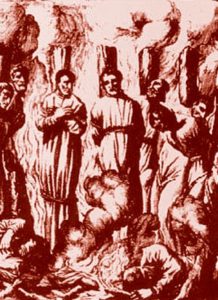
     On 25 August 1624, five Catholic heroes faced hellish deaths for having brought Christ to the people of Japan. Burned at the stake in Ōmura, east of Nagasaki, were Father Miguel Carvalho, S.J., Fathers Luís Sotelo and Luís Sasada, Franciscans, Father Pedro Vázquez, Dominican, and Franciscan Brother Luís Baba.

     Padre Miguel Carvalho, the Jesuit, had entered Japan in 1622 on a Portuguese trading-ship, having disguised himself as a soldier. The three Franciscans had been sent from Japan as private ambassadors to King Philip III of Spain and the Vatican, only to be arrested on their return. Fray Pedro Vázquez, dauntless Dominican, had once risked death by disguising himself as a Japanese official to gain entry to Nagasaki’s prison, where he heard the confessions of Catholic prisoners bound for execution.

     A decade had passed since the fateful Anti-Christian Edict of  1614 exploded onto Japan on 14 February—ironically, Saint Valentine’s Day. Tokugawa Ieyasu, the retired-yet-reigning Shogun, on that day fettered Japan with a brutal regime of suppression worthy of Josef Stalin or Mao Zedong, a regime that his progeny would tighten with each new accession to the Shogunal throne. By 1624, every cleric in Japan was living on the scythe’s edge, daring a gruesome death; nevertheless, these men of God carried on.

     In July 1623, Father Carvalho had slipped into the Ōmura domain to hear the confessions of her underground Christians. Having done his heroic work, he was betrayed by a spy, arrested, and jammed into a hellhole of a prison where the four other servants of God already languished, awaiting martyrs’ deaths.

     Ōmura was the first domain in Japan where Catholicism took deep root; its ruler, Ōmura Sumitada, christened Bartolomeo, had embraced the Faith in 1563 and championed it, braving violent opposition and even a rebellion led by his anti-Catholic half-brother. Bartolomeo stood firm as a pillar of the Church unto his death in 1587.

     Bartolomeo’s progeny, however, did not prove so redoubtable: his son and heir apostatized in a fit of pique, and his son, christened Bartolomeo like his grandfather, was cowed into apostasy when the second Tokugawa Shogun fumed threats of dire consequences at him should he not rid his domain of that irking religion of truth and light. The cowed apostate started executing priests in May 1617; perhaps by the time Father Carvalho showed up in Ōmura, its ruler’s conscience was numb, inured to spilling holy martyrs’ blood.

     On 22 July 1623, Father Miguel Carvalho was thrown into a foul, stinking cell no bigger than a closet—“16 hand full long and 8 broad,” he wrote—with the four Christian stalwarts with whom he would die. It comforted him that his imprisonment began on the Feast of Saint Mary Magdalene, his patroness, and that he had managed to convert two of his captors on his way to jail.

     Thirteen months the five faithful men endured an unendurable penance, awaiting the chance to prove to the downtrodden souls of Ōmura that Christ lives in His martyrs. That chance finally came on the feast day of the saintly King of France who had daily set beggars at his own table.

     August 25, 1624: the Feast of Saint Louis. The five condemned men of God were led to the execution-ground in Ōmura with ropes strung tight around their necks and their arms bound. Only their hands were free—free enough for each priest to walk clutching a cross on the way to his Calvary. The Palme of Christian Fortitude (Douai, 1630) relates their ordeal:

   They arrived at the place appointed for their death, a field called Hokonohara, when giving thanks unto those who had conducted them, … the Priests lifting on high the crosses which they bare in their hands, they began to recite psalms with a loud voice; when Father Carvalho, perceiving now a great multitude to be assembled, turning unto them, You must understand, said he, that we are Christians, and that we die of our free and voluntary accord, for the faith of Christ our Lord.  The admirable serenity of their countenances put their joy so clearly in view of the beholders, that amazed thereat they said, these men seemed to go rather to some feast or banquet, than unto death.

          The five men were loosely tied to their stakes in order that, flailing about in their agonies, they might provide amusement to the crowd: the loose cords would also burn away quickly, giving each victim the chance to flee the flames and apostatize.

          But not a man gave in. The first to die was Brother Luís Baba, the native Japanese catechist.  Freed by his burnt-away cords, he ran to the stakes of his priest-companions to kneel and kiss their hands, and

then exhorting with a loud voice the standers by to embrace the faith of Christ in which alone is true safety and salvation,  he returned generously unto the stake again, and leaning himself unto it, without any further tying … he endured, without ever moving himself, the fury of those flames, until at length he rendered his invincible soul to God.

          The next to die was Father Carvalho, and then Father Luís Sasada, a native-born Japanese who tried, like his countryman Luís Baba, to leave his stake and do reverence to the surviving priests. He could not move his feet, though, for they were burnt to cinders. The longest survivors were Fathers Luís Sotelo and Pedro Vázquez, who endured the torment of a slow, smoky fire of straw “and other dry litter” to choke them and cook them slowly, torturously—to effect their apostasies. Yet they hung on

3 hours in the fire, ever immovable, consuming away in lingering slow flames; after which space of time they ended the course of a combat so much [the] more glorious, as it was produced longer, upon the twenty-fifth of August 1624, by order of the Governors of Ōmura and Nagasaki.

          Five shining examples of faith, five luminaries to strengthen us from Heaven.  

 ***

            Luke O’Hara became a Roman Catholic in Japan. His articles and books about Japan’s martyrs can be found at his website, kirishtan.com.

July 25, the Feast of Saint James the Greater

Saint James the Greater by Guido Reni, ca. 1636-1638

          Today, July 25, is the Feast of Saint James the Greater, the first of Christ’s Apostles to suffer martyrdom. He and his brother Saint John the Beloved were nicknamed “Sons of Thunder” by Jesus for their audacious faith and desire for glory.

          Perhaps it was audacious, thunderous preaching of the Word of God from out of the mouth of Saint James, that Son of Thunder, that drove King Herod Agrippa to order his beheading in A.D. 44—a year that also saw the death of Herod himself while he was on a visit to Caesarea. Saint Luke tells us in Acts of the Apostles:

          On an appointed day Herod put on his royal robes, took his seat on the platform, and delivered a public address to them [i.e. the people of Tyre and Sidon]. The people kept shouting, “The voice of a god, and not of a mortal!” And immediately, because he had not given the glory to God, an angel of the Lord struck him down, and he was eaten by worms and died.                                                                                                                 Acts 12:21-23 (NRSV)

          A fitting recompense for taking the life of a chosen Apostle of Christ—yet the voice of that Son of Thunder is eternally alive in his epistle, tempered and honed to perfection.

          My brothers and sisters, whenever you face trials of any kind, consider it nothing but joy, because you know that the testing of your faith produces endurance; and let endurance have its full effect, so that you may be mature and complete, lacking in nothing.

                                                       James 1:2-4 (NRSV)

          I think this is the soul of martyrdom: a perfected joy, mature and complete, that steels a believer even in the very jaws of the lion.

Antonio Ishihara Magoemon: Warrior, Merchant, Martyr

(アントニオ石原孫右衛門)

Antonio Ishihara Magōemon:

Warrior of Bizen, Merchant of Sanuki, and Faithful Samurai of Christ

July 16, 1617


                                               Ikoma Masatoshi

        It all started with a lust for vengeance burning in the heart of a certain man of Sanuki who had been the loser in a certain lawsuit. Digging for dirt with which to destroy the victor, he heard that his opponent was harboring a Christian uncle in his home and reported this to the Daimyō of Sanuki, Ikoma Masatoshi. The uncle slipped away discreetly, unscathed, but the unsubstantiated charge sparked a roundup of Christians in Ikoma’s domain—a roundup that turned up several faithful Catholics, none of whom was willing to deny the Faith.

       Seven or eight of these Ikoma exiled from his domain, thus ridding his hands of them—perhaps they were peasants, inconsequential men living hand-to-mouth. But then there was the man named Ishihara Magōemon: a man of means, a warrior-turned-merchant who was also a faithful Kirishitan christened Antonio.

            Antonio Ishihara Magōemon had served as a samurai of Bizen until the autumn of 1600, when the dynasty of the Tokugawa Shōguns was set in stone by Tokugawa Ieyasu’s victory over the Western forces at the battle of Sekigahara on 21 October of that year. Antonio would probably have served the Daimyō of Bizen, Ukita Hideie, on the Western side—the losing side—until that day, after which he would have found himself cut loose from both his erstwhile earthly lord and his living.

            With samurai grit he rebuilt his life, becoming a successful merchant in the province of Sanuki on the island of Shikoku, most likely in the town of Takamatsu, a short sail from Bizen across the Seto Inland Sea. That is where he met his faithful end on 16 July 1617, offering his neck to the executioner’s sword rather than mouth the words of apostasy that both friends and foes were urgently demanding of him.

            In 1616, Antonio had traveled to the province of Harima, just east of Bizen, on the trail of a certain priest, presumably traveling incognito, who had come to Sanuki to minister to its Catholic faithful but had somehow missed Antonio. Catching up with this intrepid missionary, Antonio confessed his sins and received not only Christ’s absolution, but also a cornucopia of Christian teaching from out of the mouth of this man who was living on the very sword’s edge of death to fulfill his vows to Christ. Antonio then returned to Sanuki afire with the Spirit and began to live his faith openly and boldly, indifferent to the Shōgun’s ban on Christianity. On Sundays, he opened his home to his fellow-Catholics for prayer, discussion and spiritual reading.

       Then the roundup: when the Daimyō’s men came sniffing around for Christians, one or more of Antonio’s neighbors, terrified to have an openly-practicing Kirishitan in their midst, reported his faithful love of God and neighbor to them. At that report, Ikoma, the Daimyō, exploded with rage, ordered the good man’s arrest, and confiscated all his property.

       In his imprisonment, Antonio was deluged with pleas from his friends, both pagan and Christian, that he make a merely-outward show of recantation in order to appease the Daimyō’s anger and thereby save not merely his own life, but those of his wife and children too, not to mention his confiscated property. Antonio replied that he would obey his lord the Daimyō in everything, even give his life for him—but that he could not betray Christ. He then requested that he be crucified for being Christian. On hearing this, Ikoma fumed that he would kill Antonio with his own sword and leave his corpse to be chopped to pieces by his men. News of this death-sentence filled Antonio with joy, and he called his entire household to the jail—he had that privilege, for he was samurai—to beg forgiveness for any offence he may have given any of them.

       With nightfall, Ikoma’s men came to take Antonio to his death and led him out of prison with his hands bound tight behind him. When a friend of his complained to the guards that it was unbefitting a samurai to be so handled, Antonio assured them that all was good and well. “It suits me to go thus, sirs,” he said, “since I did not merit being crucified as I requested and desired—for my Lord Jesus Christ was bound.” He then went on to thank them profusely for the good they were doing him.

       As Ikoma’s men led Antonio down the dark road to the execution-ground with torches lit, he prayed aloud, preached Christ to his captors, and urged some Christians who were following along to go home before any harm should come to them. Reaching the execution-ground, he fell to his knees and recited the Confiteor aloud. Next he prayed some final prayers, called the names of Jesus and His Mother, and bent his head to receive the executioner’s sword. The slash did not come, however: instead, one of the executioners begged the stout Christian to reconsider, promising to make peace between Ikoma, the Daimyō, and Antonio, if only he would feign apostasy—just a simple word…

       “The law of the Christians is not one that suffers such deceptions and embellishments,” Antonio proclaimed, firmly planted on his knees and awaiting his glorious end. He then declared to his reluctant executioners that he could already see his eternal crown.

       Dazzled by that vision, Antonio implored all within earshot to study the Faith. Next, he turned to one man who had apostatized out of fear and urged him to repent. Finally, before bending his head to receive the fatal slash, he asked a friend to bury him as a Christian, and only then did he signal the swordsman. Thus, there on his knees on the soil of Takamatsu, that town perched at the edge of the shimmering Seto Inland Sea in the benighted province of Sanuki, Antonio Ishihara Magōemon baptized the island of Shikoku with his sacred lifeblood.

     Behold the Daimyō’s proclamation, inscribed on a placard put on public display along with the Martyr’s severed head:

      This man was killed by order of Sanuki-dono for being Christian against the law of the Tenka [i.e. the Shōgun] on the 14th day of the 6th month in the 3rd year of Genna [i.e. 16 July 1617].

      The third year of Genna, literally “original Japan”: an imperial-era name redolent of retrogression, of what Japan was meant to be—according, at least, to the Shogunal dynasty so cruelly committed to extirpating Christ. Yet Ikoma, the Daimyō, so intent on proving his fealty to the Shōgun by this gruesome display, had with his inscription conjured up an echo of Pontius Pilate’s own placard reading:

Jesus of Nazareth, King of the Jews.

     An echo shimmering in every precious drop of that sacrificial Christian blood poured out as a testament of Christ among us, victorious in death.

Sources:
  1.  Pedro Morejón, Historia y Relacion de lo sucedido en los Reinos de Japon y China, en la qual se continua la gran persecucion que ha avido en aq̃lla Iglesia, desde el año de 615. hasta el de 19. Por el Padre Pedro Morejon de la Compañia de Iesus, Procurador de la Prouincia de Iapon, natural de Medina del Campo. (Lisboa: Rodriguez, 1621)
  2. Webpage:  ここに立つ教会 at:     http://ch.febcjp.com/2017/10/10/resp171010_00/
  3. Webpage: 讃岐の殉教者 アントニオ石原孫右衛門親子 at: http://www.sakuramachi.catholic.ne.jp/martyrs/index.html?fbclid=IwAR0bUVIUhlLxhsP1hhrgnNzhzbUMOZj8RFdWWzxlIPJF3hy1hwTa0CDB88w


 Copyright 2019 by Luke O’Hara
Kirishtan.com


THE KIRISHITAN HOLOCAUST OF 12 APRIL 1638: AMAKUSA SHIRO AND THE FALL OF HARA CASTLE

Amakusa Shiro as depicted in sculpture on the grounds of the vanished Hara Castle

              Under the Fallen Blossoms, Buried History

           In the Japanese village of Minami Arima, every spring at cherry-blossom time, two mortal foes march their little armies up the castle road.  One is a leathery old samurai in armor and the other a pony-tailed teenager in a flowery red cape, with his face painted up like a geisha’s.  The man is the Shogun’s general; the boy is Amakusa Shiro.  At road’s end their armies will have mock combat, eliciting laughs from the crowd.

            Beyond the cherry trees, overlooking the sea, stands a very different Amakusa Shiro:  a stout young man in prayer with two swords in his belt.  This statue is truer to history, more like the young samurai who stood here awaiting the holocaust in that horrific cherry-blossom spring of 1638.  Here thirty-seven thousand souls would offer up their starving flesh, writing their testament in blood into this sacred soil.  Here was Hara Castle, the grave of the Shimabara Rebellion, the dying gasp of old Catholic Japan.


            The Shimabara Peninsula had boasted seventy Catholic churches in her prime, and the nearby Amakusa Islands had been staunchly Catholic too; but since 1612 the Shoguns had been tightening the vise and all faithful Catholics now faced death by torture.  The current Shogun, Iemitsu, demanded Christ’s extinction.  Iemitsu was a sadist, a pederast, a drunkard, a tyrant and a paranoiac, and he feared Christ as a demon would.

            To top this off, the lords of Shimabara and Amakusa were practicing tax-extortion.  There had been three years of drought and starvation, but these two profligates demanded exorbitant payments from their peasants, or else.  Some defaulters were tied up in coats made of straw and set alight.  One sheriff seized a farmer’s wife—nine months pregnant—stripped her and put her into a cage in an icy stream to make her husband pay up.  She and her baby died in the cage.

            Then there was the torture of another tax-defaulter’s only daughter, a beautiful virgin.  The sheriff stripped her naked and burnt her artfully with torches; enraged, her father killed him. Perhaps this sheriff’s atrocity was the spark for the Shimabara Peninsula’s explosion into rebellion. Thousands attacked their cruel master’s fortress in the town of Shimabara, brandishing a banner that proclaimed, We were timely born to die for the Faith.

            It did seem like the end of time: there were burning, vermilion skies and flowers blooming out of season. And down in Amakusa there was a prodigy. Fifteen-year-old Shiro was the son of an old Catholic samurai named Jinbei. Jinbei and his cronies concocted a phony prophecy by a mythical missionary of old that “foretold” Shiro’s coming to liberate the downtrodden Christians; they then acclaimed the boy as their prophesied redeemer in a public ceremony.

            Thus was the rebellion seeded. After the explosion in Shimabara, closet-Christians in the nearby Amakusa Islands flocked to Shiro’s flag to wage war on their oppressors; meanwhile, entire villages throughout the Shimabara Peninsula were vowing in writing to obey Shiro to the death. After an unsuccessful attempt to take their despotic feudal lord’s fortress at Tomioka, Shiro’s Amakusan army sailed to Shimabara with him to join their Shimabaran brethren, and all barricaded themselves and their families inside the disused fortress called Hara Castle in the south of the Shimabara Peninsula.

            On Christmas Day the Shogun learned of the rebellion and commissioned a general, Itakura Shigemasa, to go down south to Shimabara and wipe out the despised Catholics. His army—thrown together with units from various feudal clans—didn’t wait for his orders but attacked as soon as they had arrived at Hara Castle, expecting an easy victory; the Christian marksmen atop the castle walls mauled them. Enlightened, the invaders withdrew to lick their wounds and prepare themselves for real warfare.

            Reinforcements came, but the rebels repulsed Itakura’s second, bigger assault. Now he had to save his honor: he ordered an all-out attack on Japanese New Year’s Day, 14 February 1638.  Many contingents fought bravely at the outset, but the determined rebels exhausted them, and when Itakura tried to rally his army for a last, grand effort, all the mustered units refused to budge. Now Itakura must save face: grimly leading only his own little band of vassals, he charged the fortress. A hail of bullets killed the men on his left and right, but he made it to the outermost castle wall and died trying to scale it alone, shot through the chest.

             Now a new, veteran general—Matsudaira Nobutsuna—arrived with orders from the Shogun to stand clear and starve the Christians out. He surrounded the fortress with over 125,000 men and backed them up with cannon-fire from both the government camp and a 20-gun Dutch merchantman anchored offshore of Hara Castle’s eastern, seaward wall.

            That winter was severe, and inside Hara Castle the cold and hunger did its work: what had been a triumphal juggernaut transformed into a purgatory. By March, the rebels had run out of rice, and some were eating the empty rice-sacks; nor was there sufficient drinking-water, for the Shogun’s men had tunneled under the castle wall and drained its reservoir.  Firewood and gunpowder were also scarce. The Shogun’s vise was pinching their Christian kingdom and their very bellies, while cannonballs came screaming in to crunch flesh and bone. One went through Shiro’s sleeve and killed four or five of his companions.

            Matsudaira masterfully played his hand once he had tightened the vise. He tempted the Christians with promises: rice and homes and land and tax-relief, if only they would leave their fortress and abandon the Faith. These tempting lies dropped out of the sky, delivered as letters wrapped around arrows shot over the castle walls. Some nonbelievers, dragged into the rebellion against their will, did defect, but the Christian stalwarts shot testimonies back to the besiegers: they wanted only to worship Christ; that denied them, they would just have to die, they declared. Letting them live as Christians was, of course, not an option, for the Shogun, trapped in his private darkness, viewed the Faith with terror.

            By spring the rebels were desperate. In a furtive night-sortie in early April, they tried to rob food and ammo from the government camp but were repulsed with heavy losses: the Christians had made the mistake of setting fire to enemy tents and thus illuminated themselves, perfect targets for massed musketry. After the raiders’ retreat into the fortress, the government troops cut open the stomachs of Christian dead and found that they had been eating only leaves.

             The Shogun’s hour had finally arrived.  On the Eleventh of April 1638, his horde swarmed over the outermost wall of Hara Castle, having first sent down a rain of fire-arrows. The wasted defenders fought with anything at hand—empty guns, cooking-pots—while their Christian kingdom burned all around them. The innermost wall, the wall of the citadel at the mountaintop, was stormed on the morning of the Twelfth, and the fighting ended at noon, when the last rebel combatant was dead. Those taken prisoner—the elderly, the ill, mothers and their children—they beheaded without exception. “Even the little girls,” one observer lamented.

             The Shogun’s army ringed the burnt-out Hara Castle with 10,860 impaled Christian heads; they sent 3,300 more to Nagasaki as a lesson to that town’s surviving Catholics. As a warning to the Portuguese there—who had brought the Catholic Faith to Japan—they stuck four heads, including Shiro’s, onto stakes at the foot of the bridge to the island where the Portuguese were now confined. Soon the Portuguese would be banned from Japan entirely, and all Japanese required to appear before a magistrate annually and tread on a Christian sacred image to prove their loyalty to the Shogun.

          In the wake of the rebellion, barely a soul remained in the south of the Shimabara Peninsula: all but the rare deserter had died at the hands of the Shogun’s army. In order to have the land tilled, therefore, the Shogunate repopulated the Peninsula by forcibly removing peasants from Shikoku and Honshu and installing them willy-nilly in the ghost-towns of Shimabara.

            In Japan’s Catholic heyday, at least seventy Catholic churches dotted the Shimabara Peninsula; today only three remain. But every spring at cherry-blossom time, the villagers of Minami Arima do remember the holocaust of the 37,000 with a Buddhist memorial service in the evening, and the next day with a parade, with Amakusa Shiro made up like a dainty geisha and the Shogun’s general a proper man.

        This is a sad testament to the expunging of the Faith from what was once a wholly Catholic land: the fun and games obscure the monstrous truth of the slaughter of those 37,000 who believed themselves ‘timely born to die for the Faith.’ It also ignores the countless martyred children: martyrs because they, unlike so many of their parents, had not chosen to rebel but had been scooped up by their parents, taken from their homes, and rushed to Minami Arima and through the gates of Hara Castle, from whence there would be no return. These innocents the Shogun’s hordes executed for the crime of being Christian. Even the little girls.

          When will Hara Castle’s little martyrs be remembered?

Copyright © 2005, 2013, 2015, 2019 by Luke O’Hara
(Originally published, in an earlier version, in Our Sunday Visitor)


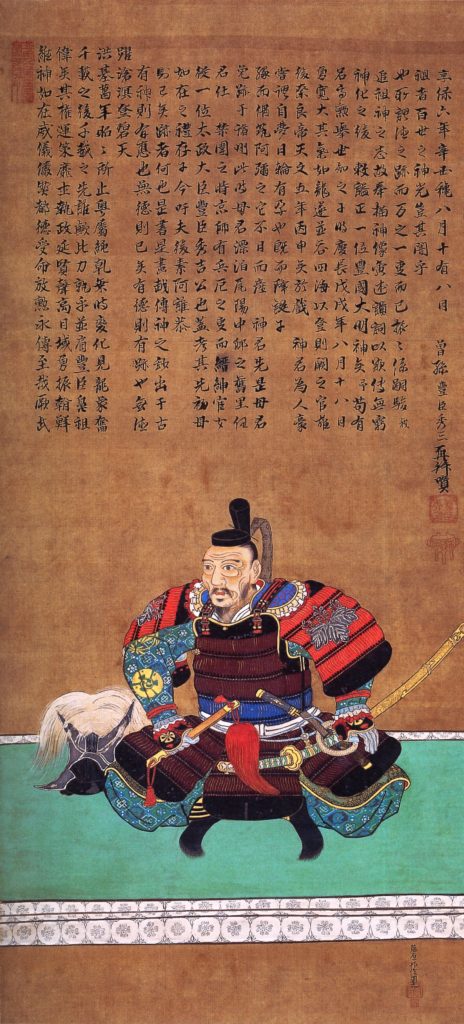
5 February 1597: I do not want this religion …of Love and Union

Toyotomi Hideyoshi

 “I do not want this religion:  a religion of love and union, which is therefore harmful for this kingdom.”   

                                                                        The Taikō Hideyoshi

On February 5, 1597, twenty-six bloodied men and boys were crucified on a mountain overlooking Nagasaki Bay for the crime of being Christian. For twenty-eight days they had been marched through towns and villages and countryside, being spat upon and ridiculed and otherwise abused along the way to their destination, Nagasaki, at the westernmost edge of Japan—for the Christian town of Nagasaki was, in the dictator Hideyoshi’s eyes, the perfect place to make a show of his power.

Hideyoshi had proscribed the Faith a decade earlier, perhaps in the merest fit of pique—fueled by drunkenness—and had ordered all clergy, or bateren, out of Japan. Unwilling to abandon their flocks, however, most of the clergy in the country had stayed on at the risk of their lives and gone incognito, abandoning the Jesuit habit to wear the ordinary Japanese clothing of the day.

They knew the ruler well—Toyotomi Hideyoshi, the Taikō, the Retired Imperial Regent—and they knew that he needed the good offices of the Jesuit clergy in Japan to smooth his acquisition of Chinese silk and European guns from the Portuguese traders who brought those goods to Nagasaki from Canton and beyond. Treading on this uncertain ground, the incognito Jesuits went on pastoring their flocks discreetly, striving to save their parishioners’ immortal souls while keeping their own heads down and making no blatant displays of their presence that might light the fuse of Hideyoshi’s volatile temper.

The fateful spark, however, was bound to come sooner or later. It came on October 19, 1596, when the San Felipe—a Mexico-bound Spanish galleon laden with rich Chinese silks—limped into the Japanese port of Urado after having been blown off course by a typhoon. The local daimyō (feudal lord), feigning helpfulness, had the ship towed into his harbor and right onto a sand-bar, which broke the ship’s back and converted her into a shipwreck. Now, by Japanese law, her cargo was forfeit, or so the daimyō told the Spaniards, and he quickly sent word to Hideyoshi, from whom he could expect a rich reward in the divvying-up of the spoils.

 The Spanish captain dispatched an embassy of two Franciscan friars and two of his crewmen to Ōsaka, the Taikō‘s capital, to save his cargo, but such an embassy could be embarrassing for Hideyoshi: he had already claimed the cargo for himself. He therefore engineered an interrogation of the ship’s pilot at the hands of a clever underling: Hideyoshi’s man construed a “confession” that the friars were the vanguards of Spanish conquest; this gave Hideyoshi an excuse to explode with rage and in his fury order the round-up and crucifixion of all Franciscans in his captive realm. In the event, his zealous men netted six Franciscans, three Jesuits and fifteen Catholic laymen. (Two more martyrs would be added to their number later on.) Hideyoshi ordered their ears and noses cut off; next they were to be paraded around the cities of Kyōto, Ōsaka and Sakai in carts, and thereafter marched eight hundred kilometers to Nagasaki, there to be crucified. A sympathetic official in Kyōto intervened: only their left earlobes were cut off, but the rest of the sentence would be carried out in full.

The Twenty-Six Martyrs had started their death-march on the tenth of January, 1597. The youngest of the martyrs was twelve, the oldest sixty-four. Twelve-year-old Louis Ibaraki laughed when they clipped his ear, and thereafter he marched along jauntily toward Nagasaki. On their wintry road to Calvary, Thomas Kozaki, fourteen, wrote to his mother, “You should not worry about me and my father Michael”—his father was marching with him to be crucified—“I hope to see you both very soon, there in Paradise,” he explained.1

At one point in their trek, the guards grabbed Peter Sukejiro, a young believer accompanying the martyrs, robbed him of everything he had with him and threw him in with them, thus sentencing him to death on their own authority. Rather than protest, Peter merely remarked, “Seeing that we all have to die anyway, it’s better to die for the Faith,” 2 thus proving his own fitness for martyrdom.

 The martyrs’ last night on earth was miserable: it was a bitterly frosty night and they must have prayed and shivered all night long, since they were hunched together in open boats offshore of Togitsu, a Christian village north of Nagasaki, with musket-men guarding the shoreline. Hideyoshi’s sheriff, afraid of Christian violence, would not take the risk of putting them under a Christian roof for the night, as if he had something to fear from that “religion of love and union” that Hideyoshi had proscribed.

On the Fifth of February the martyrs were marshaled to their feet at dawn and marched double-time toward Nishi-zaka, the mountain slope atop which they would die; it would be a twelve-kilometer marathon. The local Christians lined the roadside in silent reverence watching them pass, breathing not a whisper of hostility. From time to time Jesuit Brother Paul Miki exclaimed, “Today is Easter Sunday for me! The Lord has shown me such mercy!” as he climbed toward his Calvary.3 The martyrs arrived there at half-past nine in the morning: just about the time Our Lord was crucified.

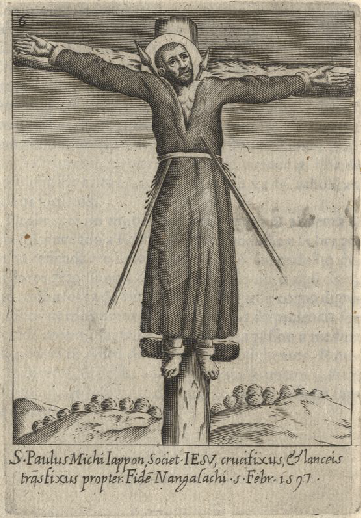
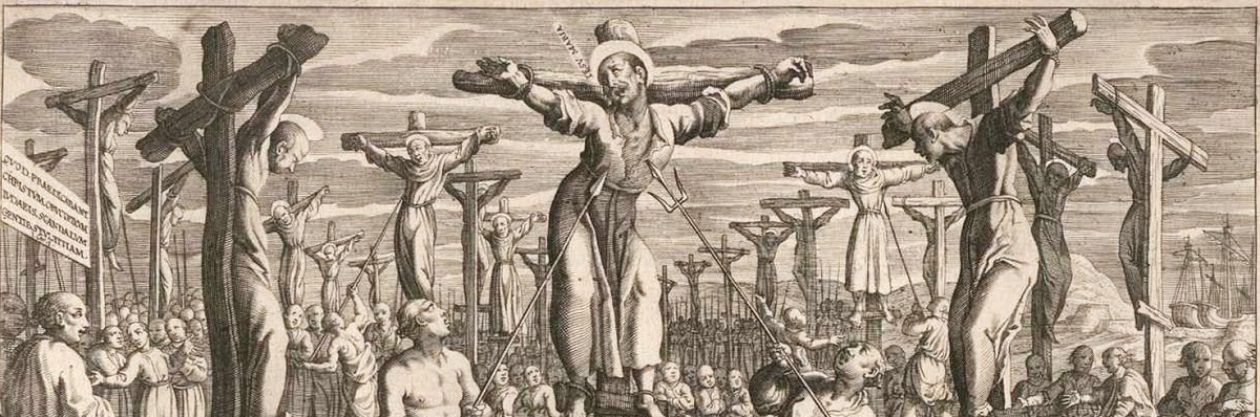
   Up on their crosses the Twenty-Six awaited the coup de graçe that would end their Japanese-style crucifixions: twin spear-thrusts from below, into their left and right sides and upward through their hearts and out their shoulders. The false charges laid against them were painted on a placard stood in front of the row of crosses for all to see, but all of Nagasaki knew that they had been condemned merely for the crime of being Christian. Paul Miki spent his last minutes preaching, just as he had been doing all the length of their grueling march to Nishi-zaka, proclaiming to the thousands of Nagasaki Christians blanketing the hillside below, “I greatly rejoice to die for this cause!”

St. Paul Miki crucified
by Antonio Cardim, Elogios, 1650

When the soldiers unsheathed their spears, the crucified martyrs and the crowd all started shouting in one voice, “Jesus!  Mary!” This holy cry resounded again and again until every last martyr’s heart was pierced; it resounded among the hills of Nagasaki, across the waters of the bay, and through the rigging of the ships from halfway round the world that lay in Nagasaki Bay tethered to their moorings, their crewmen watching transfixed by the spectacle above, as if it were they themselves and their holy Faith whose hearts were being pierced.

Twelve-year-old Louis Ibaraki had long been prepared for this moment. At the start of their journey, the martyrs had been paraded in oxcarts around Hideyoshi’s capital of Ōsaka and around nearby Sakai, the mercantile center of Japan; standing in one of those oxcarts the three youngest boys had brightly sung the Our Father and the Hail Mary as their just-clipped ears poured blood. Now, raised on their crosses, the three sang a Psalm—Praise the Lord, O ye children, praise ye His Holy Name. Louis alone among the Twenty-Six was there entirely by personal choice, for he had been offered his life by Hanzaburō, the sheriff in charge of the execution, on condition that he give up the Faith.

Louis didn’t hesitate; his answer was swift and clear: “I do not want to live on that condition, for it is not reasonable to exchange a life that has no end for one that soon finishes.” 4 — a holy precocity reminiscent of Our Lord at age twelve in the Temple, “Sitting in the midst of the teachers, listening to them and asking them questions, and all who heard him were astounded at His understanding and His answers.” 5

In that same spirit, on the Fifth of February in the Year of Our Lord 1597, atop that slope called Nishi-zaka that overlooked wholly-Catholic Nagasaki and its perfect harbor, the boy-Saint Louis Ibaraki shouted words that would carry his blessing to the ears and hearts of all the listening world, before the soldiers gouged their spears into his sides and up through his twelve-year-old heart:  “Paradise!  Paradise!” he shouted, struggling toward Heaven, “Jesus!  Mary!”

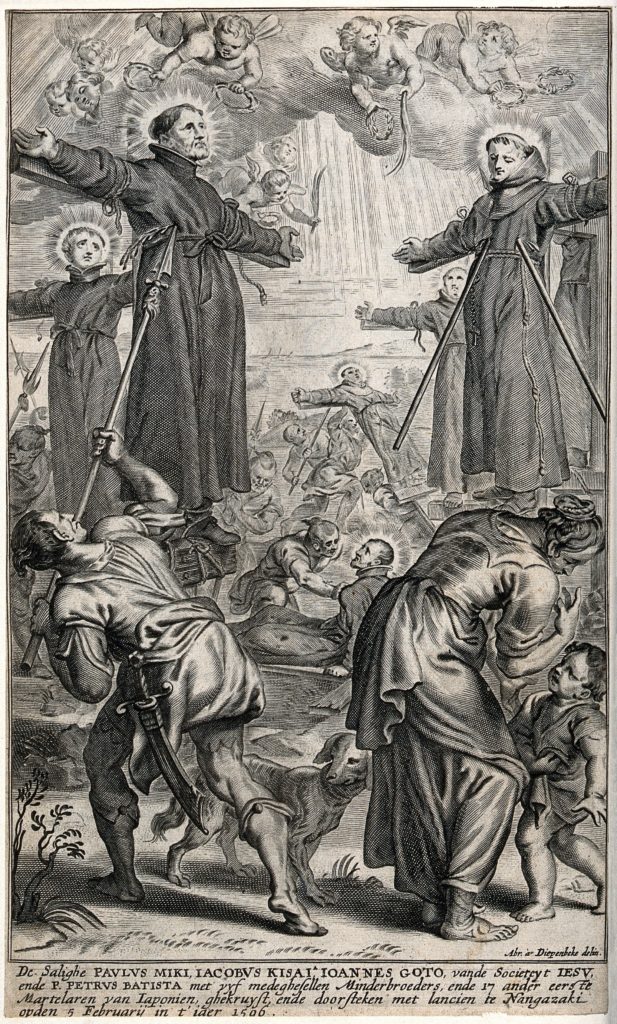
 Martyrdom of Paul Miki S.J., Jacob Kisai S.J., John Goto S.J. and

P. Petrus Battista. Engraving, 1667, after A. van Diepenbeeck.

Source: Wellcome Collection, London


_______

1 Diego Yuuki, S.J., The Twenty-Six Martyrs of Nagasaki  (Tokyo, Enderle, 1998), 55.

2 Yuuki, 56.

3 Yuuki, 70.

4 Yuuki, 60.

5 Luke 2:46b-47 (New American Bible, Revised Edition)