Category Archives: Martyrs

An April Holocaust

        In the Japanese village of Minami Arima, every spring at cherry-blossom time, two mortal foes march their little armies up the castle road. One is a leathery old samurai in battle armor and the other a pony-tailed teenager in a flowery red cape with his face painted up like a geisha’s. The man is the shogun’s general; the boy is the rebels’ leader, Amakusa Shiro. At road’s end, atop the mountain, their armies will have mock combat, eliciting laughs from the crowd as cherry-blossom petals flutter to earth among them.

Statue of Amakusa Shiro on the grounds of the citadel. Photo by Luke O’Hara

    Beyond the cherry trees, overlooking the sea, stands a very different Amakusa Shiro: a stout young man in prayer with two swords in his belt. This statue is truer to history, more like the fifteen-year-old samurai who stood here awaiting the holocaust in that horrific cherry-blossom spring of 1638. Here thirty-seven thousand Christian souls would offer up their starving flesh, writing their testament in blood into this sacred soil. Here stood Hara Castle, the grave of the Shimabara Rebellion, the dying gasp of old Catholic Japan.

In the reign of the Catholic daimyo Arima Harunobu, the Shimabara Peninsula had been the Christian bulwark of Japan. This land, then called Arima, had boasted seventy Catholic churches in her prime, and the nearby Amakusa Islands had been staunchly Catholic too. In 1612, however, the Tokugawa shoguns’ vise began to close. Arima Harunobu was executed that year, and by Amakusa Shiro’s day, all faithful Catholics faced death by torture. 

The current shogun, Tokugawa Iemitsu, demanded Christ’s extinction.  Iemitsu was a sadist, a pederast, a drunkard, a tyrant and a paranoiac, and he feared Christ as a demon would.

      Under Iemitsu’s aegis, the lords of Shimabara and Amakusa were not only suppressing the Faith; they were also practicing tax-extortion. Despite a three years’ drought having starved the land, these two profligates demanded exorbitant tax payments from their captive subjects, or else. Some defaulters were tied up in coats made of straw and their coats set alight. One sheriff seized a farmer’s wife—nine months pregnant—stripped her, and put her into a cage in an icy stream to make her husband pay up. She and her baby died in the cage.

            Then there was the torture of another tax-defaulter’s only daughter, a beautiful virgin. The sheriff stripped her naked and burnt her artfully with torches; enraged, her father killed him. Perhaps this was the spark for the Shimabara Peninsula’s explosion into rebellion. Thousands attacked their cruel master’s fortress in the town of Shimabara, brandishing a banner that proclaimed: We were timely born to die for the Faith.

            It did seem like the end of time: there were burning, vermilion skies, and flowers were blooming out of season. And down in Amakusa there was a teenage prodigy. Fifteen-year-old Shiro was the son of an old Catholic samurai named Masuda Jinbei. Jinbei and his cronies concocted a phony prophecy by a mythical missionary of old that “foretold” Shiro’s coming to liberate the downtrodden Christians; then, in a public ceremony, they acclaimed the boy as their prophesied redeemer.

      Thus was the rebellion seeded. After the explosion in Shimabara, closet-Christians in nearby Amakusa flocked to Amakusa Shiro’s flag to wage war on their despotic feudal lord’s minions, the armed thugs who policed their religion and robbed them blind. The boy-general’s army of reborn Catholics swelled with ever more recruits as it swept from east to west across Amakusa’s three main islands, driving its oppressors before it. These fled to their commander’s mountaintop fortress at Tomioka, an islet dangling from the archipelago’s northwestern corner, scrambling for refuge.

     Meanwhile, entire villages throughout the Shimabara Peninsula were vowing in writing to obey Shiro to the death. After three unsuccessful assaults on the fortress at Tomioka, Shiro decided not to squander his forces but instead took his army across the Hayasaki Strait to Shimabara. There they would join their brethren in arms, and all would barricade themselves, along with all their households, inside the disused fortress called Hara-no-jo, or Hara Castle, in the south of the peninsula.

         On Christmas Day of 1637, Shogun Iemitsu learned of the rebellion and commissioned Itakura Shigemasa, an aristocrat with little experience of war, to muster troops under the shogunal seal, march them to distant Shimabara and there wipe out the despised Catholics. Itakura’s army—thrown together with units from various feudal clans—didn’t wait for his orders but attacked as soon as they had arrived at Hara Castle, expecting an easy victory; the Christian marksmen atop the castle walls mauled them. Enlightened, the invaders withdrew to lick their wounds and prepare themselves for real warfare.

          Reinforcements came, but the rebels repulsed Itakura’s second, bigger assault. Now he had to save his honor: he ordered an all-out attack on Japanese New Year’s Day (Feb. 14, 1638). Many contingents fought bravely, but the determined rebels exhausted them, and when Itakura tried to rally his army for a last, grand effort, all the mustered units refused to budge. Now Itakura had to save face: grimly leading only his own little band of vassals, he charged the fortress. A hail of bullets killed the men on his left and right, but he made it to the wall and died trying to scale it alone, shot through the chest.

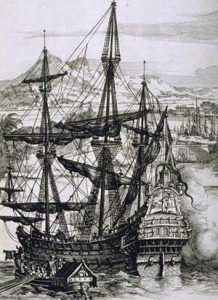
             Next a new, veteran general—Matsudaira Nobutsuna—arrived with orders from the shogun to stand clear and starve the Christians out. He surrounded the fortress with over 125,000 men and backed them up with cannon-fire from both the government camp and a 20-gun Dutch merchantman anchored offshore.

          That winter was severe, and inside Hara Castle the cold and hunger did its work: what had been a triumphal juggernaut transformed into a purgatory. By March the rebels had run out of rice and some were eating the empty sacks; they were also short of drinking-water, firewood, and gunpowder. The Shogun’s vise was pinching their Christian kingdom and their very bellies while cannonballs came screaming in to crunch flesh and bone. One went through Shiro’s sleeve and killed four or five of his companions.

         Matsudaira masterfully played his hand once he had tightened the vise. He tempted the Christians with promises: rice and homes and land and tax-relief, if only they would leave their fortress and abandon the Faith. These tempting lies dropped out of the sky, delivered as letters wrapped around arrows shot over the castle walls. Some nonbelievers, dragged into the rebellion against their will, did defect, but the Catholic stalwarts shot testimonies back to the besiegers: they wanted only to worship Christ; that denied them, they would just have to die, they declared. Letting them live as Christians, of course, was not an option, for the wretched shogun, trapped in his private darkness, viewed the Faith with terror.

            By spring the rebels were desperate. In a sudden night-sortie in early April they tried to rob food and ammo from the government camp, but were repulsed with heavy losses: the Christians had made the mistake of setting fire to enemy tents and thus illuminated themselves, perfect targets for massed musketry. After the raiders’ retreat into the fortress, the government troops cut open the stomachs of rebel dead and found they had been eating only leaves.

             The shogun’s hour had finally arrived. On the Eleventh of April 1638, his horde swarmed over the outermost wall of Hara Castle, having first sent down a rain of fire-arrows. The wasted defenders fought with anything at hand—empty guns, cooking-pots—while their Christian kingdom burned all around them. The innermost wall, the wall of the citadel at the mountaintop, was stormed on the morning of the Twelfth, and the fighting ended at noon, when the last rebel combatant was dead. Those taken prisoner—the elderly, the ill, mothers and their children—they beheaded, without exception. “Even the little girls,” one observer lamented.

           The shogun’s army ringed the burnt-out Hara Castle with 10,860 impaled Christian heads; they sent 3,300 more to Nagasaki as a lesson to that town’s underground Catholics. As a warning to the Portuguese there—who had brought the Catholic Faith to Japan—they stuck four heads, including Shiro’s, onto stakes at the foot of the bridge to the man-made island where the Portuguese were now confined. Soon the Portuguese would be banned from Japan entirely, and all Japanese required to appear before a magistrate annually and tread on a Christian sacred image to prove their loyalty to the shogun.

          In the wake of the rebellion, barely a soul remained in the south of the Shimabara Peninsula: all but the rare deserter had died at the hands of the shogun’s army. In order to have the land tilled, therefore, the shogunate repopulated the peninsula by forcibly removing peasants from the islands of Shikoku and Honshu and installing them willy-nilly in the ghost towns of Shimabara.

            In Japan’s Catholic heyday, at least seventy churches dotted the Shimabara Peninsula; today there are only three—a sad testament to the successful expunging of the Faith from a fervently-Catholic land. Sadder still, the slaughter of those 37,000 who believed themselves ‘timely born to die for the Faith’ goes unnoticed by the Church at large, for they died as rebels fighting against—not praying for—their persecutors.

Yet this view ignores the countless martyred children: martyrs because they, unlike so many of the adults, had not chosen to rebel, but had been scooped up by their parents and rushed to Minami Arima and through the gates of Hara Castle, there to await the holocaust through months of bitter cold, terror, and starvation. These little ones the shogun’s horde executed solely for the crime of being Christian. Even the little girls.

         In this strange April of our own affliction, let us remember the souls of Hara Castle’s little martyrs.


***

Luke O’Hara became a Roman Catholic in Japan. His articles and books about Japan’s martyrs can be found at his website, kirishtan.com.



28 February 1627: the First Martyrdom at Unzen Hell

Paulo Uchibori and Sons, Martyrs of Arima

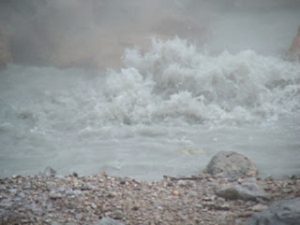
A glowering, scar-faced volcano named Mount Unzen looms over the Shimabara Peninsula in southwestern Japan. Atop it, bubbling, sulfurous hot springs vomit out white crud and belch acrid steam: they call this place “Unzen Hell.” From 1627 onward, the local ruler found the biggest of its caustic, skin-eating pools perfect for torturing Christians. 

In the hands of the Catholic ruler Arima Harunobu, this peninsula, known as Arima, had once been the Christian bulwark of Japan. In 1612, though, the de-facto shogun Tokugawa Ieyasu condemned Harunobu to death and entrusted Arima to Harunobu’s spineless heir Naozumi. Naozumi then renounced Christ, joined Ieyasu’s own Buddhist sect, and vowed to stamp out the Faith in Arima, his family’s ancestral domain. 

As if to seal his apostasy, Naozumi burnt three staunchly-Catholic samurai along with their wives and children on the Feast of Our Lady of the Rosary of 1613. Arima’s faithful Catholics flocked to this martyrdom in their thousands, wearing rosaries around their necks and singing hymns to the martyrs while Naozumi cowered in his hilltop fortress overlooking the scene. He soon requested transfer to another fief; rather than accompany their apostate lord to his new home, most of Arima’s Catholic samurai renounced their livelihoods and stayed behind in Arima. Prominent among these stalwarts was Paulo Uchibori, a samurai born in Arieh, a coastal village not far from the Arimas’ home castle. 

The shogun’s vise tightened on Arima in 1614: Hasegawa Sahioye, Governor of Nagasaki, invaded her with an army of ten thousand men to wage a gruesome campaign of anti-Christian terror, and he threw Paulo Uchibori into prison. Hasegawa was soon recalled to the capital, but he left behind two hills of Christian flesh, one of chopped-up bodies and the other of heads, in a field below Naozumi’s abandoned hilltop castle in the south of Arima.

This was the spiritual landscape handed over to Matsukura Shigemasa, an old ally of Ieyasu’s, in 1616. At first, Shigemasa turned a blind eye to Arima’s Christians, and since he respected Paulo Uchibori’s samurai grit, he let him out of prison; but in 1626, Shigemasa went up to the capital to pay homage to Ieyasu’s grandson, the Christ-hating Shogun Iemitsu, third of the Tokugawa shoguns. According to the late Jesuit historian Father Diego Yuuki, Iemitsu could think of nothing but the crackdown on Christianity as if he were possessed. (A hypothesis bolstered by this shogun’s appetites for pederasty, for cutting down random strangers with his sword, and for gleefully watching the torture of Christians.)  

Matsukura Shigemasa drank deep of the poison in the wretched Iemitsu’s soul during his stay at the shogun’s capital: he went back to Arima a changed man, determined to purge Christ from his domain, and he had sent down orders to arrest Paulo Uchibori and his family. When Shigemasa got back home, he found thirty-seven Christians in his dungeon. On 21 February 1627, Shigemasa decreed this doom for sixteen of them: cut their fingers off, hang stones around their necks, and drown them in the sea. Paulo’s three sons were among the sixteen. 

Paulo himself and nineteen others were stripped naked and forced to watch the tortures and executions. First, the executioners lined the condemned Christians up along the bank of the moat around Matsukura’s fortress, calling each one forward and cutting that victim’s fingers off one by one: some all ten, some fewer, at the torturer’s whim. Paulo’s eighteen-year-old son Antonio they called first: he bravely strode up and spread his hands out on the cutting-board, evincing not the slightest wince as they sliced his fingers off.

Paulo’s youngest, five-year-old Ignacio, manifested a miracle when they cut his tender little index-fingers off: after each slash, he brought the mutilated hand to his face and smiled, watching the blood jet out. The astonished pagans drew away in fear: like the Gerasenes, terrified by Christ’s power over evil.

After mutilating these heroes, Matsukura’s men stripped them, tied ropes around their necks and ankles, and took them out in a boat for the final torture: hanging stones around their necks, they plunged each into the icy sea, pulling him out and demanding that he renounce Christ to save his life, and dropped him in again, pulling him out to give him another “chance,” and in, and out, over and over. None of them apostatized; every one drowned a Christian.

Looking on from a nearby boat were the twenty other Christians forced to watch the tortures and drownings, with Paulo among them. He heard his heroic son Antonio gasp, “Father, let us thank God for such a big blessing” before they drowned him, and he watched them suspend little Ignacio above the waves before his eyes for a small eternity before they finally sunk the mutilated five-year-old to the bottom of the sea.

The twenty witnesses they then took back to their stripped-off clothes; warning-signs had been sewn on them, threatening with grave punishment anyone who would dare give these Christians any shelter. Next, they cut the three middle fingers off each of their hands, branded the word CHRISTIAN on their foreheads and set them loose to fend for themselves: stark, horrific examples of the shogun’s certain wrath to would-be believers; but rather than succumb to their misery, these stalwart Catholics went around preaching Christ fearlessly, urging apostates to return to the Faith. This was not the lesson that Matsukura had intended for the souls of Arima, so the twenty were eventually ordered back to his castle.

At dawn on February 28, 1627, Paulo and fifteen others were taken out of Matsukura’s dungeon to start their climb up Mount Unzen. Along the way they sang hymns and recited the Creed, and when their guards stopped to rest, they knelt, made an Act of Contrition, and prayed a Rosary. Finally, singing another hymn, they arrived at the “Hell” where they were to die; there the guards tied ropes around their necks for dunking them, as if they were not human beings but the merest meat for boiling.

The first to die jumped into the boiling sulfur-water on the executioners’ command; Paulo admonished the others to wait for Matsukura’s men to do the killing: faithful Catholics must not kill themselves. He kept on encouraging and guiding his fellow-Catholics through their martyrdoms, guiding them Heavenward, which infuriated Matsukura’s executioners; so they saved Paulo for the last, cruelest execution: they hung him upside-down by his feet and dunked him head-first, yanking him out  to see the result. He sang out, “Praised be the Most Blessed Sacrament!”

They dunked him again, maybe expecting better results this time, and pulled him out a second time. Again he prayed, “Praised be the Most Blessed Sacrament!” No whining, no squirming, no surrender to the shogun: only praise for the Conqueror of Death, until they plunged him in a third time, for good.

This was the stuff of which Saint Francis Xavier had exulted on his first arriving in Japan on the Feast of the Assumption of 1549: here was the good earth that bore fruit a hundredfold. 

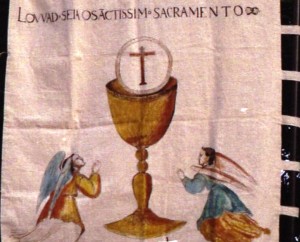
Eleven years later, Paulo’s prayer would crown the flag of rebellion that would fly over Hara Castle, where 37,000 Catholics would shed their blood for Christ. (It had long been the flag of the Confraternity of the Blessed Sacrament.) Those words of  praise, joy and victory would soar over the Shimabara martyrs’ final battleground while the Shogun’s horde stamped out his fury—words that cannot be erased or silenced, singing through Japan’s buried centuries of darkness; words flying high and ringing still: Praised be the Most Blessed Sacrament.

We dare not shut our eyes, nor stop our ears.

A reproduction of the Kirish’tan rebels’ battle-flag, flying at a memorial Mass on the sacred earth where Hara Castle stood.

 -End-

Photos Copyright 2007 by Luke O’Hara


**************************************

The Twenty-Six Martyrs, San Felipe, and the Tyrant

On a brisk February morning in the Year of Our Lord 1597, 26 haggard men and boys were marched up a steep slope called Nishi-zaka toward a terrace of land that overlooked Nagasaki Bay. There they would find a row of crosses laid out on the ground awaiting them.

The scene might have looked restful to the condemned men and boys as they surveyed those crosses, for this was the end of a 28-days’ winter marathon. With their left ears mutilated and their hands trussed up tight behind their backs, they had been herded like cattle half the length of Japan to spend their last night on earth shivering in bitter cold, huddled in open boats moored offshore of Togitsu, a fishing village north of Nagasaki. Now, as they stood atop Nishi-zaka, gasping perhaps for breath, there was just one question, voiced by the youngest first:

“Which cross is mine?”

Louis Ibaraki, twelve years old, ran to the cross pointed out to him and fell to earth to hug it: here was the vessel that would carry him heavenward to meet his Lord.

It had all started when a Mexico-bound Manila galleon named San Felipe limped into Urado Bay, battered and blown off course by a typhoon. San Felipe was laden with Chinese silks and other luxuries, her cargo worth a fortune, and the ruler of Japan, Toyotomi Hideyoshi, was sore in need of funds to finance his war in Korea.

Spanish galleon – Public Domain (PD-US)

As Urado Bay was blocked by underwater sand bars, the ship’s pilot wanted to take her westward to Nagasaki, but the daimyo of Urado convinced the wearied passengers that he could safely tug her into port, and their demands won the day. Reluctantly the pilot watched as the daimyo’s men tugged his heavy-laden ship over two sand bars; the first merely scraped San Felipe’s keel, but the second broke her back. Seawater flooded into the cloven ship as crateful after crateful of her precious cargo poured out onto the bay, and now San Felipe was a shipwreck, her cargo forfeit by Japanese law.

Gleefully the daimyo reported his jackpot to Hideyoshi, who immediately arranged for the cargo’s transfer to his storehouses; the daimyo he rewarded with 5,000 silver bars.

Toyotomi Hideyoshi (PD-US)

The exasperated captain dispatched an embassy of two Franciscan friars and two of his crewmen to Hideyoshi’s capital to save his cargo, but such an embassy could be embarrassing for the tyrant: he had already claimed the cargo for himself. He therefore engineered an interrogation of the ship’s pilot at the hands of a clever underling: Hideyoshi’s man construed a “confession” that the friars were the vanguards of Spanish conquest; this gave the ruler an excuse to explode with rage and in his fury order the round-up and crucifixion of all Franciscans in his captive realm. In the event, his zealous men netted six Franciscans, three Jesuits and fifteen Catholic laymen. (Two more martyrs would be added to their number later on.) 

Hideyoshi ordered their ears and noses cut off; next they were to be paraded around the cities of Kyoto, Osaka and Sakai in carts, and thereafter marched eight hundred kilometers to Nagasaki, there to be crucified. A sympathetic official in Kyoto intervened: only their left earlobes were cut off, but the rest of the sentence would be carried out in full.

The Martyrs started their death-march on January 10, 1597. The youngest three were twelve, thirteen and fourteen, and the oldest sixty-four. Twelve-year-old Louis Ibaraki laughed when they clipped his ear and thereafter marched along jauntily toward Nagasaki. On their wintry road to Calvary Thomas Kozaki, fourteen, wrote to his mother, “You should not worry about me and my father Michael”—his father was marching with him to be crucified—“I hope to see you both very soon, there in Paradise.”

On February 5, 1597, after that bitterly-frosty night at Togitsu, the martyrs were marshaled to their feet at dawn and marched double-time toward Nishi-zaka—a twelve-kilometer marathon—as the local Christians lined the roadside in silent reverence. Br. Paul Miki preached all along the way, just as he had been doing all the length of their march: he was said to be the greatest preacher in Japan.

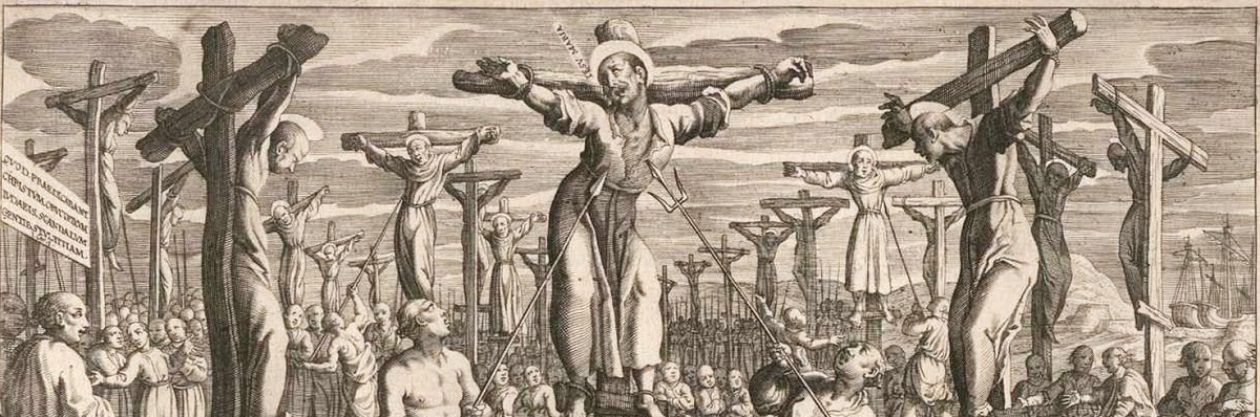
Up on their crosses the Twenty-Six awaited the coup de graçe that would end their Japanese-style crucifixions: twin spear-thrusts from below, into their left and right flanks and upward through their hearts and out their shoulders. 

At the start of their journey, while being paraded in oxcarts around the capital, the three youngest boys had brightly sung the Our Father and the Hail Mary as their just-clipped ears poured blood; now, raised on their crosses, the three sang a Psalm—Praise the Lord, O ye children, praise ye His Holy Name. 

When the soldiers unsheathed their spears, the crucified martyrs and the crowd blanketing the mountainside all started shouting in unison, “Jesus!  Mary!” This holy cry resounded again and again until every last martyr’s heart was pierced—resounding among the hills of Nagasaki and across the bay, where ships from halfway round the world lay tethered to their moorings, their crewmen watching transfixed by the spectacle above as if it was their holy Faith whose heart was being pierced.

Saint Paul Miki crucified (PD-US)

Cheerful despite his mutilated ear, the wintry marathon, that final night of misery, and even his sentence of death, twelve-year-old Louis Ibaraki had long been prepared for this moment. He alone among the Twenty-Six was there entirely by personal choice, for Terazawa Hanzaburo, the sheriff in charge of the execution, had tried to save the boy’s life, offering to make him his page. Louis asked if he could then go on being a Christian, and on hearing “No,” his answer was swift and clear: he chose eternal life over a merely-mortal one.

A faith implicit in his immortal words, prayed before the soldiers gouged their spears into his sides and up through his twelve-year-old heart: “Paradise!  Paradise!” he shouted, struggling toward Heaven, “Jesus!  Mary!”

***

Luke O’Hara became a Roman Catholic in Japan. His articles and books about Japan’s martyrs can be found at his website, kirishtan.com.


December 28th: In Honor of the Holy Innocents

Slaughtering the Healers

Massacre of the Innocents by Peter Paul Rubens. Public Domain (PD-US)


“It is the little ones who heal us,” said Father Leonard, completely out of the blue.  I had been confessing some now-forgotten sin  when out came this treasure from the store-room of his heart.

It came to me some days later that the face of God must have something in it of the face of a child.  This would explain why Jesus said, “In heaven their angels always behold the face of my Father who is in heaven.” (Matt. 18:10)  That is, the faces of the angels’ appointed little ones, untainted as yet by actual sin, are so many little faces of God, so much like the face of the Infant Jesus.

When the Pharisees asked the adult Jesus why He hung around with the likes of us, He answered, “Those who are well have no need of a physician, but those who are sick.” (Luke 5:31)  Our spiritual forefathers understood the preciousness of each human life, and thus the infinite value of healing.  How appalled they would have been to breathe the putrid ambience of our brave new world where slithery phrases like ‘freedom of choice’ and ‘women’s reproductive rights’ mean the wholesale murdering of babies in their mothers’ wombs, and—horror unspeakable—the slaughtering of babies while they are being born, and even after having emerged alive into our world:  murdered by the very ‘physicians’ who should be delivering those newborn healers into their mothers’ loving arms.  How infuriated our forebears would have been by the hissing sound of those three slithery words—‘Freedom of Choice’—that deny both freedom and choice to the little boys and girls being butchered by so-called physicians.  And how it must wrench the guardian angels to see their own tiny, Godlike charges torn out of the womb with steel pincers piece by piece, limb by limb, tiny hands and feet and torso, and, most wrenching of all, the tiny bleeding head with its tortured face of God frozen in eternal agony.  How bitterly the guardians must weep to see us slaughter their helpless little ones, those tiny healers, as if infanticide really were the merest expression of ‘women’s reproductive rights’ or, God save us, ‘women’s health.’

If only we could hear the angels gasp, or feel the rain of tears they shower over every butchered child; but perhaps we are too far gone, too ‘experienced,’ too hardened of heart:  perhaps our calluses are long since grown too thick for us to hear or feel such holy pain.  We are so desperately in need of love, of innocence, of healing.

How very sick indeed our world will be when we have finally slaughtered all the little ones.

Luke O’Hara

Kirishtan.com

27 December 1613: Orders Arrive to Register all Christians

27 December 1613: Orders Arrive to Register all Christians

Tokugawa Ieyasu, “Retired” Shogun and de-facto ruler of Japan
Saint Francis Xavier, Apostle of the Indies


            Two days after Christmas of 1613, Tokugawa Ieyasu’s orders arrived in Kyoto, Fushimi, Osaka and Sakai, the major population centers at the core of Honshu Island: lists were to be made of all Christians (i.e. Catholics), both foreign and Japanese, residing in those cities. This was the prelude to roundup and deportation, the order for which would arrive on 27 January.  
            The news of December 27, 1613 was but the merest subterranean rumble portending the eruption soon to come: an explosion of cold-blooded cruelty that would flood all Japan, leaving no Catholic at peace for the next two and three-quarters centuries.
            Ieyasu had already banned the Faith in all shogunal domains, and his minion Hasegawa Sahioye had by this time piled up hills of Catholic corpses in Arima, long known as a Catholic refuge. This was only the beginning of Arima’s scourging, a trial by fire that would culminate 25 years later in the mass extermination of 37,000 Catholics at Hara-jō, a disused mountaintop fortress on the southeastern coast of the Shimabara Peninsula.   
            Nevertheless, displays of dauntless faith would abound amid the horrors to come: time and again, Japan’s Catholic faithful would prove the verity of Saint Francis Xavier’s words, written in Kagoshima in 1549, when he assessed the nation thus:
    The people whom we have met so far, are the best who have as yet been discovered, and it seems to me that we shall never find among heathens another race to equal the Japanese.[1]
            Perhaps the saint, through some supernatural grace, foresaw the persecutions that so many of Japan’s faithful would endure to the end with superhuman courage. Perhaps, after his untimely death in 1552, he was praying to strengthen each tortured soul as he watched their ordeals from Heaven, doing his utmost to fill the Celestial Court with thousands of unequaled companions—who, having conquered death, can strengthen us who remain here below with their own powerful intercessory prayers.  
Luke O’Hara, Kirishtan.com

[1] Charles Ralph Boxer, The Christian Century in Japan 1549-1650 (Lisbon: Carcanet, 1993) 401.

Yatsushiro Martyrs, 8 and 9 December 1603

‘Crucifixion’ by Marco Palmezzano (1460-1539)
     On 8 December 1603, two Catholic samurai of Yatsushiro were beheaded for refusing to renounce Christ, and the following day all the remaining members of their immediate families were crucified for clinging to their convictions too.  The youngest of these martyrs was seven-year-old Ludovico (his baptismal name).
       On his mother’s instructions, this child-martyr kept repeating the holy names of the Lord and the Blessed Virgin— Iézusu! Maria! —as he hung on his cross awaiting the spear-thrust that would pierce his heart, gouging into him through his right kidney and out through his left shoulder.  His mother was hanging on the cross next to his own.
      The little boy rode to Heaven on eagle’s wings; lifted, that is, by the Almighty Name.  Imagine that family reunion, once all had arrived at their eternal Home.

December 8th, 1941: Birth, Death, Eternity

U.S.S. Shaw exploding at Pearl Harbor on 7 December 1941, Hawaii time
December 8, 1941: a day that has lived in infamy for 78 years.
What? December 8th?
Americans remember Pearl Harbor on the 7th of December, but it was December 8th in Japan when the Japanese Imperial Navy’s dive bombers hit our bases in Hawaii.  December 8th also marks the Feast of the Immaculate Conception of the Blessed Virgin in the Roman Catholic Church.
Mere coincidence, one might imagine, but here’s another “coincidence”:  the Emperor’s surrender proclamation was broadcast to his astonished nation on August 15, 1945.  The 15th of August marks the Feast of the Assumption of the Blessed Virgin, which pegs the end of the earthly life of the Lord’s mother, who was soon to return to earth time and again to dazzle the wondering, upturn’d eyes of mortals in the form of countless apparitions warning mankind to believe in her Son’s reality and the direness of man’s addiction to sin, lest countless souls needlessly consign themselves to eternal fire—the pool of fire that is the second death. (See Revelation 20:14-15)
So the front and back covers of that Book of Death that mankind knows as the Pacific War coincide with the conception of the Blessed Virgin (for conception is the start of full-fledged human life) and her departure from earthly life—which, for those who cling to Christ, is only the beginning of eternal bliss.  But all this must be merest coincidence.
Just like the coincidence of Saint Francis Xavier’s arrival in Japan by dint of an irresistible wind that drove his ship straight to Kagoshima, the home town of his Japanese interpreter, an escapee from Japan who was now a convert to the Faith.  The ship’s captain had been determined to avoid Japan, but that almighty wind had had its way, and now there was nothing to do but land his passengers.
And the date?  By the merest coincidence, the 15th of August 1549, the Feast of the Assumption of the Blessed Virgin:  the birth of Christendom in Japan.
Birth, death, Eternity.
Luke O’Hara, Kirishtan.com

Three Jesuits, Two Eras

Martyrdom of Bl. Leonard Kimura and four other Christians in Nagasaki, November 18, 1619. By an anonymous Japanese artist. Source: Wikimedia Commons


Given the whirlwind of troubles afflicting the Church today—the worship of pagan idols at the Amazon Synod, the ongoing cover-up of clerical sex crimes, the theft of half a billion dollars from Peter’s Pence—some of the faithful might be tempted to throw up their hands, drop all pretense of being truly Catholic, and join the gulled masses on their merry ride to hell. Thank God we have the witness of the martyrs.

In the final week of November 2019, Pope Francis was treading soil baptized with Catholic blood in one of history’s cruelest persecutions. While visiting Tokyo, Hiroshima, and especially Nagasaki, our first Jesuit pope likely recalled Saint Francis Xavier, whose pioneering mission brought Christ to Japan on the Feast of the Assumption in 1549. Hopefully, the modern Francis also contemplated the agonies and privations that his forebears lived and breathed in the centuries of that great darkness.

When that first Jesuit mission reached Japan, St. Francis Xavier and his two Jesuit companions found the country in a state of civil war. It was thus providential that they landed in Kagoshima, whose powerful lord gave them safe haven where they could learn about the Japanese and plant the Gospel seeds that would root in countless Japanese hearts. St. Francis Xavier reported:[1]

          The people whom we have met so far, are the best who have as yet been discovered, and it seems to me that we shall never find among heathens another race to equal the Japanese. … They are a people of very good will, very sociable, and very desirous of knowledge; they are very fond of hearing about things of God.

After trekking much of Japan, the saint departed in November 1551, leaving his two Jesuit companions behind to carry on the superhuman task ahead. He would fall ill on November 20, 1552 and die twelve days later on an island south of China, carrying to Heaven his unfulfilled dream of getting into that closed country, converting its emperor, and returning to Japan to do the same.  

Yet the seeds he had planted did thrive, so much so that the warlord Toyotomi Hideyoshi, whose power grew to compass all Japan, became jealous of the priests of that religion that had stolen the hearts of tens of thousands of his people. In 1587, Hideyoshi banned the Faith; a decade later, to drive in his point, he crucified 26 Catholic men and boys on a slope called Nishi-zaka overlooking Nagasaki Bay. His death in 1598 gave the Church a needed respite.

And yet short-lived. In 1614 a new persecution shook Japan. The Tokugawa shoguns who succeeded Hideyoshi made the very life and breath of every human being in Japan contingent on his willingness to spurn the Catholic Faith and betray all known believers to the murderous regime. 

But some preferred a holy death in public view to hell and dishonor. One such fearless believer was yet another Jesuit, a humble lay brother named Leonardo Kimura.

In November of 1619, Brother Leonardo was confined in Nagasaki’s jail, where he had spent three grueling years. Japanese prisons of this period were deathly hellholes,[2] their prisoners crammed like sardines into dark, dank, unvented wooden cages whose dirt floors bred vermin while the air stunk beyond description. Disease and infestation were rampant, and many died, their bodies sometimes left in place for days on end until official permission could be gotten by the guards to remove them.

However, neither dankness nor lice nor stench nor filth nor inhuman cramping nor lethal illness was sufficient to deter Brother Kimura from saving souls. Within the confines of his pestilential earthly hell, he lived a holy life along with three fellow-prisoners in his spiritual charge. Their regimen is documented in François Solier’s Histoire:[3]

They started every day with an hour of silent prayer; next they prayed the Litany of the Saints aloud followed by other prayers, a second hour. They did spiritual reading until mealtime, after which each applied himself to some edifying activity. Evenings, another hour of prayer. All fasted at least three days a week, during which they also scourged themselves. They prayed five hours on Fridays in honor of the Five Wounds of Christ. Every month they did the Forty Hours devotion to bring Heaven’s help to the persecuted Christians and the preachers of the Gospel.

Eventually the warden, seeing that this Jesuit had turned his jail into a house of prayer, moved him to a separate cell whose ceiling was so low that he couldn’t raise his head while squatting on the floor; still he evangelized. By the time they led Leonardo out of prison to meet his death, he had 86 baptisms under his belt, numbering both prisoners and guards.

Yet, in dying, he proclaimed Christ more boldly than ever. While being marched toward a death-cage at the edge of Nagasaki Bay along with four other faithful believers, this indomitable Jesuit proclaimed the Gospel at the top of his lungs to the thousands lining the roadside, watching from boats offshore, and blanketing the mountainside opposite the bay: a message of hope for all the truth-starved ears of benighted Catholic Nagasaki.

But this was only the prologue.

The five were tied to stakes; the wood was lit; a cloud of smoke enveloped the martyrs—and then a marvel. The smoke cleared to reveal Leonardo wrapped in flames, his face exuding joy, waiting for his ropes to burn away. Then, freed of his stake, he bent to earth, took up two burning embers in his hands, and held them aloft “as if they were heavenly jewels,”[4] singing Laudate dominum omnes gentes.

Nagasaki’s thousands, astonished, “made the air ring with the sacred names of Jesus and Mary”[5] while a children’s choir began singing praises from a boat offshore.

The martyrs’ bones and ashes would be chopped to bits, bagged up and sunk into the deep as if to wipe the dazzling truth from history, a futile stab at the invincible. For history cannot forget.

Perhaps, back in Rome, Pope Francis will reflect on that dazzling truth, having looked out on that water from atop Nishi-zaka, better known as Martyrs’ Hill—where so many faithful Jesuits shed their lives.

***

Luke O’Hara became a Roman Catholic in Japan. His articles and books about Japan’s martyrs can be found at his website, kirishtan.com.


[1] Charles Ralph Boxer, The Christian Century in Japan 1549-1650 (Lisbon: Carcanet, 1993) 401.

[2] Boxer, 347-349.

[3] François Solier, Histoire Ecclesiastique des Isles et Royaumes du Japon, Tome 2 (Paris : Sebastien Cramoisy, 1627) 575-576.

[4] Solier, 579.

[5] Jean Crasset, Histoire de l’Église du Japon, Tome Second (Paris : Estienne Michallet, 1689) 325.


Domingo Hoshino, 26 November 1616: Crucify him!

Hiroshima Castle today.   Photo by Hiroaki Kikuchi
Fukushima Masanori


In the Year of Our Lord 1616, a young samurai named Hoshino Kanzō returned to Fukushima Masanori’s castle-town of Hiroshima after some years’ absence to care for his father, who was mortally ill. The young man’s return must have been bittersweet, since his father, egged on by his Jezebel of a stepmother, had thrown him out of his home years earlier over his devotion to Christ. Perhaps his very baptismal name, Domingo, set her teeth on edge.

On his eviction, Domingo Hoshino had made his way to Nagasaki to seek spiritual help from the Portuguese Jesuit priest who had baptized him, Fr. Mattheus de Couros, and afterwards traveled to the island of Shikoku, where he found work as a samurai in the service of a prominent daimyō. When the Tokugawa persecution of 1614 extended its tentacles to Shikoku, however, Domingo was given the choice of abandoning either his faith or his living. Of course, he chose the latter. This made him not only a rōnin—a wandering samurai without a master, and thus perhaps considered a dangerous tramp—but also a Kirish’tan rōnin, perhaps treated as anathema by all and sundry.

        Thus, on his return to Hiroshima, Domingo was longing for rest, for a home, and for a chance to repair the filial ties that his stepmother had sundered by dint of her malign influence over the old man—who now lay on his deathbed, shorn of any strength to resist his wife’s predations. It must have wrung his heart to see his eldest son’s face again after those years of absence. Certainly Domingo’s heart, too, would have stung on seeing his father near death, still neither baptized nor converted. Domingo did the little he could to nurse his father’s body back to health, but all his efforts to save his soul were frantically resisted by his Jezebel stepmother until the old man was dead.

One can imagine the desolation that must have followed fast upon the spent anguish in the heart of the dead man’s returned discarded son. His father’s apparently unrepentant death was not the final blow, however: as if not yet having injected enough venom into her despised stepson’s life and soul, that wanton shade of a mother snatched away Domingo’s inheritance, grabbing legal title over the family home. She was determined to make him a Kirish’tan outcast again. 

No doubt these facts steeled Domingo’s certainty of the justice of his cause when he marched to Fukushima Masanori’s castle on 26 November 1616 to petition for redress of the theft of his inheritance. He was probably thinking not only of himself, but also of his younger brother, who would be solely under that Jezebel’s malevolent influence in his forced absence. His younger brother’s soul was in jeopardy just as his father’s had been.

Masanori’s castle stood on a rise in Hiroshima armored with massive masonry on all sides, surrounded by a moat, and planted with pretty groves of pine trees. Perhaps it reminded Domingo of his days of samurai service in Shikoku; perhaps he felt readmitted to the human race for a space of moments as he climbed the stone steps into the castle keep for an audience with the daimyō himself. That changed abruptly, though, when one of Masanori’s samurai, an ally of the stepmother’s in her rotten scheme, stood up to denounce Domingo as an incompetent, a coward, a madman, and above all an accursed Christian who had long before been thrown out of the family home for having defied his father’s orders to quit that banned religion—and would he now come storming back to Hiroshima to demand that home for his own?

Since the accuser had publicly denounced the petitioning Domingo as a flagrant violator of the shogun’s prohibition against practicing the Christian Faith, Masanori was forced to act enraged at the ‘discovery’ of the young man’s Catholicism. (This daimyō had in fact been sympathetic to Christianity before the shogun forced him to execute a crackdown; he may well have long known about the young man’s conversion.) He asked if it were true that he was a Christian and that he had indeed defied his father’s orders to renounce Christ; Domingo answered Yes.

Masanori then ordered him to commit suicide by hara-kiri.   

“I will gladly die or suffer any torture you give me for the sake of Christ,” Domingo answered, “but I cannot commit suicide, for it is against our [Christian] law, as all know.”

This Masanori acknowledged. He then declared that, since Christians so esteemed the Cross, there was one obvious solution: “Crucify him!”

With his hands tied behind his back and a noose around his neck—gross ignominy for a samurai—Domingo was led out of the castle grounds by a cordon of soldiers. The man at the head of the procession held a sign proclaiming Fukushima Masanori’s sentence of death:

I order this man executed for having become a Christian against the law of the Lord of the Tenka (i.e. the Empire) and for having refused to renounce his religion in defiance of his parents…

       It concluded with the charge that Domingo, having gone to Nagasaki to become a Christian, had thereafter returned to Hiroshima. Domingo had actually received baptism in Hiroshima at the hands of Fr. de Couros some years before the 1614 ban. That final charge in the death-sentence was obviously a ploy to absolve Masanori and his domains, far removed from Catholic Nagasaki, of any taint of Christian sympathies.

The condemned Catholic thanked God all the way to the execution ground, where a cross had been prepared, awaiting him. He reverenced the cross, said a prayer, embraced it, and passively allowed his executioners to tie his arms and legs to the wood (Japanese crucifiers did not nail their victims to the cross) and fasten his neck to the upright with an iron clamp. Then he was lifted up.

He began to preach of the truth of the Faith to all within earshot, insisting that they deceive themselves who hold that there is any salvation outside of Christ. Domingo Hoshino ended his sermon with the names of Jesus and Mary, shouted as the spearmen standing at the foot of his cross drove their spears into his flanks, up through his heart, and out the shoulders. This is how Japanese crucifixions culminated.

On Masanori’s orders, Domingo’s body was left to rot eight days on the cross as a terror to any who would dare to worship Christ in his domains. Rather than prove a deterrent, though, the corpse of the crucified Christian became a holy shrine, drawing a steady stream of Catholics come to do the faithful martyr reverence—and, if possible, scoop up some of that sacred earth baptized with his blood.      

After that octave of would-be terror, the local Catholics took away Domingo Hoshino’s body for proper burial. He was the first Catholic martyred in Hiroshima and the first in all Japan crucified under the Tokugawa persecution, a samurai of 23 or 24 years of age, faithful unto death to his Lord above.


Sources:

1. Pedro Morejón, Historia y Relacion de lo sucedido en los Reinos de Japon y China, en la qual se continua la gran persecucion que ha avido en aq̃lla Iglesia, desde el año de 615. hasta el de 19. Por el Padre Pedro Morejon de la Compañia de Iesus, Procurador de la Prouincia de Iapon, natural de Medina del Campo. (Lisboa: Rodriguez, 1621) 76-77.

2. Webpage of the Pauline Sisters: キリシタンゆかりの地をたずねて,  広島県 広島市 広島キリシタン殉教の碑.   URL: https://www.pauline.or.jp/kirishitanland/20111104_koi.php


Saint Marina of Omura, a Holy Martyr of November

November the Eleventh marks the martyrdom of Saint Marina of Ōmura, canonized by Pope John Paul II on October 18, 1987.

I first learned of her story on seeing her statue in the courtyard of the Kako-machi Catholic Church in Ōmura, Nagasaki Prefecture, Japan—a lady in black-and-white Dominican habit clutching a crucifix to her breast and standing atop a crown of flames that would send her straight to Heaven, her face aglow with faith and hope and love—and superhuman strength.

In 1626, entering the Dominican Order as a Tertiary, or lay Dominican, she had dedicated her life and her virginity to Christ:  a vow which was anathema to the Shōgun up in Edo (modern-day Tokyo):  Iemitsu, a sin-enslaved sadist who, heavily guarded, would prowl the streets of his capital at night in disguise, looking for innocent victims to test the sharpness of his sword on. Of all his imagined enemies he feared Christ the most.

Marina lived in Ōmura, a very long way from the capital but not far from the port-town of Nagasaki, the Christian capital of Japan. Ōmura itself had been a Christian stronghold in former times. Indeed, Ōmura Sumitada, lord of Ōmura three generations past, had been Japan’s first-baptized Christian domainal lord, and had had his own daughter baptized as ‘Marina’. Alas, since those days, a profusion of anti-Christian tyrants had put an end to the freedom of conscience that some parts of Japan had once known: in Saint Marina’s day, to profess Christ was death throughout Japan.

Her supposed crimes were legion:  she had manifested charity selflessly, giving refuge in her home to hunted priests and persecuted Christians at risk of her life. Thank God that Saint Marina—like so many Holy Martyrs before her—despised the pains of death, for in her eyes these were but the merest footsteps in her steady climb to Heaven to meet her one true Spouse and Lord.  Once arrested, she was stripped naked and paraded through the whole domain of Ōmura to shame her, yet she marched with perfect modesty: as a virgin self-promised to Christ, she remained untainted. She was transferred to Nagasaki and immolated by ‘slow fire’ on Nishi-zaka, the holy execution-ground overlooking Nagasaki Bay—the sacred soil that had held the crosses of the Twenty-Six Martyrs of Japan back in February of 1597.  Many holy souls had followed their path to Heaven since that icy winter day thirty-seven years before; Marina of Ōmura would stand tall among them as a paragon of indomitable faith.

‘Slow fire’ meant that the firewood prepared for Marina’s execution had been covered with saltwater-wetted straw, leafy green branches, and soil to produce noxious, choking, eye-stinging smoke. The firewood was also placed at a distance from her stake in order to prolong her miseries by producing a slow, roasting heat, thus delaying merciful death—and, if the torturers had their way, eliciting frantic gyrations and screams from their Catholic victim.

Marina, however, did not amuse her torturers with displays of agony; instead, she prayed for her persecutors and her fellow persecuted Christians as she rendered up her life for Christ: thus is she remembered in Ōmura and beyond as a Christian heroine of remarkable strength.

Superhuman, supernatural strength, modesty, and courage, as befits a faithful spouse of Christ.

Saint Marina of Ōmura, pray for us.

Copyright © 2015 by Luke O’Hara

Kirishtan.com


References:


Witnesses of the Faith in the Orient, Ed. Ceferino Puebla Pedrosa, O.P., Trans. Sister Maria Maez, O.P. 2nd. Ed. (Hong Kong: Provincial Secretariat of Missions, Dominican Province of Our Lady of the Rosary, 2006) 78-79.

http://www.vatican.va/news_services/liturgy/saints/ns_lit_doc_19871018_ruiz-compagni_en.html

Boxer, Charles Ralph, The Christian Century in Japan 1549-1650 (Lisbon: Carcanet, 1993) 363-364.

On “slow fire”:  P. Ángel Peña, O.A.R., Santa Magdalena de Nagasaki (Lima: Agustinos Recoletos, Provincia del Perú, no date) 39-40.