
23 March 1643: a Polish Jesuit dies in the Pit in Faithful Silence
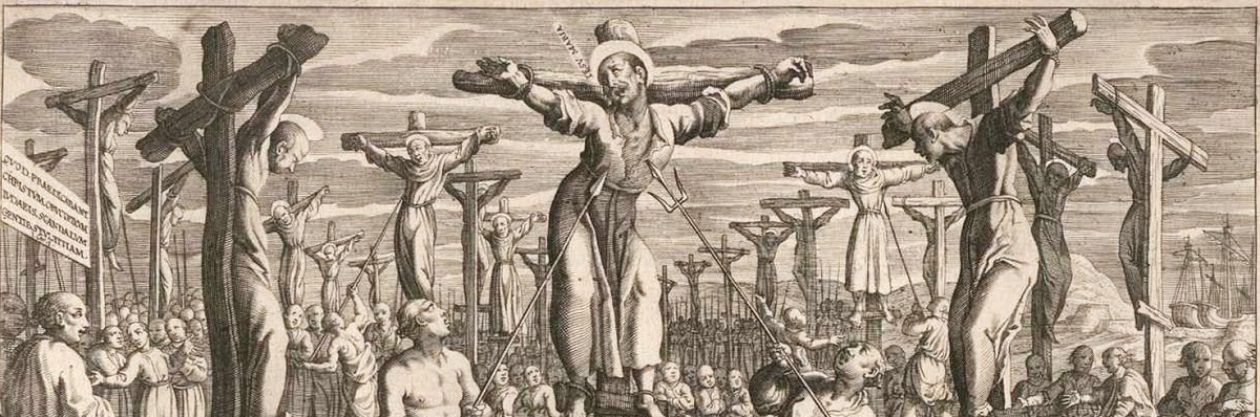
Humankind—as well as all creation—owes an immeasurable debt of gratitude to Father Antonio Rubino and his companions, fearless men of God who threw their very lives to the wind for the sake of Japan and its harried people, to give the Japanese an example intended to lead them to freedom in aeternam. They had set out for Japan in 1642 from Manila in a ship secretly prepared for them by the Governor of the Philippines; they had traveled disguised as Chinese; but they died as public spectacles, proudly and fearlessly proclaiming the saving truth of Christ, the Faith they had come to die for.
In October of 1633, the acting Provincial of the Jesuit Province of Japan had apostatized under the most extreme torture and was reputed to be acting as an agent of the Shogun in effecting the apostasies of other missionaries caught by the Japanese authorities. This man, Christovão Ferreira, was indeed acting as interpreter and translator for the Shogun’s men, but there seems to be no evidence that he in fact urged the captives to apostatize; rather, he did his translating work in shame. Nevertheless, his public example of renouncing Christ was a scandal that could lead the whole Japanese nation to perdition, and Father Rubino vowed to offer himself up as a shining counter-example of faithfulness to Christ unto death, a torch of truth to dazzle the eyes and firm the wills of all Japan’s Christians: he and his companions would sail to Japan, enter the country by stealth, and try to bring Ferreira back to life—eternal life, that is—or atone for his apostasy by dying as heroic martyrs themselves.
Giovanni Antonio Rubino was born in Turin in 1578, thirty-one years after Saint Francis Xavier’s pioneering mission to Japan to spread the Word and save yet another race of man. Of noble birth, Father Rubino determined in his youth to devote his life to Christ by joining holy orders. Overcoming his father’s opposition, he joined the Society of Jesus and was sent to Goa in the Portuguese Indies. The consummate scholar, he served the Church in Asia for some forty years at Goa, Cochin, and Colombo as teacher or principal at those cities’ Jesuit academies.
This man, this faithful scholar-priest, is a towering unsung giant of Christian history, a real-life version of the tortured priests in Martin Scorcese’s Silence: a giant because, unlike the fictional priest in that movie who decided to tread on an image of Christ and thus wordlessly proclaim his apostasy, Father Antonio Rubino held out for the heavenly crown of glory—held out to the end, which came on 22 March 1643, when he finally expired hanging in the Pit atop the slope called Nishi-zaka in Nagasaki, Japan’s capital city of martyrs.
Father Rubino and his mission companions—four priests, one brother, and three lay Catholics—sailed out of Manila disguised as Chinese; on 11 August 1642 their ship ran aground on a small island in the Satsuma Strait: they had reached Japan. Within three days they were discovered, arrested, and taken to Nagasaki. There they were interviewed by the Nagasaki Bugyo, the Shogun’s deputy; the apostate priest Christovão Ferreira served as the Bugyo’s interpreter, but slunk out in shame after having been harshly scolded by Father Rubino for his faithlessness.
The Bugyo sent Father Rubino’s party to Mount Unzen, where they would endure the boiling sulfur-water tortures of “Unzen Hell” for seven months; the torturers also burned them with rods of red-hot iron. The final torture session on Unzen, especially gruelling, they suffered on 16 March 1643. None apostatized.


Boiling sulfurous springs atop Mount Unzen
The men of Father Rubino’s party were given their death-sentence, torture to death in the Pit, on 18 March: they rejoiced at the news, thanking God. The Bugyo, mystified, asked if they understood what he had told them; they replied that they had understood the Japanese perfectly: this was why they had come—to testify to the truth of Christ with their own precious lives, lives they held worthless if not spent for the Faith.
They were paraded through the streets of Nagasaki as spectacles of shame: riding on pack-horses with hands tied behind their backs; their heads and beards half-shaven, the shaven half painted red; iron “tongues” in their mouths to clamp their tongues and keep them from speaking; and signs on their backs proclaiming their crime:
The Emperor of Japan condemns these people to death for having preached the Roman Faith, long proscribed in all these domains.
Atop the slope called Nishi-zaka, on the execution-ground overlooking Nagasaki Bay, Father Rubino and his companions were violently thrown from their horses and their bodies bound in tight coils of rope. Then each martyr was suspended from a gallows head-downward waist-deep into his appointed pit, whose bottom was filled with the vilest filth. A lid was closed around his waist, closing out fresh air, closing in the stench; the lid cut off his circulation, causing excruciating pain. To multiply the martyr’s agonies astronomically, the torturers twisted the rope from which he hung: back and forth, back and forth, back and forth, each turn an eternity of earthly hell.
 The Pit (an artist’s inaccurate conception)
Yet no-one apostatized: all five men of Father Rubino’s mission held out for the Christian crown of glory, and thus, in their dauntless silence, refuted the lie of apostasy, the vacuous notion that any temporary earthly suffering—no matter its present horror—is too high a price to pay for Eternal Life.
Father Antonio Rubino won the martyr’s crown on 22 March, 1643 at age 64 or 65, the second of his mission-group to gain that victory. The lifelong scholar and teacher had taught his life’s greatest lesson in silence, a silence blaring out its truth to all mankind like a startling angelic trumpet in the heavens.
Copyright 2017 by Luke O’Hara
Website: Kirishtan.com
On March 21, 1643, a Christian hero whom we know only by the name of Thomas died in the pit on Nishi-zaka in Nagasaki. Born in Korea, he was a humble lay Catholic serving Catholic exiles at a Japanese church in Cambodia when he was chosen to accompany Father Antonio Rubino and his companions on a one-way self-sacrificial mission to Japan.
Like the brave Jesuit priests of Martin Scorcese’s Silence, Father Rubino offered his life up to God on a wildly reckless mission to sneak into Japan, find the apostate priest Christovao Ferreira, and convince him to recant his apostasy and die for the Faith—both to save his own soul and to repair the bad example he had set for the onlooking Japanese faithful by his apostasy.
Unlike the Jesuit-priest characters in Silence, however, the real historical Jesuit Antonio Rubino, along with all the other members of his mission, endured seven months of the “Unzen Hell” boiling sulfur-water torture pictured in that film; they did not give in. The Shogun’s deputy in Nagasaki then condemned the dauntless members of Father Rubino’s mission to the ultimate torture of the Pit. This test too would prove fruitless for the Shogun’s purpose: Father Rubino and his companions all gave their lives for Christ atop the slope called Nishi-zaka, that holy ground sanctified first by the blood of the Twenty-six Martyrs of Nagasaki on 5 February 1597.
Thomas, faithful lay Catholic, was the first to die, the first among the hardy souls of Father Rubino’s mission to give up his earthly life for the sake of his immortal soul—indeed, for all our immortal souls, whether watching from that slope overlooking Nagasaki Bay on the 21st of March in the Year of Our Lord 1643 or gaping through the lens of history, still transfixed by the sight of that fearless Peace that passeth all understanding.
Copyright 2017 by Luke O’Hara
Website: Kirishtan.com
“I do not want this religion: a religion of love and union, which is therefore harmful for this kingdom.” The Taikō Hideyoshi
.jpg&container=blogger&gadget=a&rewriteMime=image%2F*)
(Toyotomi Hideyoshi)
Copyright 2007/2014 by Luke O’Hara
1 Diego Yuuki, S.J., The Twenty-Six Martyrs of Nagasaki (Tokyo, Enderle, 1998), 55.
2 Yuuki, 56.
3 Yuuki, 70.
4 Yuuki, 60.


Copyright © 2016 by Luke O’Hara
Kirishtan.com
[1] Léon Pagès, Histoire de la religion chrétienne au Japon depuis 1598 jusqu’à 1651. (Paris: Charles Douniol, 1869), 828, note.
[2] Pagès, 829.
[3] For interesting details on this apparition, see: Ines G. Županov, “Passage to India: Jesuit Spiritual Economy between Martyrdom and Profit in the Seventeenth Century” in Journal of Early Modern History, Vol. 16, Issue 2 (2012), pp 121-159.
[4] Pagès, 830.
[5] Pagès, 831.
[6] C. R. Boxer, The Christian Century in Japan, 1549-1650. (Lisbon: Carcanet, 1951), 369-370.
[7] Pagès, 832.
[8] Pagès, 833.
[9] A replacement for the boat the Japanese exiles had built; it had been found unsuitable.
[10] Pagès, 834.
[11] He may in fact have had smallpox. See Liam Matthew Brockey, The Visitor: André Palmeiro and the Jesuits in Asia. ( Cambridge, Mass: Belknap Press, 2014), 405.
[12] Saint Magdalena of Nagasaki received that torture, described here: https://kirishtan.com/santa-magdalena-of-nagasaki-spouse-of-christ-martyr-and-one-of-gods-greatest-miracles/
[13] Boxer, The Christian Century, 351.
[14] Ibid, 351.
[15] Pagès, 836.
[16] Willis, Clive. “The Martyrdom of Father Marcello Mastrilli S.J.” Journal of the Royal Asiatic Society Hong Kong Branch 53 (2013): 220. http://www.jstor.org/stable/23891244.
[17] Willis, 220-221.
[18] Pagès, 836.
[19] Pagès, 836-837.
[20] Pagès, 837.
[21] Willis, 222. A translation from the original Portuguese.
[22] Ibid.
[23] Pagès, 838.
[24] 竹中采女正, Nagasaki Bugyō from 1629 to 1633, when he was removed from his post for illegal trading. He was forced to commit seppuku in 1634.
[25] Borrowed from https://kirishtan.com/samurai-martyrs-father-julian-nakaura/ . The excerpt from François Caron is quoted in Boxer, The Christian Century, 354.
[26] Japanese borrowing of the Portuguese ‘padre.’
[27] Pagès, 838.
[28] The Jesuits’ report notes an additional reason: “The reason for their hurry was a forthcoming celebration in the temple the next day, a day on which acts of judicial punishment were forbidden.” Willis, 223. Also noted in Léon Pagès, Histoire, 838.
[29] Willis, 223.
Julian Nakaura: Samurai, Ambassador, and Martyr


[1] Pierre François Xavier de Charlevoix, Histoire de l’établissement, des progrès et de ladécadence du christianisme dans l’empire duJapon, Vol. 2, p. 187.
[2] Ibid.
[3] Léon Pagès, Histoire de la religion chrétienne au Japon depuis 1598 jusqu’à 1651, p. 413.
[4] Ibid, my translation.
[5] Ibid, my translation.
[6] Ibid.

In the Year of Our Lord 1613, the domain of Arima was in the hands of Arima Naozumi, the son of Arima Harunobu, longtime stalwart patron and protector of the Church in Japan. After Harunobu’s execution in 1612, Naozumi had apostatized on the orders of the de-facto Shōgun Tokugawa Ieyasu and received lordship of his dead father’s domain on condition that he do his utmost to exterminate the very Faith that he had from his childhood espoused.
Although his domain was far removed from Ieyasu’s castle-town up on the Pacific coast of Honshu, down home in Arima, Naozumi had the ruler’s own hound at his heels: Hasegawa Sahiōye, Governor of nearby Nagasaki—a close advisor of Ieyasu’s and a hell-driven enemy of Christ. Plotting to grab the domain of Arima for himself, Hasegawa threatened Naozumi, greenhorn Lord of Arima, with the Shōgun’s own hellfire if he did not prove his determination to purge the land of Christians with some solid evidence posthaste.
Naozumi called in his eight top samurai, formerly his father’s liegemen, and pleaded with them to renounce Christ, if only on paper, to save him from the threatened wrath—indeed, to save all of Arima’s faithful from that wrath, or so he claimed, citing Hasegawa’s threat. Hearing their new liege lord’s artful pleading, five of the eight samurai agreed to the stratagem. Three, however, refused to budge: Leo Taketomi Kan’emon, Adrian Takahashi Mondo, and Leo Hayashida Sakuemon.
Naozumi sentenced them to death by burning, along with their wives and children. However, the new, spineless Lord of Arima postponed the order until the three Christian stalwarts were safely out of his castle and headed home. All of them being samurai, they and their families were escorted unbound to their respective prison cells, where each family was locked up together: Adrian Takahashi with his wife Joanna; Leo Taketomi with his son Paulo; and Leo Hayashida with his wife Marta, his eighteen-year-old daughter Magdalena, and his son Diego, eleven years old.
Soon twenty thousand Kirish’tan had surrounded their prison, singing prayers and keeping vigil—at which they stayed for three days and nights on end, some huddling around campfires to keep warm in the night, some distributing food to those who were too hungry to bear it. For fear that the faithful would take relics from their remains, Naozumi ordered the martyrs-to-be spirited out of his jail to another location—clear proof that Arima Naozumi, his apostasy notwithstanding, retained a clear understanding of the restorative power of relics. Undeceived, Arima’s Kirish’tan faithful followed the soon-to-be martyrs to their new prison to continue the vigil.
On the morning of Sunday, October 7, 1613, the prisoners were led out of their cells to meet their deaths. All were wearing the kimono of the Guild of Saint Mary, given them by its chief, and each but the youngest—eleven-year-old Diego—had his or her arms bound with rope in the form of a cross. Diego, seeing that all the others were bound, asked that the guards bind him too. They insisted that they had no more rope, and on hearing this, the boy submitted quietly.
En route to their deaths, each martyr was flanked left and right by a Marian with a lit candle in one hand and a rosary in the other; these members of the Guild sang the rosary as they marched with the holy ones. Coming to a river, the martyrs were ferried across, after which they had to traverse muddy ground. A certain man offered to carry Diego on his back across the mud, but the boy declined: “Our Lord Jesus didn’t ride a horse up Calvary,” he explained, and he tromped into the mud on his own two feet. Crowds of believers with scissors or knife in hand mobbed the holy ones to strip from their clothing some relic for saving; the condemned protested that they themselves were but mere sinners. Had the Eight not thus rebuffed these adorers, they would likely have been stripped stark naked.
They arrived at the place of execution: a wooden stable of sorts filled to the rafters with firewood, surrounded by a stockade, on the beach in front of the hill atop which loomed Hino-eh Castle. Their liege lord was most likely watching from up there, high above the heads of the countless Christians jammed into the town below the castle, people from all over the Peninsula, the erstwhile Christian bastion of Japan.
Leo Taketomi climbed onto a pile of wood and made a speech to the thousands, but many of his words were drowned out by the noise of the crowd. His few audible words went something like this:
Behold the faith of Arima’s Christians: for the glory of the Lord and as a testimony to our faith we now die. My brethren, my hope is that you shall preserve your faith unshaken to the very end!
Leo stepped down; each of the martyrs was tied to a stake; the executioners lit the firewood. Quickly a storm of flames erupted around the three families. The chief of the Guild of Saint Mary, just beyond the stockade, held up a painting of Jesus in his Passion so that the martyrs could see it, a help in their death-throes. The crowd sang the Credo, the Pater Noster, the Ave Maria, and other prayers to strengthen the martyrs; reportedly the martyrs evinced nothing but joy amidst the flames.
The boy Diego’s ropes were the first to burn away: he ran to his mother’s side shouting, “Zézusu! Maria!” and fell. Next his eighteen-year-old sister Magdalena found her arms free of the burning ropes: she reached down to pick up a flaming branch and held it above her head, seemingly worshiping the fire that would send her to Heaven as she held up her head with her other hand. Seeing this, the gasping crowd made the sign of the Cross. Finally, Leo Hayashida boomed the name of Jesus out of the midst of the flames; that word shook the crowd as a whirlwind of fire devoured the eight holy martyrs. All the onlookers beat their breasts as his shout resounded over all the scene.
When that shout of Heaven’s victory reached his ears, Arima Naozumi, looking down from his castle’s overlook, must have felt as if that maelstrom of flames were in his own stomach. Meanwhile, down below, all those thousands of his Kirish’tan subjects, fallen to their knees, were praying for the souls of the martyrs—and perhaps for the soul of their earthly lord as well, cowering in his fortress high above.
This martyrdom proved to be only a prelude to the litany of sufferings that Arima was bound to endure.
Copyright 2015/2016 by Luke O’Hara
Website: Kirishtan.com
The illustration is from a 1624 history of the persecution in Japan by Nicolas Trigault; I borrowed the image from the website of the Catholic Bishops’ Conference of Japan, at http://www.cbcj.catholic.jp/jpn/feature/kibe_187/arima.htm
12 April 1638 saw the gory finale of the months-long siege of Hara Castle, a finale that would expunge Christendom in all of Shimabara and Amakusa and drive it underground throughout the remaining scraps of Japan where Christians dared to cling to the Faith. The excerpt below from “Amakusa Shiro and the Fall of Hara Castle: a Kirishitan Holocaust” describes the final assault and its aftermath.
The Shogun’s hour had finally arrived. On the Eleventh of April 1638, his horde swarmed over the outermost wall of Hara Castle, having first sent down a rain of fire-arrows. The wasted defenders fought with anything at hand—empty guns, cooking-pots—while their Christian kingdom burned all around them. The innermost wall, the wall of the citadel at the mountaintop, was stormed on the morning of the Twelfth, and the fighting ended at noon, when the last rebel combatant was dead. Those taken prisoner—the elderly, the ill, mothers and their children—they beheaded, without exception. “Even the little girls,” one observer lamented.
The Shogun’s army ringed the burnt-out Hara Castle with 10,860 impaled Christian heads; they sent 3,300 more to Nagasaki as a lesson to that town’s surviving Catholics. As a warning to the Portuguese there—who had brought the Catholic Faith to Japan—they stuck four heads, including Shiro’s, onto stakes at the foot of the bridge to the island where the Portuguese were now confined. Soon the Portuguese would be banned from Japan entirely, and all Japanese required to appear before a magistrate annually and to tread on a Christian sacred image to prove their loyalty to the Shogun.
In the wake of the rebellion, barely a soul remained in the south of the Shimabara Peninsula: all but the rare deserter had died at the hands of the Shogun’s army. In order to have the land tilled, therefore, the Shogunate repopulated the Peninsula by forcibly removing peasants from Shikoku and Honshu and installing them willy-nilly in the ghost towns of Shimabara.
In Japan’s Catholic heyday, at least seventy Catholic churches dotted the Shimabara Peninsula; today only three remain. But every spring at cherry-blossom time, the villagers of Minami Arima do remember the holocaust of the 37,000 with a Buddhist memorial service in the evening, and the next day with a parade, with Amakusa Shiro made up like a dainty geisha, and the Shogun’s general a proper man.
Perhaps a fitting testament to the expunging of the Faith from what was once a Catholic land—after all, a prettied-up cartoon parody of that would-be forgotten slaughter of yesteryear fits in well with the animé unreality that so enthralls the Japan of today. But the made-up fun obscures the monstrous truth of the slaughter of those 37,000 who believed themselves ‘timely born to die for the Faith,’ and it ignores the countless martyred children: martyrs because they, unlike so many of their parents, had not chosen to rebel, but had been scooped up by their parents and rushed to Minami Arima and through the gates of Hara Castle. These the Shogun’s hordes executed for the crime of being Christian. Even the little girls.
When will Hara Castle’s little martyrs be remembered?
 Shōgun Tokugawa Iemitsu