Saint Paul Miki and Companions


website:  Kirishtan.com

            The martyrdom of Saint Paul Miki and Companions, otherwise known as the Twenty-six Martyrs of Japan, is perhaps the fulcrum of Japanese Christian history.  Theirs was the martyrdom that laid bare the core of Japan’s ancient conflict with private conscience—that is, the sense that one’s own moral conviction overrides not only temporal social convention, but even the orders of an earthly superior, when that convention or those orders contravene the moral law.  Saint Paul tells us that that law is inscribed on every human heart, that it is universal.


            Here is a short rendition of the Martyrs’ story—a piece I published some years back.  Their feast is celebrated on the 6thof February in the Roman Catholic Church, but their martyrdom actually took place on February 5, 1597—Japan time.


The Twenty-six Martyrs


by Luke O’Hara


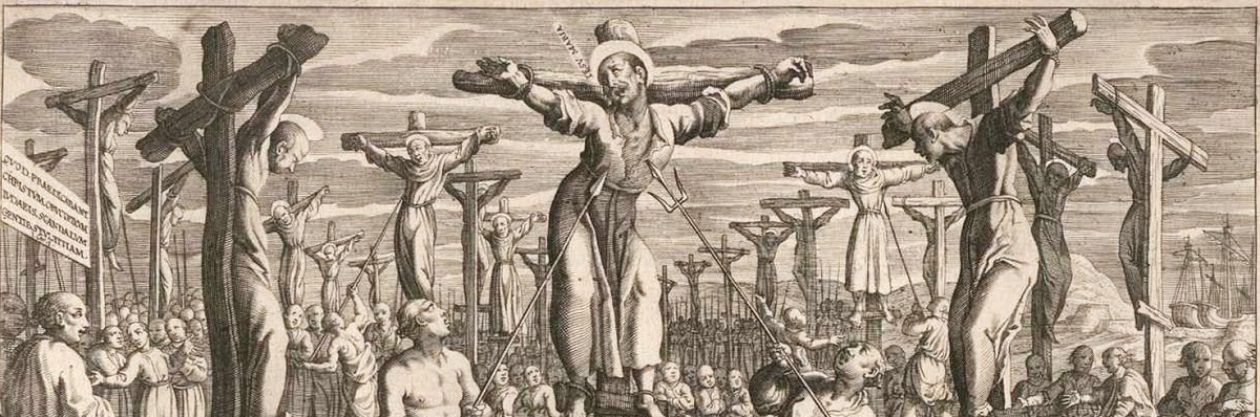
    Above a hilltop overlooking Nagasaki Bay floats a row of men and boys in bronze, frozen eternally in attitudes of joy. ‘Floats,’ I say, because they seem to hang suspended in mid-air along a wall of stone. These are the Twenty-six Martyrs of Japan. Most of them have their hands folded in prayer, and all their mouths are open in praise. Like a halo around each martyr’s head, words are inscribed behind him in bronze relief. These are the last words each was heard to say or sing before being pierced with spears from below; this is how Japanese crucifixions usually ended.


          The Twenty-six were crucified on this hill on the Fifth of February, 1597 because, according to Toyotomi Hideyoshi, the man who then ruled Japan, they were “foreigners … come from the Philippines” who had “built churches, preached their religion, and caused disorders.” In point of fact, most of the martyrs—twenty of them—were Japanese.


          The ‘disorders’ they had caused were as follows: they had built hospitals, orphanages and leprosaria for the poor and outcast, offered charity to the indigent, and labored tirelessly to spread the Gospel of Christ in a land whose people had been esteemed by Saint Francis Xavier as “the best who have yet been discovered.” As for their having “built churches,” Hideyoshi himself had given the Franciscans a plot of land on which to build.


          But a few of the Franciscans had indeed arrived recently from the Philippines.  They had come in a crippled Spanish galleon headed for Mexico that had been blown off course by a typhoon and had limped into Japan in dire need of repairs. When the battered San Felipe showed up at the port of Urado richly laden with Chinese silks and other treasured cargo, the local ruler contrived to tow the ship into port against the ship’s pilot’s wishes—ostensibly for repairs—and in the process broke her back on a sand bar, spilling much of her cargo into the bay. Now the San Felipe was a shipwreck, and now, by Japanese law, her cargo was forfeit.


          But Hideyoshi himself had promised his personal protection to Spanish ships only four years earlier. With this in mind the Spaniards sent a deputation to him to petition for return of the confiscated cargo, but by the time they arrived, the divvying-up of the spoils had already been decided. Now Hideyoshi had to save face. He contrived to ‘discover’ a Spanish plot to take over Japan by Catholic infiltration, and when he had produced some fishy evidence he flew into a rage and ordered the rounding-up of the Franciscans. In the end the round-up netted six Franciscans, three Jesuits and seventeen hapless Japanese laymen: the youngest twelve years old, another thirteen, and the oldest sixty-four.


          Hideyoshi ordered that their ears and noses be cut off and they be paraded around the cities of Osaka and Kyoto in carts and then marched to Nagasaki to be crucified, a journey of perhaps eight hundred kilometers; it would take them twenty-seven days. A sympathetic official mitigated the sentence; only their left ears were cut off.


          Along the route, Jesuit Brother Paul Miki distinguished himself for his constant preaching; Bishop Dom Pedro Martins called him the best preacher in Japan. The youngest, twelve-year-old Louis Ibaraki, traipsed along laughing, and reportedly laughed even when they cut off his ear. Four days before the end the boy was offered his life on condition that he renounce the Faith. His reply: “I do not want to live on that condition, for it is not reasonable to exchange a life that has no end for one that soon finishes.”[1] When the Twenty-six arrived at the execution-ground their crosses were there awaiting them. Louis asked “Which one is mine?” and then ran to embrace the one pointed out.


          The monument depicts in bronze how they died: Paul Miki, hands spread, was preaching to the thousands of Nagasaki Christians kneeling on the hillside below when the spears pierced his heart, and Louis’s last words shout out from the wall behind him:  “Paradise! Jesus! Mary!”


          Saint Francis Xavier’s praises still ring true.


     (The Twenty-six were canonized on June 8, 1862.)


(First published in Our Sunday Visitor.)


[1]Diego Yuuki, S.J., The Twenty-Six Martyrs of Nagasaki, p. 60.  (Enderle Book Co., Tokyo, 1998)
 

December 8th: Birth, death, Eternity


               December 8, 1941: a day that has lived in infamy for 71 years.  Americans remember Pearl Harbor on the 7thof December, but it was December 8th Japan Time when the Japanese Imperial Navy’s dive bombers hit Pearl Harbor.  December 8th also marks the Feast of the Immaculate Conception of the Blessed Virgin in the Roman Catholic Church.
                Mere coincidence, one might imagine, but here’s another “coincidence”:  the Emperor’s surrender proclamation was broadcast to his astonished nation on August 15, 1945.  The 15th of August marks the Feast of the Assumption of the Blessed Virgin, which pegs the end of the earthly life of the Lord’s mother, who was soon to return to earth time and again to dazzle the upturn’d eyes of mortals in the form of countless apparitions warning mankind to believe in her Son’s reality and the direness of man’s addiction to sin, lest countless souls needlessly consign themselves to eternal fire—the pool of fire that is the second death. (See Revelation 20:14-15)
               So the front and back covers of that Book of Death that mankind knows as the Pacific War coincide with the conception of the Blessed Virgin (for conception is the start of full-fledged human life) and her departure from earthly life—which, for those who cling to Christ, is only the beginning of eternal bliss.  But all this must be merest coincidence.
               Just like the coincidence of Saint Francis Xavier’s arrival in Japan by dint of an irresistible wind that drove his ship straight to Kagoshima, the home town of his Japanese interpreter, an escapee from Japan who was now a convert to the Faith.  The ship’s captain had been determined to avoid Japan, but that almighty wind had had its way, and now there was nothing to do but land his passengers.
               And the date?  By the merest coincidence, the 15thof August 1549, the Feast of the Assumption of the Blessed Virgin:  the birth of Christendom in Japan.
               Birth, death, Eternity.

Luke O’Hara, Kirishtan.com

The Yatsushiro Martyrs

December 8th and 9th, 1603:  Two Catholic samurai of Yatsushiro were beheaded for refusing to renounce Christ, and the following day all the remaining members of their immediate families were crucified for clinging to their convictions too.  The youngest of the crucified martyrs was seven-year-old Ludovico (his baptismal name).  On his mother’s instructions, he kept repeating the holy names of the Lord and the Blessed Virgin–Iézusu! Maria!–as he awaited the spear-thrust that would pierce his heart, gouging into him through his right kidney and out through his left shoulder.  His mother was hanging on the cross next to his own.
The little boy rode to Heaven on eagle’s wings; lifted, that is, by the Almighty Name.  Imagine that family reunion, once all had arrived at their eternal Home.

November 11, Saint Marina of Omura

     November the Eleventh marks the 378th anniversary of the martyrdom of Saint Marina of Omura, canonized by Pope John Paul II on October 18, 1987. I first learned of her story on seeing her statue in the courtyard of the Kako-machi Catholic Church in Omura, Nagasaki Prefecture, Japan—a lady in lay Dominican garb clutching a crucifix to her breast and standing atop a crown of flames that would send her straight to Heaven, her face aglow with faith and hope and love—and superhuman strength.

     She had dedicated her life and her virginity to Christ: a vow which was anathema to the Shogun up in Edo (modern-day Tokyo): Iemitsu, a sin-enslaved sadist who would prowl the streets of his capital at night in disguise, heavily guarded, looking for innocent victims to test the sharpness of his sword on. Of all his imagined enemies he feared Christ the most.

     Marina lived in Omura, a very long way from the capital but just a few hours’ ride on horseback from the port-town of Nagasaki, the Christian capital of Japan. Omura itself had been a Christian stronghold in former times. Indeed, Omura Sumitada, lord of Omura three generations past, had been Japan’s first-baptized Christian domainal lord, and his daughter had herself been baptized as ‘Marina’. Alas, a string of anti-Christian dictators had, since those days, put an end to the freedom of conscience that some parts of Japan had once known: in Saint Marina’s day, to profess Christ was death throughout Japan.

Her crimes were legion: she had manifested charity to the utmost, giving refuge in her home to hunted priests and persecuted Christians at the risk of her life. Thank God that Saint Marina—like so many Holy Martyrs before her—despised the pains of death: for in her eyes these were but the merest footsteps in her faultless climb to Heaven to meet her one true Lord.

Arrested, she was stripped naked and paraded through the whole domain of Omura to shame her; yet, as a virgin self-promised to Christ, she marched with perfect modesty. She was immolated by ‘slow fire’ on Nishi-zaka, the holy execution-ground overlooking Nagasaki Bay—the sacred soil that had held the crosses of the Twenty-Six Martyrs of Japan back in February of 1597. Many holy souls had followed their path to Heaven since that icy winter day thirty-seven years before; Marina of Omura would stand tall among them as a paragon of indomitable faith.

‘Slow fire’ meant that the firewood beneath her feet had been wetted to prolong her miseries and delay merciful death. Marina, however, did not amuse her torturers with displays of agony; instead she prayed for her persecutors and her fellow persecuted Christians: thus is she remembered in Omura as a Christian heroine of remarkable strength. Superhuman, supernatural strength, humility, and courage, let us say—as befits a faithful child of God.

Saint Marina of Omura, pray for us.


Luke O’Hara, Kirishtan.com

Praised Be the Most Blessed Sacrament


Luke O’Hara

see:  Kirishtan.com

1:55 PM  –  Public


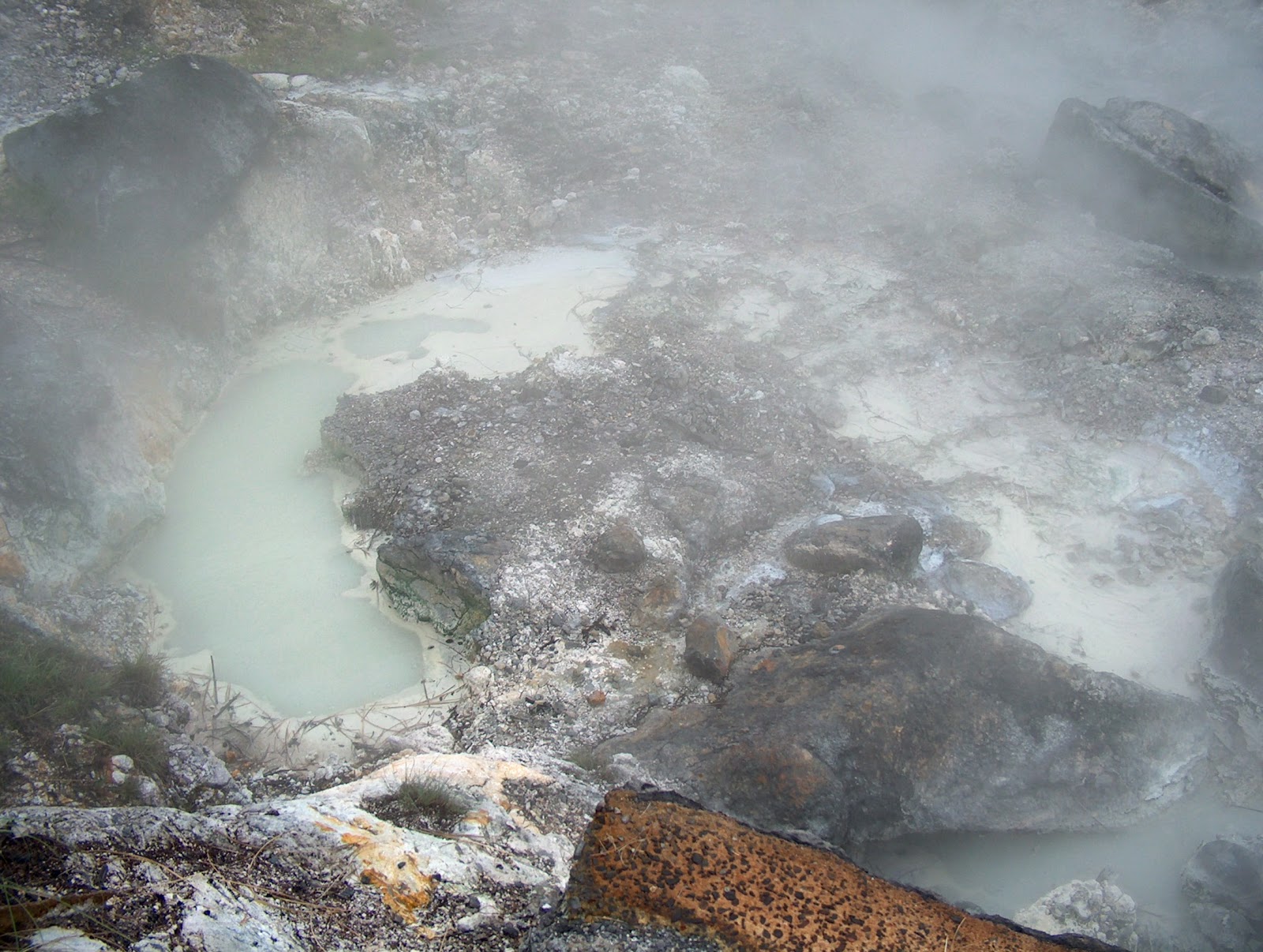
The photo on this page is a bird’s-eye view of one of the sulfurous hot springs atop the Shimabara volcano where so many Christians–Kirish’tan, that is–were boiled by the local daimyo’s minions in order to procure their apostasy.   Here died many a Japanese Kirish’tan hero, among them Blessed Paulo Uchibori, whom the torturers hung upside down and dipped into the boiling sulfur-bath head-first.
They pulled him out, expecting him to renounce Christ, but to their astonishment, Paulo shouted a victory cry: “Praised Be the Most Blessed Sacrament!”
Again they dunked him, determined to boil away that strength of Spirit in him, but when they pulled up the rope again, the boiled Christian’s shout of faith resounded in redoubled strength:  “Praised Be the Most Blessed Sacrament!”
They plunged him in again, this time not to force a change of heart–for this was too plainly impossible–but to drown him in the boiling hell which would send him straight to Heaven.  Perhaps their consciences could no longer bear the sting of Truth burning in those words of his, those quintessential Kirish’tan words:  “Praised Be the Most Blessed Sacrament!”

May God grant that we all learn from his example–in this present age so steeped in lies–to not traduce the Truth:  our Faith.


Kirish’tan: Heaven’s Samurai A novel of Old Japan

      Saint Francis Xavier; Saint Paul Miki, Saint Luís Ibaraki and the other 26 Martyrs of Japan; Arima Harunobu, Konishi Yukinaga and Omura Sumitada, the Christian daimyo of Amakusa and Shimabara; the great warlords Shimazu Yoshihisa, Kato Kiyomasa, Toyotomi Hideyoshi and Tokugawa Ieyasu:  these characters live again in the pages of Kirish’tan:  Heaven’s Samurai.


     The novel is available at https://www.createspace.com/3650514


or go to my website:  Kirishtan.com
Use this code for a 10% discount:  WK65CU3H