A Winter Offering: The 53 Martyrs of Yonezawa

Anonymous, “The Christian Martyrs of Japan,” 17th century (photo: Public Domain)

Luke O’Hara Blogs    January 29, 2022

Looking down from Heaven on frosty Yonezawa in the winter of 1629, one would have seen blooms of crimson spreading upon the white-blanketed earth below, for her mantle of virgin snow was being baptized with Christian blood.

Although Yonezawa, in north-central Japan, was home to many Catholics, it seems to have escaped shogunal scrutiny for some years. Perhaps because its ruler, Uesugi Kagekatsu, was a redoubtable warrior, the Shogun Hidetada ignored his tolerance of Christians in his domain. Kagekatsu ruled Yonezawa until his death in 1623, the very year that Tokugawa Iemitsu succeeded to the shogunate.

Iemitsu had a demonic taste for personally observing the torture of Christians. Perhaps this taste rubbed off on Kagekatsu’s heir, Sadakatsu, for in 1628, while paying homage to Iemitsu in Edo (now Tokyo), Sadakatsu sent orders back home to register all Catholics in his domain and order them to apostatize.

Ishida Shuuri, the head sheriff in Yonezawa and a decent man with no taste for injustice, reported back to Sadakatsu that there were no Christians in his domain. Shuuri’s immediate underling, however, jealous of his position, reported to Sadakatsu that Yonezawa was in fact rife with Catholics.

On Dec. 22, 1628, Sadakatsu sent down orders to Shuuri to put to death all Catholics unwilling to apostatize.

“There are 3,000,” Shuuri replied. This quashed Sadakatsu’s enthusiasm for murder for a time — he would be exterminating too many of his vassals and sacrificing considerable tax income and manpower.

But Sadakatsu had the twisted Shogun Iemitsu breathing down his neck. He needed a sop.

Prominent among Yonezawa’s Catholics was Amagasu Yemon, christened Luís, a veteran samurai. Sadakatsu ordered Yemon and all his family to apostatize on pain of death.

Shuuri counted Yemon a good friend; to save his friend, he wrote up a summary of the Ten Commandments as best he could recall them, enhancing them, as he saw it, with one final commandment enjoining samurai loyalty, and presented this memorial to Sadakatsu. He then asked him to consider how a people so steeped in virtue could possibly be a threat to the state. This staved off the inevitable for a space of days; Yemon’s friends were overjoyed at the thought that he and his family would after all be spared.

Overjoyed until a friend of Yemon’s elder son, Tayemon, came from Sadakatsu’s castle to break the news to him that all of the family were to be executed. Tayemon was in his sickbed with fever, but at this news, he cried out that he was healed, jumped out of bed, and mounted a horse to gallop off and tell his father. Yemon ordered coffins prepared at once for all his family.

On Jan. 11, 1629, two samurai arrived at Yemon’s house to notify him, with Shuuri’s apologies, that he and his family were to die the next morning. Yemon thanked them and promised that all would be ready to leave at a moment’s notice when called.

As Yemon and his two sons were themselves samurai, they surrendered their paired swords, the long katana and the shorter wakizashi, to be delivered to Shuuri, promising that their matchlock guns and lances would be delivered on the morrow. It was the height of humility for a samurai to give up his swords.

Yemon immediately set things in order — all would wear their finest apparel. They would make a grand procession to the execution ground, for they were celebrating the holiday of their lives. Yemon then offered to pay his servants and send them off to freedom; all refused, insisting they wanted to die for Christ along with their master. The servants of Yemon’s sons, Tayemon and Ichibyoe, did the same.

With all the family and servants gathered at Yemon’s house, they spent the night in prayer. The next day, two hours before dawn, two of Shuuri’s officers arrived to start the proceedings. Yemon greeted them at the door and took them upstairs, where they found the entire household on their knees dressed in festal garb, the men and boys with hands tied behind their backs and rosaries around their necks and the ladies, hands untied, with rosaries in their hands. Two 12-year-old boys serving as pages would lead the procession, one carrying a pike on high with a picture of Our Lady fixed to its point and the other bearing a blessed candle.

Before leaving, the martyrs commended themselves to Our Lady’s protection and rose from their knees to file out onto the snowy street to begin their march. With Our Lady’s image on high, the two boys in front were followed by another servant, and then the women carrying their rosaries. Among these, 17-year-old Tecla, Ichibyoe’s wife, carried their infant daughter in her arms, perhaps with her rosary laced through her fingers, while Dominica, Tayemon’s young wife, walked ahead of her alone, clutching her rosary in silent anguish, I suspect, for her own infant daughter was nestled in the arms of her handmaid, Maria, to their rear. Perhaps she hadn’t the heart to coo to her child as she carried her off to be beheaded.

At a distance behind the women, Yemon’s sons led the men. Each had his hands bound behind his back and a rosary round his neck, with Yemon last. As people lined the street watching them in awed silence, two men joined them along the way, Christian faithful going to their deaths in peace.

By the time they arrived at the execution ground, the sun was full risen, emblazoning a sharp contrast between the pristine blanket of white spread out under Heaven and the crimson blooms that soon began to spread with each new slash of a sword — but first, all knelt in prayer around the Blessed Virgin’s image held on high.

The women and girls, the vanguard, were beheaded first, followed by the men, and Yemon last. The two boys who had led the procession were denied martyrdom despite their protests, and sent home in tears.

More martyrdoms would follow in Yonezawa that day — 53 Christian souls ascended to their Maker through the chill, crystal air of that January morning to nestle, finally, in his waiting, loving arms.

Luke O’Hara became a Catholic in Japan. His articles and books about Japan’s martyrs can be found at his website, kirishtan.com.

(This article appeared in the National Catholic Register.)


Saint Marina of Omura, a Holy Martyr of November

I first learned of her story on seeing her statue in the courtyard of the Kako-machi Catholic Church in Ōmura, Nagasaki Prefecture, Japan—a lady in black-and-white Dominican habit clutching a crucifix to her breast and standing atop a crown of flames that would send her straight to Heaven, her face aglow with faith and hope and love—and superhuman strength.

In 1626, entering the Dominican Order as a Tertiary, or lay Dominican, she had dedicated her life and her virginity to Christ:  a vow which was anathema to the Shōgun up in Edo (modern-day Tokyo):  Iemitsu, a sin-enslaved sadist who, heavily guarded, would prowl the streets of his capital at night in disguise, looking for innocent victims to test the sharpness of his sword on. Of all his imagined enemies he feared Christ the most.

Marina lived in Ōmura, a very long way from the capital but not far from the port-town of Nagasaki, the Christian capital of Japan. Ōmura itself had been a Christian stronghold in former times. Indeed, Ōmura Sumitada, lord of Ōmura three generations past, had been Japan’s first-baptized Christian domainal lord, and had had his own daughter baptized as ‘Marina’. Alas, since those days, a profusion of anti-Christian tyrants had put an end to the freedom of conscience that some parts of Japan had once known: in Saint Marina’s day, to profess Christ was death throughout Japan.

Her supposed crimes were legion:  she had manifested charity selflessly, giving refuge in her home to hunted priests and persecuted Christians at risk of her life. Thank God that Saint Marina—like so many Holy Martyrs before her—despised the pains of death, for in her eyes these were but the merest footsteps in her steady climb to Heaven to meet her one true Spouse and Lord.  Once arrested, she was stripped naked and paraded through the whole domain of Ōmura to shame her, yet she marched with perfect modesty: as a virgin self-promised to Christ, she remained untainted. She was transferred to Nagasaki and immolated by ‘slow fire’ on Nishi-zaka, the holy execution-ground overlooking Nagasaki Bay—the sacred soil that had held the crosses of the Twenty-Six Martyrs of Japan back in February of 1597.  Many holy souls had followed their path to Heaven since that icy winter day thirty-seven years before; Marina of Ōmura would stand tall among them as a paragon of indomitable faith.

‘Slow fire’ meant that the firewood prepared for Marina’s execution had been covered with saltwater-wetted straw, leafy green branches, and soil to produce noxious, choking, eye-stinging smoke. The firewood was also placed at a distance from her stake in order to prolong her miseries by producing a slow, roasting heat, thus delaying merciful death—and, if the torturers had their way, eliciting frantic gyrations and screams from their Catholic victim.

Marina, however, did not amuse her torturers with displays of agony; instead, she prayed for her persecutors and her fellow persecuted Christians as she rendered up her life for Christ: thus is she remembered in Ōmura and beyond as a Christian heroine of remarkable strength.

Superhuman, supernatural strength, modesty, and courage, as befits a faithful spouse of Christ.

Saint Marina of Ōmura, pray for us.

Copyright © 2015 by Luke O’Hara

Kirishtan.com


The Galleon, the Tyrant and the 26 Martyrs of Nagasaki

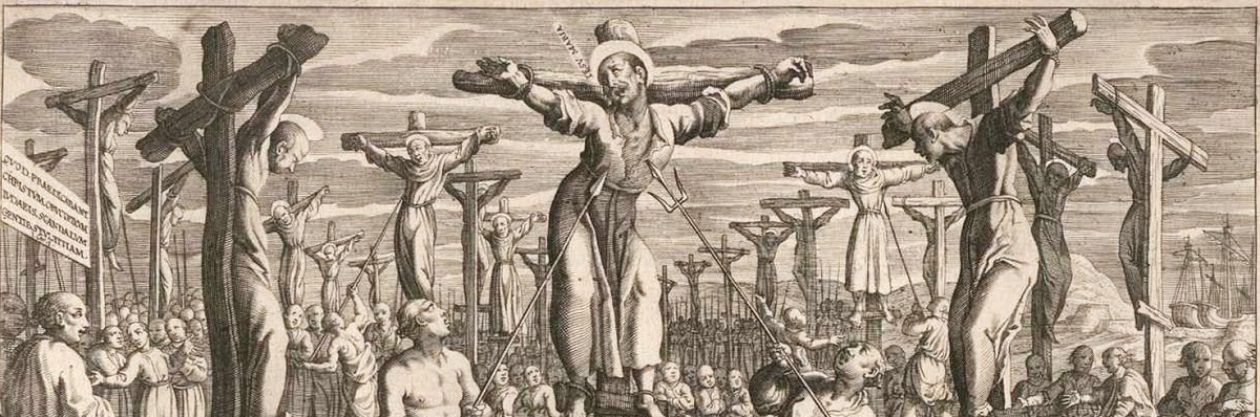
The air was electric with a holy silence, all Nagasaki dumb with grief, as the parade of martyrs marched past toward the hilltop where their crosses waited.

Wolfgang Kilian, “The Martyrs of Nagasaki,” 1628
Wolfgang Kilian, “The Martyrs of Nagasaki,” 1628 (photo: Public Domain)

Raked by frothing waves and howling wind, the galleon San Felipe rode the merciless Pacific bereft of mainmast and rudder, her battered old hull the merest plaything of the tempest. Aboard her were a litany of friars — Franciscan, Dominican and Augustinian — clinging for their lives to whatever handholds the creaking old behemoth could provide and praying for deliverance, if not for themselves, then at least for her proud Spanish captain and his crew. All had been alarmed by signs in the heavens — first, a blazing comet, then crosses burning in the clouds, seemingly pointing toward Japan.

The San Felipe had been bound for Acapulco in New Spain. An old workhorse heavy-laden with fine Chinese silks and other riches, she was grossly overloaded, well beyond the limit for safe sailing. She had left Manila on 12 July 1596, and well into her journey she was hit head-on by the last typhoon of the season. Not only did that raging tempest rip away her mainmast and her rudder; it carried her along on its rampage to Japan, dumping her at last off the west coast of Shikoku, near the port of Urado, on Oct. 19.

San Felipe’s pilot, Francisco de Olandia, wanted to limp his vessel down the coast to Kyushu and on up to Nagasaki, Christian haven, with a makeshift rudder. The exhausted passengers, however, insisted on putting in to port at once, and their demands won the Captain, Matías de Landecho, over to their side.

The pilot duly sounded the harbor at Urado and came back with bad news: a sand bar lurked underwater; the overloaded galleon would scrape bottom; some cargo must be offloaded first to lighten the ship.

The local ruler, Chōsokabe Motochika, forbade that necessary move. He offered, though, to tow the ship in and dredge a passage if needed. He at once enforced his “offer,” sending 200 armed boats out to tow the galleon straight onto that sand bar, breaking San Felipe’s back. Now she was a shipwreck, and now, by Japanese law, her rich cargo was forfeit.

Motochika sent a dispatch to the warlord-ruler of Japan, Toyotomi Hideyoshi, with an inventory of the treasure-trove he had just purloined, expecting a rich reward.

Hideyoshi was elated. He sent a man down at once to confiscate the cargo — who “even seized the gold that the shipwrecked Spaniards carried in their pockets.”

Historians have noted that Hideyoshi’s vengeful war in Korea, in addition to rebuilding in the wake of recent earthquakes, was draining his coffers. His driving force, though, is best explained in the words of Fray Pedro Bautista, Franciscan: “His greed devoured and engulfed everything.”

Captain Landecho sent his pilot, along with a friar-interpreter, on an embassy of protest to Hideyoshi, who had previously guaranteed security for Spanish shipping. This embassy was waylaid by Hideyoshi’s own confiscator, Masuda Emon, who asked the pilot to explain how the King of Spain had conquered his vast empire spanning the globe. Francisco de Olandia purportedly told him that first they sent in friars to suborn the locals, who then joined ranks with invading Spanish troops to take over the country. One Jesuit historian wrote that the wound this rash answer inflicted was still gushing blood 120 years later.

At any rate, it served as a pretext for Hideyoshi to explode into a rage and demand the execution of all Catholic priests in Japan. He soon realized, though, that without the intermediation of the Jesuits, he would be hard put to strike profitable deals with the Portuguese merchants bringing Chinese silks and gold from Macao. Thus, he moderated his orders: his men were to round up all religious in his capital of Osaka and the nearby imperial city of Kyoto. They would then cut off their ears and noses, parade them in oxcarts through Kyoto, Osaka, and nearby Sakai, and march them southwest to Nagasaki, where they would be crucified.

Ishida Mitsunari, Governor of Lower Kyoto, mercifully intervened. At Captain Landecho’s request, he ordered his men to clip only the left earlobes of the prisoners, who numbered 24. The blood-letting began on Friday, Jan. 3, 1597, at a crossroads in Upper Kyoto. The youngest prisoner, 12-year-old Luis Ibaraki, laughed when they cut his ear, and Thomas Kozaki, 14, dared them to cut his, saying, “Come on, cut me and shed the blood of Christians!”

After this mutilation, all 24 were loaded onto oxcarts, three martyrs in each, and paraded around Kyoto, the imperial capital. All were Franciscans but the three in the last cart, Jesuit Brother Paul Miki and his two lay catechist companions. Many called Paul Miki the best preacher in Japan; he preached ceaselessly along his via crucis. The two catechists, John Goto and James Kisai, would become Jesuits before they mounted their crosses.

With their ears dripping blood, the three youngest — Luis, 12, Anthony, 13, and Thomas, 14 — sang the Our Father and the Hail Mary from their oxcart while others preached to the crowd, a spectacle that must have dazzled even the hardest of heart.

This parade was repeated in Osaka and Sakai. Then, on Jan. 9, the martyrs began their brutal winter’s trek to Nagasaki, a journey of 27 days. They traveled daily from dawn to sunset in single file, sometimes on foot, sometimes on horseback, until they reached their lockup for the night. Brother Miki used every opportunity to preach, and many wrote letters that have been handed down to us.

“You should not worry about me and my father, Michael,” Thomas Kozaki, 14, wrote to his mother. “I hope to see you both very soon there in Paradise.” His father was with him on that via crucis; the bloodstained letter would be found on his crucified body.

To the Jesuit Provincial, Brother Miki wrote, “Please don’t worry about us three and our preparations for death, because by divine goodness we go there with joy and happiness.”

Perhaps the most bitter leg of their journey was their last night on earth, spent huddled, freezing, in three boats moored in Omura Bay offshore of Togitsu, a fishing village. The men in charge feared a Christian uprising if these bloodied religious were to be lodged ashore, for Togitsu was just north of Nagasaki, the Rome of Catholic Japan.

Come morning, the road to Nagasaki was indeed lined with Christians, but there was not a hint of danger. Rather, the air was electric with a holy silence, all Nagasaki dumb with grief, as the parade of martyrs marched past toward Nishi-zaka, the hilltop where their crosses waited. The martyrs’ number was now 26, two laymen having been robbed and thrown in with them enroute by greedy guards. Neither protested, but accepted martyrdom as a blessing.

Atop Nishi-zaka lay the crosses. Although the climb was steep, young Luis was full of energy and asked, “Which cross is mine?” Then he ran to the one pointed out, lay down and hugged it: this vessel would take him home.

Unique among the Twenty-Six, Luis had been offered a chance to save his life. The sheriff in charge of this execution had orders to crucify only 24; he wanted to save this innocent boy and offered him the chance to be his page — on condition that he stop being a Christian. “I do not want to live on that condition,” the brave boy replied, “for it is not reasonable to exchange a life that has no end for one that soon finishes.”

The crosses rose; Paul Miki began his last sermon, preaching that the only way to salvation was through Christ; the three youngest boys sang a Psalm, “Praise the Lord, ye children”; some sang the Te Deum and the Sanctus; and then the coup de grâce.

Japanese crucifixions ended with paired spearmen driving their spearheads up into the flanks of each victim, through the heart and out the shoulders. On Nishi-zaka two pairs began their work, starting at opposite ends of the row of crosses and working toward the center. All, both the martyrs and the crowd, started chanting Jesus! Mary! as the martyrs’ hearts were pierced one by one.

Before the spearmen reached young Luis Ibaraki, he was struggling to climb toward Heaven, and these words of hope burst from his lips: “Paradise, Paradise!” he shouted, his 12-year-old heart still beating. “Jesus! Mary!”

Words that no raging tyrant can ever hope to still.

Luke O’Hara became a Catholic in Japan. His articles and books about Japan’s martyrs can be found at his website, kirishtan.com.

This story first appeared in the National Catholic Register.

1 November 1622: Fr. Pietro Paolo Navarro, Jesuit Martyr

This story begins on Christmas Day in the Year of Our Lord 1560, when the town of Laino Borgo in Cosenza, Italy was graced with the birth of a boy of noble blood. Eschewing the life of privilege that could have awaited him, the boy chose instead to serve his God and save the souls of his fellow men in a foreign land.

View of Laino Castello, near Laino Borgo. Photo by Mboesch (Creative Commons. see license link below)

Pietro Paolo Navarro entered the Society of Jesus at Nola (Kingdom of Naples) in 1579, the very year that Father Alessandro Valignano, the great Italian Jesuit, entered Japan at the port of Kuchinotsu to remake the face of her Church and spread its fame across the Catholic world. Father Navarro arrived in Japan in 1586, landing at the port of Hirado along with seven other priests aboard the trading-ship of Domingos Monteiro. Saint Francis Xavier had visited Hirado in 1550, leaving a number of converted souls in his trail of miracles, along with great hopes for the future of the Japanese Church.

First, Father Navarro applied himself assiduously to the study of Japanese. He learned the language quickly and could soon preach powerfully to the Japanese in their own tongue, so he was sent to Iyo in Shikoku to found a new apostolate. Sadly, that was to be short-lived.

On July 24, 1587, the Feast of St. James, the dictator Toyotomi Hideyoshi proclaimed a ban on the Catholic Faith and ordered the expulsion of all clergy. Fr. Navarro withdrew from Iyo but stayed on in Japan, moving secretly around the island of Kyushu to serve her orphaned Christians.

By 1596, Father Navarro was pastoring the church of Yamaguchi, famously founded by St. Francis Xavier with an astounding display of courage. In the face of constant threats to his life, the saint had preached the Gospel in the streets of that city, railing against the unspeakable abuses committed by the Buddhist clergy of his day, particularly the “abominable sin” of pederasty so rampant among them. He had preached the same lesson in an audience with the ruler of Yamaguchi, an addicted pederast, while Brother Juan Fernández, his companion and interpreter, trembled for their lives.

Saint Francis Xavier

On February 5, 1597, Hideyoshi crucified the 26 Martyrs of Nagasaki in a fit of megalomania. The following year he died in a frenzy, babbling incoherently about “a thousand things out of context” and talking about crowning his little son King of Japan.[1] This dream never saw fruition, nor did Hideyoshi’s command, in his last will and testament, that he be deified after death as Shin-Hachiman, i.e. the New God of War.

Father Navarro professed his fourth solemn Jesuit vow at Nagasaki in 1601. It seemed a time of great promise for the Japanese Church: Hideyoshi was dead, and his successor, the Shogun Tokugawa Ieyasu, seemed anything but hostile to the Catholic mission. Dutch and English protestants, bitter enemies of everything Catholic, had arrived in Japan in 1600, however, and their calumnies were quick to find the Shogun’s ear. In 1612, things came to a head when the Catholic lord of Arima got duped into bribing a shogunal official for a phony promise to enlarge the Arima domain. Both schemer and victim were Catholic; this infuriated the Shogun, who banned the Faith in all shogunal territories. The ban would extend to all Japan in 1614.

1617 was a year replete with the shedding of Christian blood on Japanese soil. We find Father Navarro in the domain of Bungo, where, given the frantic hunt to round up and exterminate Catholic missionaries, he was forced to hide for some days on end in a hole he had dug. There, having no help from his fellow man, he turned to God, who not only sustained him, but gave him strength to ‘return to his work with ardor’ once the danger had passed. He went about disguised as a baggage-porter, wearing a straw hat under which he could presumably hide his face in shadow.[2]

In May of 1619, Fr. Navarro was given responsibility for all of the Shimabara Peninsula (Arima) and the far flung Amakusa Islands to the south, among the most fervently-Catholic regions of all Japan. He must have foreseen his end, for, come Advent of 1621, he made a general confession to the Jesuit Provincial at Kazusa in southern Arima. He sailed northward from there to the hot-springs town of Obama and, two days later, passed by night to the village of Hachirao, where he went on retreat to do the Ignatian Spiritual Exercises. He had intended to then celebrate the Nativity at the old Catholic castle-town of Arima, but the locals wrote him urging him to stay away for fear of the daimyo’s spies. He thus celebrated Christmas at Hachirao and afterwards set out for Arima in the night, a risky journey, for he had to take the main road in bright moonlight. He was readily spotted by a servant of the daimyo’s, who grabbed him by the robe; the priest submitted without protest.

Matsukura Shigemasa, the daimyo of Arima, was as yet no enemy of the Christians. He had taken over the domain from Arima Naozumi, an apostate who had failed in his promise to the Shogun to purge his ancestral religion from the land. Matsukura put Fr. Navarro under house arrest but gave him the privilege of receiving visitors, saying Mass and hearing confessions. In the meantime, he strove to get shogunal permission to merely deport the well-beloved priest to Macao rather than burn him alive as the Shogun’s law demanded, often summoning him to his fortress, Shimabara Castle, to question him about the Catholic Faith.[3] Father Navarro’s answers clearly moved Matsukura profoundly, for at their final meeting, he, the lord of the castle, escorted the priest of that banned ‘foreign’ religion outside, fell to his knees, put his palms to the earth, and bowed his head to the ground—a gesture that could have cost him his life.

Shimabara Castle. Photo by Luke O’Hara

The Shogun’s answer—death by fire—arrived on the eve of the Feast of All Saints. On the morning of 1 November, 1622, Father Navarro said Mass “with an abundance of tears,” apparently informed by the Spirit that this was his last day in this Vale of Tears, for he had not yet been told of his death sentence. Matsukura gave him the word two hours before noon.

Father Navarro “put his chaplet around his neck to prepare himself for the final combat” and stepped outside into a windy autumn day.[4] He would be burned along with three companions—Jesuit brothers Dennis Fujishima, 38, and Pedro Onizuka, 18; and layman Clemente Kyuemon— none of whom could keep up with 64-year-old Fr. Navarro in his zeal to reach the site of his holocaust. The condemned Christians were accompanied by fifty armed soldiers to the execution-ground outside the gate of the city, all of them presumably sprinting to keep up with that old Italian priest burning with an unquenchable love of the Lord he would soon meet face to face.

Reaching his appointed stake, he took off his hat and bowed to it before the guards tied him to the instrument of his death as they would the three others. When Matsukura arrived, the firewood was lit, and a gust of wind engulfed Fr. Navarro’s mantle in flame, yet he used all his strength to encourage his companions to hold on for the crown of glory. When his ropes had burnt away, he fell onto his side shouting, “Jesus! Mary!” These holy names he shouted to his last breath, with the hair-shirt he had worn for penance clinging to his skin, revealed under his burnt-away mantle. His three companions, too, held on to the end, all worthy sons of St. Francis Xavier.

Fr. Navarro in the flames. Note his hair-shirt. (from Cardim, Elogios)

In 1623 a new Shogun took over: Tokugawa Iemitsu—sadist, pederast, and such an enemy of Christ that it seemed he was possessed by a demon. Matsukura Shigemasa he soon won to his side, turning him into a persecutor who tortured his Catholic subjects by mutilation, branding, and boiling them in the hot sulfur springs atop Mount Unzen.

Matsukura fell mortally ill in 1630 and summoned 200 apothecaries to bring their cures to Shimabara Castle. In a panic he took all their concoctions together, creating a brew that boiled noxious in his stomach and drove him to a frenzy in which he hallucinated demons from hell. Or were they hallucinations? For stones came flying from out of nowhere in the corridors of Shimabara Castle, and ‘long, supernatural howls’ resounded within its walls.[5]

Mephistopheles flying over Wittenberg, in a lithograph by Eugène Delacroix (Public Domain)

On 19 December, Matsukura fled to the hot-springs town of Obama, where he slipped into a bath whose water his servants had tested and found merely tepid. Yet their raving master felt himself burning, and he thought that the fire inside him could devour his surroundings. This was his final frenzy.[6] The mountain atop which he had tortured and killed so many Christians in boiling sulfur-springs towered over his bath-house; perhaps as he died he was hearing the voices and seeing the faces of the martyrs he had murdered.

I wonder if he saw the face of Father Pietro Paolo Navarro looking benignly down at him as he bowed his forehead to the earth to do the priest reverence on that bygone day at Shimabara Castle? Or did he see him wrapped in flames, cheering on his companions in martyrdom? Either memory, with a wriggle of repentance, might have saved poor Matsukura Shigemasa’s soul.


Copyright © 2021 by Luke O’Hara


[1] François Solier, Histoire Ecclesiastique des Isles et Royaumes du Japon, v.2 (Paris: Sebastien Cramoisy, 1627) 127.

[2] Solier, 767-8.

[3] James Murdoch, A History of Japan during the Century of Early Foreign Intercourse 1542-1651 (Kobe: Office of The “Chronicle”, 1903) 647 note.

[4] Solier, 766.

[5] Léon Pagès, Histoire de la religion chrétienne au Japon depuis 1598 jusqu’à 1651: pte. Texte (Paris: Charles Douniol, 1869) 732.

[6] Ibid, 732.

Photo of Laino Castello Creative Commons license link: https://creativecommons.org/licenses/by-sa/4.0/deed.en

21 October 1633 – Father Julian Nakaura: Priest, Samurai and Martyr

The jumbled boulders of Nakaura lie brooding on the shore, defying the sea to do its worst.  Behind them squats a hill clothed in bamboo, its giant knees of rock protruding through the trees.  A continent of charcoal cloud looms over the coast, yet the sun blazes triumphantly in the distant west, riding high above the Gotoh Islands:  it burns one’s face, even in the tail-end of winter.

Julian Nakaura was born here.  They honor him with a memorial that overlooks the village:  a pony-tailed boy in bronze pointing out at the sea, towards the Rome the real boy visited.  But I prefer the Julian who stands, weathered and flinty, at the entrance to the Shimabara Catholic Church, way down south: a gentle old man steeled by trial and perseverance, a Missal in hand and nothing but his own two sandaled feet to carry him. Those old feet would carry him to a death unheard of even in a Europe where the burning of heretics and the disemboweling and mutilation of Roman Catholic priests was the order of the day.


Statue of Father Julian Nakaura in his old age in the courtyard of the Shimabara Catholic Church

In 1582 Catholicism was flourishing in some parts of Japan; especially on the island of Kyushu.  The Jesuits had opened a school in Arima, southeast of Nagasaki, for training Catholic samurai youth to become future teachers, catechists and priests—a Seminario.  Father Alessandro Valignano, dispatched by Rome as Visitor to Japan, had set up the school in 1580, and two years later he came up with a brainstorm:  choose some fine young samurai from the student body and send them on an embassy to Rome as showpieces of the Japanese Church.  Their mission would be twofold: to impress upon the nobility of Catholic Europe the quality of this newest and farthest-flung Catholic seedbed, and to impress upon themselves the grandeur of Catholicism in Europe and report their impressions to their native brethren on their return.  Omura Sumitada, the first Japanese daimyo (domainal lord) to be baptized, loved the plan as soon as it hit his ears; he promised his full support.  Two other daimyo also joined in–Arima Harunobu and Otomo Sorin. The mission was prepared immediately.

For the four young ambassadors—Julian, Mancio, Martin and Miguel—the journey was no pleasure-cruise.  On the second leg—the voyage to India—some of the sailors died of fever; it nearly killed one of the four ambassadors, too.  They narrowly escaped shipwreck passing through the Singapore Strait; they spent a night cocooned in blankets tied to poles, being carried by porters through an Indian jungle, to be confronted in a clearing by a furious swordsman growling in a language none of their party understood, and all of them unarmed.

But when the four adolescents from Kyushu hit Lisbon in August of 1584, they were the hottest personalities in Catholic Europe. Like the Beatles on tour they were awaited at the docks by an adoring mob; their guardians kept them on board ship until evening so they could be slipped ashore discreetly. From Lisbon to Rome and back again, honor guards, trumpet fanfares and cannon and mortar salutes would greet them in town after town.

They were received in private audience by Philip II, King of Spain, Portugal, Naples, Flanders and much of the Americas.  He gave each of them a hug:  these boys had sailed halfway round the world braving mortal dangers for the sake of God’s Church.  Pope Gregory XIII also greeted them with hugs, had them to dinners in his private quarters and sent messengers to inquire about their welfare three times a day.

Gregory fell ill during their stay and suddenly found himself nearing death.  Having received the Last Rites he asked about Julian, who had come down with a fever some days before, and hearing that the boy had recovered, was relieved; Gregory XIII died two hours later.  Sixtus V succeeded him; the four boys were seated around the new Pontiff at his coronation.

But when the four—now young men—disembarked at Nagasaki in 1590, they were coming back to a Japan very different from the one they had left eight and a half years earlier.  That Japan had been made up of largely-independent feudal states, their own lords all ardent Catholics; in the new Japan all was under the heel of one man, the warlord Toyotomi Hideyoshi, who had banned the Christian religion in 1587 and ordered all the priests out; most had gone underground instead.  This was the beginning of three centuries of persecution—the grisliest persecution Christianity has ever seen, anywhere.

Arima Harunobu, the lord of Arima, had bravely invited the Jesuits of Nagasaki into his domain after Hideyoshi’s crackdown, but his castle-town of Arima was becoming an ever-more-risky place for a Jesuit school, so they moved the Seminario first to another town in his domain, and then out of Arima entirely, deep into the interior of Amakusa-shimo Island, to the south.  While at Rome the boys had asked for admission to the Society of Jesus; they finally entered on July 25, 1591, and after two more years of schooling, made the Jesuit vows of poverty, chastity and obedience.  During their novitiate, Hideyoshi’s spies would sometimes come sniffing round; the four would then disperse and become refugees, holing up in farmers’ huts in the backwoods.  This too was training for a darker time to come.

On February 5, 1597, Hideyoshi had twenty-six Franciscans, Jesuits and lay Catholics crucified in Nagasaki for the crime of being Christian; only his providential death in 1598 gave the Japanese Church a breathing-space, as well as the larger world:  his planned invasion of China would be cancelled, and Japanese forces were withdrawn from Korea.  The future began to look promising again for the Japanese Church; but the Tokugawa Shoguns who succeeded Hideyoshi saw to it that being Catholic in Japan would become, instead, an ever-surer sentence of death.  In 1612 Tokugawa Ieyasu promulgated his first edict against Christianity.  Arima Harunobu was executed that year, and the Arima domain—long Japan’s Catholic haven—became a testing-ground for the Shogunate’s plan to exterminate the Faith.

Julian had been ordained a priest in 1608 and was one of those who went underground when all religious were ordered deported to Manila or Macao in 1614.  For some years his base was the port-town of Kuchinotsu at the southern tip of Arima; he probably kept a boat tied up in the harbor for quick escapes to the Amakusa Islands, southward across the Hayasaki Strait.  In 1622 Julian wrote a letter to Father Nuño Mascarenhas, S.J., whom he had met in Rome on his mission to the Pope more than three decades earlier.  It gives a hint of the sort of life he was living in Kuchinotsu:

Still the persecution continues unabated; because of it we cannot take a minute’s rest.  I cannot even calmly finish writing this letter to Your Excellency.  That is because, news having arrived that the lord of this domain has begun a new, special persecution, a believer has come to tell me that I am to be moved to a safer place.  The [feudal] lord hopes to uproot the teaching of the Gospel from this domain and see to it that not even one person remains who maintains the Faith and thus violates the command of the Tenka—the ruler of all Japan.

The “special persecution” had already killed twenty-one believers in Kuchinotsu; but Julian adds, “Thanks to the Grace of God, I still have sufficient health and strength of spirit to shepherd the Christian charges of the Society of Jesus.”  He signs the letter, “Worthless servant / Julian Nakaura.”

Strength of spirit and body he would need, and in superhuman abundance.  The Shogun’s police wanted broken clerics to parade in front of the Christians of Nagasaki, Arima, Omura, and the other stubborn Catholic holdouts:  they hoped to start a landslide of apostasies that would empty Japan of Catholics.

This was their method of persuasion:  they would coil their victim tightly in rope from the feet up to the chest, his hands tied behind his back, and then hang him upside-down from a gallows with his head and torso lowered into a hole, six feet deep, perhaps containing human waste or other filth and covered with a lid to trap the stench.  The lid was made of two boards closed together; crescent cutouts in the center closed tight around the victim’s body, pinching his waist and cutting off his circulation. It felt like his head was going to explode; his mouth, nose and ears would soon start oozing blood.  François Caron, the chief of the Dutch trading-post in Hirado, wrote, “This extremitie hath indeed … forced many to renounce their religion; and some of them who had hung two or three days assured me that the pains they endured were wholly unsufferable, no fire nor no torture equalling their languor and violence.”

On the Eighteenth of October, 1633, Julian faced the test.  He had been in prison for almost a year awaiting his turn as his fellow-servants of God were taken away to the pits, dug where the Twenty-Six Martyrs had been crucified thirty-six years before.  On that autumn morning, he was herded with seven other men—Jesuits and Dominicans—up the hill called Nishi-zaka to the execution-ground overlooking Nagasaki Bay.  Julian was about sixty-five years old and no longer robust:  he had largely lost the use of his feet, and the climb was a struggle for him; but on arriving, he faced his executioners and shouted, “I am Father Nakaura, who went to Rome.”  He was determined to die; he had shoved the fact into their faces, a challenge to do their worst.  They would.

One of Julian’s brethren broke down:  Christovaõ Ferreira, the Jesuit Provincial, gave the signal of surrender after five or six hours of the pit.  The executioners came and told Julian.  Ferreira was his superior:  if he had apostatized, why not just give in?  Julian didn’t flinch:  he was there to die.  He endured the unendurable, and he no doubt prayed.  Perhaps he remembered that day in Rome when, as a teenage boy, his heart bursting with hope, he had ignored strict orders to stay in bed and, despite a high fever, insisted on joining the other three boy-ambassadors for their first audience with the Pope.  If only he could have His Holiness’s blessing, he told them, he would get well, and he refused to be restrained by either his anxious doctors or all the Jesuits in Rome.  He did take his place in the ambassadorial party and, shivering, marched forward and knelt before the Pope.  Gregory XIII conferred his blessing on faithful Julian and ordered him back to bed immediately.  This voice the boy obeyed.

In the pit atop Nishi-zaka, that sacred slope overlooking Nagasaki Bay, Julian hung on to the end.  God took him home on the Twenty-first of October in the Year of Our Lord 1633.  No “Worthless Servant” he.

(Blessed Julian Nakaura was beatified on November 24, 2008; he is counted among the 188 Blesseds known as Peter Kibe Kasui and 187 Companions, Martyrs.)

Text and Photo Copyright 2005/2012 by Luke O’Hara

 (A version of this story first appeared in Our Sunday Visitor.)

16 October 1634: Santa Magdalena of Nagasaki

Statue of Magdalena in the Basilica of San Sebastian, Manila. Photo by Ramon F. Velasquez, license here.

Thirteen days and a half she hung in the pit, singing hymns and blessing the names of Jesus and His mother: no other human being in all the dark history of Japan’s persecution of Christ’s Church ever withstood the torturers’ cruelties so long. Yet, in the end, it was not the cruelties of the Shōgun’s minions that ended her life; rather, it was the merciful Hand of God that gently took holy Magdalena home.

A young woman of extraordinary beauty and refinement, Magdalena so enthralled the diabolic Governor of Nagasaki, Takenaka Uneme, that he tried to dissuade her from seeking the arrest and martyrdom she so craved. She was worthy of marriage to a noble of the highest order, he insisted; nay, to the very Emperor himself. But Magdalena would have none of that. She boldly declared to Uneme’s face that her only spouse was Christ,1 and in so doing handed herself, life and limb, over to him: to Uneme, the infamous deviser of the cruellest torture ever known to humankind.

The life and glorious death of Santa Magdalena, or Saint Magdalene—or Marie-Madeleine, as French historian Léon Pagès called her—is a dazzling tale so replete with signs of supernatural power as to make modern atheists stop their ears and crimp shut their eyes, lest “they should see with their eyes, and hear with their ears, and understand with their heart, and be converted,” and Jesus should heal them.2

Magdalena was a prodigy who displayed a love of learning from childhood, reading “pious books in the two languages of Portuguese and Japanese” and consecrating her virginity to God in front of an image of Our Lady of the Rosary.3 The orphaned daughter of Catholic martyrs, she risked martyrdom herself by laboring as interpreter and catechist for the Augustinian friars Francisco de Jesús and Vicente de San Antonio as she “accompanied them in their vicissitudes in the mountains.”4 Father Francisco gave her the habit of an Augustinian Tertiary and she thereafter made her profession, though barely fifteen years of age.5 Léon Pagès tells us that she worked tirelessly for the conversion of pagans, and with great success.6

Such a devoted disciple was she that, when her spiritual fathers were arrested in November of 1629, Magdalena wanted to join them in their inevitable martyrdom (they would be tortured to death by “slow fire”) by turning herself in to the authorities. God let her know that He had different plans for her, though: she would find new pastors and continue her work among her people. She served two more Augustinian Friars, Melchor de San Agustín and Martín de San Nicolás, as their right hand until they too were captured by the Shogunal authorities. She had been with them barely three months; they would die by “slow fire” on 11 December 1632.

Execution by “slow fire” consisted in tying the Christian to a stake surrounded by firewood placed far enough away from him to produce an excruciatingly slow, agonizing death. To aggravate the torture, the executioners covered the firewood with a layer of leafy foliage, then a layer of straw mixed with green branches; they doused the whole with saltwater mixed with soil; this would produce a thick cloud of acrid smoke to sting the Christian’s eyes and nose and poison every breath he took.7 Death would finally come only after hours of choking, broiling torture. The point of all this was to procure public apostasy: to produce such torment in the Christian captive that he would publicly renounce his faith, thereby opening the flood gates to mass apostasy. Slow fire, however, wasn’t doing the job: something more gruelling was in order.

Enter Takenaka Uneme. In August of 1629 the Shōgun had installed him as Governor of Nagasaki with orders to expunge the Catholic Faith from that staunchly-Catholic town, the historical wellspring of Catholicism in Japan. Since slow fire was producing only blackened corpses and seemed even to be fanning the flames of that proscribed Faith, the diabolical Uneme devised what would prove to be the ultimate in torture: “the pit.” Thus:

This was their method of persuasion: they would coil their victim tightly in rope from the feet up to the chest, tie his hands behind his back, and then hang him upside-down from a gallows with his head and torso lowered into a hole, six feet deep, perhaps containing human waste or other filth and covered with a lid to trap the stench. The lid was made of two boards closed together; crescent cutouts in the center closed tight around the victim’s body, pinching his waist and cutting off his circulation. It felt like his head was going to explode; his mouth, nose and ears would soon start oozing blood. François Caron, the chief of the Dutch trading-post in Hirado, wrote, “This extremitie hath indeed … forced many to renounce their religion; and some of them who had hung two or three days assured me that the pains they endured were wholly unsufferable, no fire nor no torture equalling their languor and violence.”8

This is how Magdalena’s next two pastors would die. The first, Dominican Father Domingo de Erquicia, described Uneme as “man dressed as demon, or devil incarnate.”9 He succumbed on 14 August 1633. The second, Italian Dominican Father Giordano Ansaloni, would meet his death on 17 November 1634. By that time Magdalena had already left this wretched earth, for she had sought out martyrdom, marching into that incarnate devil’s very lair in her black monastic habit to declare her burning love for Christ and her contempt for any torture that hell and all its minions could throw her way.

Upon learning of Father Giordano’s arrest, she went straight to Nagasaki to present herself to the authorities and demand that she too—as a Christian, a disciple of Father Giordano’s, and a member of a religious order—be arrested. At first, taken by her beauty and her obvious refinement, Uneme tried to dissuade her, but seeing her unshakable faith, he ordered her put in jail. “She entered with great happiness, shedding tears of joy,” history tells us.10 To dampen her spirits, Uneme ordered her tortured; his torturers jammed sharpened strips of singed bamboo under her fingernails. Seeing blood pouring from her wounds, she reveled, “With what rubies have you adorned my hands!”11 The torturers ordered Magdalena to scratch furrows in the earth with the bamboo strips; she obeyed, undaunted.12 They tried a water torture, pouring copious amounts down her throat and then throwing her onto the floor and loading heavy stones onto her so that the water gushed out violently through her mouth, ears, and nose.13 Though they repeated this torture time and again, giving her no rest, beautiful Magdalena was unmoved. They hung her by her arms on ropes, raised her high, and dropped her, dislocating her shoulders,14 to no avail: still she clung to Christ.

Giving up, Uneme condemned Magdalena to the pit along with ten other Christians. First he had them paraded around the streets of Nagasaki with Magdalena at their head on horseback, a rope strung tight around her throat like a garotte and tied to her wrists, bound fast behind her. A sign on her back proclaimed her sentence: condemned to death for refusing to abandon the Law of the Christians. 15 Her eyes showed no terror, nor the slightest hint of disquiet; indeed, they glowed with joy as she preached to onlookers all along the lengthy way. Finally her horse was led up the steep slope called Nishi-zaka to the execution-ground above, overlooking Nagasaki Bay. There the executioners cocooned her in rope, slung her by her heels from a gallows, and hung her, head downwards, into the pit of horrors—a six-foot-deep hole whose bottom, filled with the vilest filth the torturers could gather, reeked abominably—and clamped the lid around her waist, cutting off all light, fresh air, and even her own circulation. Perhaps, as usually happened, blood began to drip from her ears and mouth and nose; perhaps her agonies were ‘wholly unsufferable, no fire nor no torture equalling their languor and violence’; but Magdalena uttered not one groan or plaint or squeal: instead, she happily sang sweet songs in Japanese to Jesus, her Spouse in Heaven.16

This went on for nearly fourteen days. The guards would hear her ask, “Would you like to hear a song?” in the cheeriest of tones, and on their answering ‘Yes,’ Magdalena would immediately break into song, singing “a thousand canticles of praise to God our Lord in the Japanese tongue.”17 Accounts abound of miracles performed by—or through—Magdalena during that fortnight, but it was miracle enough that she had remained alive without a sip of water or a bite of food through that overlong ordeal, incredible enough to bring the torturers’ overlords up to Nishi-zaka to see for themselves just what was going on. They had no doubt that the guards had been suborned, that some Christian misfits were slipping her food and drink and bribing the guards to let them in. This the guards denied, and Magdalena backed up their words when they opened the lid to have a look at her for themselves. “Don’t be surprised if I don’t die in this ordeal,” she told the incredulous officials. “The Lord whom I adore preserves me and holds me up. I feel a paternal hand touching my face, and my body is lightened so that I don’t suffer.”18

That was enough for Uneme’s minions: they told the guards to club her unconscious, orders they must have obeyed with bitter reluctance, having been soothed for nearly fourteen days on end by Magdalena’s sweet, angelic songs—songs “in praise of her Husband [sung] with singular melody and sweetness, so much so that they said it couldn’t be a human voice.”19

Their dirty work done, those men must have closed the lid on Magdalena’s pit with leaden stomachs and searched their souls for some relief, something like that soothing Hand that had caressed that lovely maiden’s face throughout her impossibly-long ordeal. Perhaps they felt a hint of that relief when Heaven opened her floodgates that evening, drenching them as they stood at their posts atop Nishi-zaka, looking down on holy Nagasaki, home of so many martyrs, and trying to make sense of the horrors they had to stand watch over. Then, come morning, there was perfect silence: no heavenly joy, no sweet, angelic songs, for they saw Magdalena’s hole filled to the brim with Heaven’s cleansing rain, and pulling her out, they found that she had drowned: her Lord and Husband had finally, and ever so gently, taken her home.

Pretty Magdalena, holy Magdalena: the perfect bride for Heaven’s earthborn King.

Copyright © 2015/2024 by Luke O’Hara

Kirishtan.com

1 Léon Pagès, Histoire De La Religion Chrétienne Au Japon Depuis 1598 Jusqu’à 1651: Pte. Texte (Paris: Charles Douniol, 1869) 805-806.

2 Matthew 13:15, Douay-Rheims Bible.

3 Pagès, Histoire De La Religion Chrétienne Au Japon, 805.

4 P. Ángel Peña, O.A.R., Santa Magdalena de Nagasaki (Lima: Agostinos Recoletos, Provincia del Perú, no date.) 30.

5 Pagès, 805.

6 Ibid.

7 Peña, Santa Magdalena de Nagasaki, 39.

8 https://kirishtan.com/samurai-martyrs-father-julian-nakaura

9 Peña, Santa Magdalena de Nagasaki, 18.

10 Ibid, 59, quoting Luis de Jesús, Historia de los Agustinos Descalzos (1621-1650), Vol. II. Madrid: 1681.

11 Pagès, 806.

12 Peña, 50, quoting the Relación of Padre Francisco de Paula, 1636.

13 Ibid, 51.

14 Pagès, 806.

15 Peña, 56.

16 Peña, 51.

17 Testimony of Úrsula Torres, Japanese and native of Nagasaki, relating what the guards themselves had told her; recorded at the Proceso de Macao, 1 Feb. to 2 March 1638. Peña, p. 71.

18 Pagès, 806. Another rendering of her words can be found in Peña, 51: “No os canséis que no he de morir de este tormento, porque el Señor, a quien adoro, me sustenta y siento una mano suave que arrimada al rostro me está aliviando el cuerpo.”

19 Peña, 57.


Father Camillo Costanzo, S.J., Blessed Martyr (15 September 1622)

A ‘Sanctus’ for the Ages

          Calabria in Italy has produced some remarkable warriors for Christ, men of insuperable courage and faith, yet even among these titans, Fr. Camillo Costanzo stands tall. Born in 1571 in Bovalino, a village perched on the Ionian Sea under the boot of Italy, young Camillo Costanzo must have glimpsed eternity awaiting him across that fabled sea, for he would live out his life as if the promise of Heaven were always before his eyes.

Having studied law at the University of Naples and served as a soldier in Flanders, Camillo finally found his vocation in the Society of Jesus, which he entered on September 8, 1591. Once ordained, he set his heart on converting China and sailed for Macao, a Portuguese outpost west of Hong Kong housing the Jesuits’ Far Eastern headquarters. On his arrival in 1604, however, Fr. Costanzo saw his hopes of mission in China sunk by bureaucratic intransigence; instead, he was sent to Japan by a particular providence of God (says historian François Solier), arriving in Nagasaki on August 17, 1605.

The brilliant priest was soon fluent in Japanese and labored fruitfully in Christ’s Japanese vineyard nine years: first at Kokura, in northeastern Kyushu, and later at Sakai, a major commercial center near Kyoto, the imperial capital. Yet this tireless missionary traveled all the length and breadth of Japan in his evangelical labors, for we find him in southerly Nagasaki in 1609, where the widely-beloved Fr. Organtino Gnecchi-Soldo, three years bedridden, died in his arms, and some years later in Tsugaru, at the northernmost end of Japan proper, visiting Catholics exiled to the wintry north by shogunal command.

While Fr. Costanzo was in Tsugaru, the daimyo of Matsumae up in Ezo (present-day Hokkaido) requested that a Japanese physician be sent his way. A solid Catholic was chosen for the job, and Fr. Costanzo trained him in catechesis, wrote out many prayers in common use as well as the formula for baptism, and sent him northward. The doctor soon reported back that the people of Matsumae were so open to the Gospel that he was baptizing great numbers of them. Fr. Costanzo would have traveled to Matsumae himself to build a strong apostolate in that vast, virgin northland of Ezo were it not for the Tokugawas’ sledgehammer-blow of 1614 on Japanese Christendom.

Tokugawa Ieyasu’s Christian Expulsion Edict exiled all churchmen and banned Christianity across the Empire. Although some clerics managed to remain in country and carry on their ministries by going underground, the name of Camillo Costanzo was near the top of the Shogun’s list of prominent missionaries assiduously building the Kingdom of God [in Japan], and he had no choice but to surrender himself to the shogunal authorities at Nagasaki for expulsion. 


Once back in Macao, Father Costanzo began seven years’ intensive study of Japanese and Chinese religious texts, devoting himself wholly to a new mission he now envisioned. He would use the idolaters’ own “sacred” texts to prove the vacuity of their doctrines. The memory of that Catholic doctor’s glowing report from northerly Matsumae on the sprawling landscape of Ezo must have burned in his Ignatian heart all those seven years. This, apparently, was what God had made him for: to confute the lies that had long blocked the Gospel’s sweeping over Japan, the “land of the gods,” and open the floodgates to the very tsunami of Christ’s love that the Japanese, straining as they were under the Tokugawas’ cruel yoke, so desperately needed. 

With that bright dream illumining his soul, Fr. Costanzo took passage in 1621 with two other priests on a Japan-bound ship, all three disguised as Portuguese soldiers. Enroute, however, Fr. Camillo’s priestly demeanor roused the suspicions of the ship’s master, who, for fear of his own life, would have turned his passenger in to the local magistrate on landing had not certain faithful Catholics stopped him in his tracks. By 1621, most Japanese Catholics had been starved of the Sacraments for seven years or longer: the arrival of the tall, noble and erudite Father Camillo Costanzo must have come as an angelic visitation from Heaven to countless cruelly-orphaned souls. 

Having professed his fourth Jesuit vow in Japan, Fr. Costanzo was sent to Fudoyama in Hizen, not far from Higashi-Sonogi, from whose shore the 26 Martyrs had been embarked 24 years earlier to sail across Omura Bay toward Nagasaki and the execution-ground where their crosses awaited them atop a slope called Nishi-zaka. Perhaps Father Camillo visited that gray-pebbled shore and asked for those martyrs’ prayers just as this author often did. Perhaps he pictured them spending their last night on earth huddled in three open boats anchored off the opposite shore, shivering in the February cold. And then, perhaps, he envisioned their being rousted from their boats at dawn in the bleak winter chill to march the 7 or 8 miles to the foot of the steep slope called Nishi-zaka, which they would climb in exhaustion to reach that execution-ground and find their crosses laid out flat on the earth. There, atop that slope overlooking beautiful Nagasaki and its sparkling harbor, 12-year-old Luís Ibaraki would ask the executioners, “Which cross is mine?” and, running to the one they had pointed out — the smallest — the boy would fall to the ground to embrace that vessel that would carry him home.


          From Fudoyama, Fr. Camillo moved on to Karatsu (literally “China Port”) on the north coast of Kyushu, whose harried flock he shepherded three months. This was the castle-town of Terazawa Hirotaka, who had pulled down churches and persecuted Catholics in Nagasaki before becoming a Catholic himself in 1595. Nevertheless, after Hideyoshi, Japan’s overlord, crucified the 26 Martyrs on February 5, 1597, Terazawa reverted to persecutor. His depredations would play a role in the seeding of the Shimabara Rebellion of 1637-1638, which eventually left 37,000 Catholic men, women and children brutally slaughtered in its wake.

Off the northwest corner of Kyushu lay Hirado Island. Heavily-forested and largely rural, Hirado afforded ample space for hidden Christian worship, and just past Hirado, Ikitsuki Island, the fief of the staunchly-Catholic Koteda clan, stood alone like a lighthouse at the western edge of Kyushu. In this region, Fr. Camillo kept busy day and night traveling to towns, hamlets and islets ranging across Hirado, Ikitsuki, and even the Goto Islands in the East China Sea, delivering the sacraments to forlorn Catholics long orphaned of their pastors. He even managed to slip into Hirado’s prison to confess three faithful souls — Hernando Jimenez, his wife and his servant —  who had given shelter to Fr. Luís de Flores and would thus be martyred.


While on Ikitsuki, Fr. Camillo heard the confession of an earnestly-Catholic woman who hoped to convert her pagan husband. Feigning interest in the Faith, this reprobate artfully mined details about the Father’s mission route from her and duly reported all to the authorities. Boatloads of armed men were dispatched to hunt down Fr. Camillo, that dauntless, tireless shepherd of human souls whose very existence on Japanese soil seemed to irk the devil’s minions like a barbed arrow in the belly.

But all to God’s greater glory, as countless witnesses, human and angelic, would soon be privileged to see.

It was in Goto, in the harbor at Uku Island, that the inevitable arrived, sparked by the treachery of that informer on Ikitsuki Island.

Perhaps Fr. Costanzo was taking a moment’s rest in his boat when the daimyo’s soldiers sailed into the harbor — he so rarely had a safe place to lay his head. In that boat, just as predicted by the Judas on Ikitsuki, the hunters found their prey.

Who, unlike the slippery sort of fugitive they had expected, received them graciously, for this meant certain martyrdom, a prospect that filled Fr. Costanzo with joy. His joy disarmed his captors: they carried him to Hirado unbound, like a guest rather than their prisoner, after arresting his two dojuku (lay helpers), Augustino Ota and Gaspar Koteda. Seeing these two brought on board tightly bound, Fr. Camillo asked the soldiers to bind him too, but they demurred — perhaps this noble Italian priest visibly carried Heaven in his countenance, so close did he hold it to his heart.

The judges in Hirado proved less sympathetic than the soldiery had been. Asked why he defied the Shogun’s ban on Christ, Fr. Camillo answered that, although he obeyed all laws that did not violate the Commandments of God, as the Shogun had proscribed the preaching of the Gospel, a ban “utterly contrary to the will of the King of Heaven, [he] could not obey the kings of the earth to the prejudice of his service.”

          This answer infuriated one of the judges, who shouted that Fr. Camillo deserved to die. He was dragged away with a rope around his neck and taken to Iki Island to be thrown into prison with two Spanish friars captured by English corsairs on the high seas. Like St. Paul, though, Fr. Camillo used this opportunity to convert the hearts of the turnkeys and guards of his prison.

Meanwhile, the Shogun Hidetada, informed of the arrests of Fr. Costanzo and company, ordered him burnt alive and all his helpers beheaded. Augustino Ota, Gaspar Koteda, and eight others were severally shorn of their lives before the holocaust of Fr. Costanzo. The burning alive of the tall Calabrian Jesuit was saved till last as a public spectacle staged to terrify all would-be faithful Catholics on the scene — and calculated to impress the Dutch and English sojourners in Hirado, merchant-pirates who preyed on Iberian shipping and oftentimes traduced Catholics preserving the Faith underground. Thirteen Dutch and English vessels lay in harbor at Hirado on 15 September 1622, the day appointed for the Shogun’s spectacle: a large audience was thus guaranteed for Hidetada’s perverse display of shogunal justice.


When the ministers of death came for Fr. Costanzo, he greeted them with a broad smile and such graciousness as to astonish them, and before setting off, he thanked his jailers courteously. Gonroku, Governor of Nagasaki, had sent an officer to witness the execution in his name; Fr. Camillo bowed to the man, thanked him for coming, and offered his sympathy for causing him to do this unfortunate duty. Gonroku’s officer was struck dumb.

About 100 paces from the shore at Tabira, facing Hirado Island from across a narrow strait, lay the death-ground, bamboo-fenced and stocked with firewood. Beyond the opposite shore, Hirado’s citadel stood out on its mountaintop. A huge crowd had come to observe the execution, both Japanese — some of them underground Catholics — and European Protestants steeped in hatred of the Catholic Faith, a legacy handed down by their fathers. Here was the perfect battleground for this Ignatian soldier’s one-man assault on the devil’s citadel of lies: a patch of soil ordained to taste his blood and his ashes, a pulpit built as if by Almighty God Himself to confirm the believers in their faith and disabuse the haters of those lies they had suckled on. Fr. Camillo covered that hundred paces like a runner bursting with a message of victory, a dispatch in three tongues.

Once inside the fence, he announced,

          My name is Camillo Costanzo. I am a religious of the Society of Jesus and of Italian nationality, condemned to the fire for having preached the Christian Faith. I ask the spectators to remember this.

                   As the executioners tied Fr. Camillo to his stake, he began preaching with an extraordinary fervor — in Japanese first, and then in Portuguese and Flemish — a homily on Matthew 10:28, Do not fear those who kill the body but cannot kill the soul. The executioners lit the firewood, but the Jesuit preached on, his voice piercing the smoke and flame. In the midst of the inferno he finished his homily before crying out,

The sects of the Bonzes [Buddhist priests] are only dreams and fictions to divert men from the right path of their salvation.

Thick smoke covered him as if to banish his words, words pregnant with a truth that could pulverize the concreted myths of a millenium: but the smoke and flame parted like an opened curtain to reveal Fr. Costanzo praying as if unharmed. He sang out the Psalm Laudate Dominum, omnes gentes! to its end and then the Gloria before exclaiming three times in Japanese, “Oh, how well I am!” in apparent ecstasy.

But, like a lightning-quick, strangling python, a whirlwind of flame devoured Fr. Costanzo’s clothing, exposing his broiling skin as white as snow, and then he was charcoal-black.

This holocaust was over, it seemed, seared into countless human memories as if with a branding-iron. Some of the audience, stunned into circumspection, must have turned to go—when, from the midst of the fiery furnace, that glorious image of God named Camillo Costanzo, burnt black as cinder, sang out, Sanctus, Sanctus, Sanctus, Sanctus, Sanctus! as boldly and beautifully as if he were at the Altar in the very court of Heaven raising a song of praise to the Lamb of God Himself, and the flames consuming his mortal flesh the merest kisses of a thousand angels. Only then did this scion of Calabria, the perfect incarnation of St. Ignatius of Loyola’s vision of the soldier of Christ, bow his head in death.

The spectators could barely keep their hearts in their chests: this priest had truly been a paragon of in persona Christi, miraculous proof of the Power of the Keys, of the Divine Wind proceeding from the mouth of the risen Jesus when he blew on them and said, “Receive the Holy Spirit,” a wind more powerful than all the hurricanes of every age rolled into one — a blow that extinguishes eternal death. None could have left that scene, that port to Eternal Life reduced now to choking smoke and glowing embers, unchanged. 

Glory be to God in all His angels and saints—and especially in the person of Blessed Camillo Costanzo, S.J. on this 15th of September.

(This story, in a slightly different version, first appeared on Churchmilitant.com.)

Luke O’Hara lived 23 years in Japan, where his interest in the martyrs drew him into Holy Mother Church. He has never once looked back.

His articles and books can be found at his websites, kirishtan.com and lukeohara.com.
How 26 Men and Boys Conquered a King

On the morning of February 5, 1597, twenty-six crosses lined the brow of Nishizaka, the western slope of the mountain overlooking Nagasaki Bay. Below, the mountainside was blanketed with Christians awaiting the spearmen’s coups de grâce. Perhaps, amid the muffled sounds of weeping, they heard the mournful creaking of the ships in the harbor—that gateway to the West that had spawned this most Catholic of Asian cities. But above all else, they heard a preacher’s voice ringing out atop the slope.  

All of you here, please hear what I have to say,” he sang out.

Read the rest of this story at Crisis Magazine, here

6 February 2024: The 26 Martyrs of Nagasaki

Saint Paul Miki crucified – from Elogios by António Francisco Cardim, 1650
26 Martyrs monument on Nishi-zaka, Nagasaki, with Saint Luís Ibaraki in center (photo by William Underwood)

Four hundred twenty-seven years have passed since Toyotomi Hideyoshi, the Taikō of Japan, crucified the 26 Martyrs atop Nishi-zaka, the steep western slope of the mountain overlooking Nagasaki Bay. Although all of them experienced great suffering during their 27-day via crucis from Kyoto to Nagasaki, each one of them held in his heart the bright promise God gave them through Saint Paul in his first Epistle to the Corinthians:

But, as it is written: That eye hath not seen, nor ear heard, neither hath it entered into the heart of man, what things God hath prepared for them that love him. (1 Cor. 2:9)

Armed with Christian courage and patience throughout their ordeal, they won eternity—a prize they can now help us win with their intercessory prayers.

Here are links to some of my stories about them, with more stories of individual martyrs to come.

1) in the National Catholic Register:

https://www.ncregister.com/blog/26-martyrs-of-nagasaki

2) in Crisis Magazine:

https://crisismagazine.com/opinion/how-26-men-and-boys-conquered-a-king

3) on my website:

https://kirishtan.com/the-twenty-six-martyrs-of-nagasaki/


Luke O’Hara


December 8th, 1941: Birth, Death, Eternity

 The fourth angel poured his bowl on the sun, and it was allowed to scorch people with fire; they were scorched by the fierce heat, but they cursed the name of God, who had authority over these plagues, and they did not repent and give him glory.    Revelation 16:8-9

USS Shaw exploding at Pearl Harbor on 7 December 1941. Source: US Archives, photo by unknown Navy photographer


December 8, 1941: a day that has lived in infamy for 82 years.

What? December 8th?

Americans remember Pearl Harbor on the 7th of December, but it was already December 8th in Japan when 353 of the Japanese Imperial Navy’s carrier-based fighters, dive bombers and torpedo bombers hit our ships and bases in Hawaii. 

December 8th , incidentally, marks the Feast of the Immaculate Conception of the Blessed Virgin in the Roman Catholic Church.

Mere coincidence, one might say, but here’s another Marian “coincidence”: the Emperor of Japan’s surrender proclamation was broadcast to his distraught, astonished nation on August 15, 1945. The 15th of August marks the Feast of the Assumption of the Blessed Virgin, which pegs the end of the earthly life of the Mother of God, who would thereafter return to earth time and again to dazzle the wondering, upturn’d eyes of mortals in the form of countless apparitions warning mankind to believe in her Son’s reality and the direness of man’s addiction to sin, lest countless souls needlessly consign themselves to eternal fire—the lake of fire that is the second death.

So the front and back covers of that Book of Death that mankind knows as the Pacific War coincide with the conception of the Blessed Virgin (wherein began her earthly life) and her departure from this earth—which, for those who cling to Christ, is just the start of eternal bliss. But all this must be merest coincidence.

 That Imperial proclamation of surrender had been sparked by the fiery holocausts that incinerated Hiroshima and Nagasaki on the 6th and 9th of August respectively, two atomic immolations from above that began with the release of the U-235 bomb named Little Boy high above its target, Aioi Bridge in central Hiroshima, on the morning of the 6th. The B-29 bomber named Enola Gay, having released her weapon, sped away to escape the apocalypse like an exploding sun that would otherwise consume her along with the city below. Little Boy dropped through Enola Gay’s bomb bay doors at 8:15 a.m., thus releasing all the heavens’ pent-up wrath—or so it would seem.

Eight Fifteen again.

And, curiously enough, August 6th in Hiroshima and August 9th in Nagasaki suggest another coincidence, i.e., 6+9=15. And, of course, the surrender proclamation broadcast six days after the Nagasaki bombing on the ninth brings us, certainly by the merest coincidence, to August 15th.

Just like the coincidence of Saint Francis Xavier’s arrival in virgin, unevangelized Japan by dint of an irresistible wind that drove his ship straight to Kagoshima, the home town of his Japanese interpreter, a refugee from Japanese justice who was now a convert to the Faith. The ship’s captain, a Chinese pirate, had been determined to avoid Japan, but that almighty wind had had its way, and now there was nothing to do but land his passengers on Japanese soil.

To secure that voyage into the unknown, the Saint had placed his own life and those of his mission companions in the Blessed Virgin’s hands. They had sailed from Malacca (in present-day Malaysia) on 24 June 1549, the Feast of St. John the Baptist, 52 days before their miracle-driven arrival on that hoped-for Japanese shore. That June Feast, incidentally, marks the birth of the prophet who prepared the way of the Lord, the prophet whom the sound of Mary’s voice made leap for joy by cleansing him of original sin in his mother’s womb.

And the date of the Christ-bearers’ miraculous arrival in Japan?

It was, surely by the merest coincidence, the 15th of August 1549, the Feast of the Assumption of the Blessed Virgin, and thus the birth of Christendom in Japan.

Eight Fifteen: miraculous birth, fiery death, and hopeful Eternity, if only men would heed the lesson of these scourgings with fire:

Wage Christ, not war.

Wristwatch in the Hiroshima museum frozen at 8:15 am on 6 August 1945. Photo by Zigomar, CC BY-SA 3.0, via Wikimedia Commons

Luke O’Hara, Kirishtan.com